Despite Hamas' attempt to create the false impression that it is relinquishing power, the terrorist organization has no intention of giving up its weapons or loosening its grip on Gaza. In practice, Hamas is prepared for the technocratic committee to take responsibility for handling the chaos left in the Strip after the war, but it refuses to accept the principle of one weapon and one authority, the central component of governance.
In addition, the government committee has not really been dissolved. Its chairman, a senior Hamas official named Mohammed al-Farah, did "resign." But the committee itself will continue operating under another name: the Works Management Committee. All employees will also remain in their positions until the technocratic committee, which is affiliated with the Palestinian Authority, takes over.

Hamas seeks to establish a "Hezbollah model" via these points:
1. A weak Palestinian government buried up to its neck in debt, consumed with dealing with destroyed infrastructure and responding to the population's hardships.
2. A terrorist organization that continues rebuilding its capabilities and retains the authority to lead terrorist operations against Israel, even if they lead to a renewal of the war.
That is why Israel is insisting on the weapons clause in Trump's plan. Without implementation of that clause, there is no significance to Hamas handing over its powers to the technocratic committee, since those powers mainly involve infrastructure and reconstruction processes. As long as Hamas and the other terrorist organizations in Gaza do not disarm, the technocratic committee will simply become a body for managing renovations and distributing humanitarian aid. A little more than a municipality. Gaza will be rebuilt under this model, but at the same time the countdown will begin toward the next rounds of fighting with Israel.
Incidentally, this is not the first time Hamas has declared its willingness to hand over power to another Palestinian body. In the past, Hamas declared that it was prepared to transfer all powers to the Palestinian Authority government of Rami Hamdallah. That happened in the previous decade. Since then, Hamas has declared several times during the war that it was prepared to hand over governing powers. As noted, according to the "Hezbollah model."
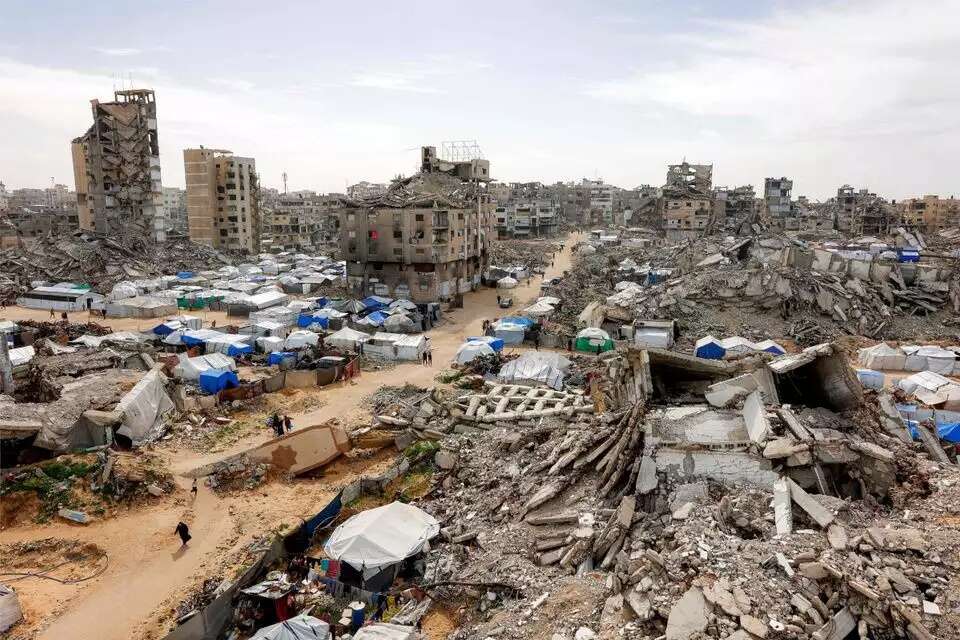
Either way, several senior officials who manage Hamas' "civilian" affairs and terrorist activity remain in Gaza. The central figure is Ali al-Amoudi: a member of Yahya Sinwar's bureau before the war, who also served as head of the propaganda office. Al-Amoudi is considered very close to the Iranian axis. Officially, he is defined as the deputy of Khalil al-Hayya, the head of Hamas' Gaza bureau, who is abroad. In practice, al-Amoudi is the one leading the organization in Gaza after the assassinations of the heads of the military wing: Izz al-Din al-Haddad and Mohammed Odeh.
Another figure is Tawfiq Abu Naim. Like al-Amoudi, he was called upon to serve as a member of the political bureau in Gaza after most of its members were assassinated by Israel or left the Strip before the war. Abu Naim was formerly the head of Hamas' policing apparatuses. Like al-Amoudi, he was released in the Shalit deal and belonged to Sinwar's close circle. On the spokesmen's front: A replacement has been appointed for the military wing spokesman Abu Obeida, and he carries the same nom de guerre. Hazem Qassem continues to serve as the spokesman for Hamas' government.
After the eliminations at the top of the military wing, one final member remains from the original council that planned and led the Oct. 7 massacre. Imad Akel, who on the eve of the war served as head of the Home Front Staff, which manages the affairs of the population. In the past, he held senior positions in the military wing, including as a "brigade commander."

Alongside him operate several brigade commanders and terrorist battalion commanders: Mohand Rajab, Gaza brigade commander; Izz al-Din al-Bik, northern Gaza Strip brigade commander, who apparently survived the latest assassination attempt against him; Hussein Fayyad, Beit Hanoun battalion commander; and Haitham al-Khawajari, Shati camp battalion commander. Arab sources indicate that new brigade commanders have also been appointed for the central camps area, Khan Younis and Rafah, even though the terrorist units are not present in all areas and have withdrawn into the part of the Strip under Hamas control, about 37%.
Meanwhile, in the political bureau abroad, the race for Hamas leadership has resumed. After no decision was reached in the first round, the Saudi channel Al Arabiya reported, citing its sources, that voting procedures had resumed in Gaza and Judea and Samaria. According to the sources, the pro-Iranian camp led by Khalil al-Hayya has strengthened, and the chances of his appointment as head of the terrorist organization are increasing. However, his main rival, Khaled Mashal, enjoys the support of Qatar and Turkey.
Hamas' two patrons are interested in a figure who can advance alternative arrangements to disarmament. For example, the "weapons storage" model proposed by Egypt, combined with guarantees that the war will not resume. This week, Hamas spokesman Hazem Qassem expressed support for a storage model handled by a Palestinian party. This apparently refers to the storage of "heavy weapons" such as rockets, while light weapons, rifles and pistols, remain with Hamas, as does control over military sites.