In response to remarks by JD Vance, Prime Minister Benjamin Netanyahu replied: "Only one leader likes us? My Facebook is flooded from India." Netanyahu was not wrong. Behind the Asian giant's enthusiastic support lies a deep relationship built on complementary interests and a shared fate rooted in a security reality of survival that no American will ever be able to understand.
The worldview is rooted first and foremost in geography. The US is protected on both sides by two oceans, and shares borders with two friendly countries that are militarily weaker than it is. For the average American, a military threat on home soil is an almost fictional scenario.
By contrast, Israel and India share direct, volatile and bloody land borders with enemies eager to shed their blood.
The perceptual gap with the Americans is clear, but precisely between Israel and India it has produced a consciousness of minority status and existential danger. Both India and Israel arose as projects of national revival after trauma and persecution, and both peoples see themselves as ancient civilizations fighting for their right to exist in a hostile region.
After decades of refusing to recognize Israel, geopolitical shifts, alongside India's economic growth and the rise of the Right in the country, paved the way for the adoption of a far closer relationship with Jerusalem. There is no doubt that this change took place in light of the meteoric rise of the BJP, Narendra Modi's party. Given its firm grip on Indian politics, it provides stability for relations with Israel.
Dramatic events also gave the leaders an opportunity to deepen ties: the coronavirus pandemic and the war that followed the events of Oct. 7. There we saw that when the countries of the "enlightened world" experience a conflict of interests, they quickly forget Israel. That fact says more about the strength of the relationship and the degree of support India provides.
Strategic partnership
While leaders of the free world struggled to express support for Israel, Modi and his party were among the first to voice support for Jerusalem. Netanyahu's millions of Indian followers are likely also millions of active online users fighting our war on social media, and not just "bots," as is sometimes claimed.
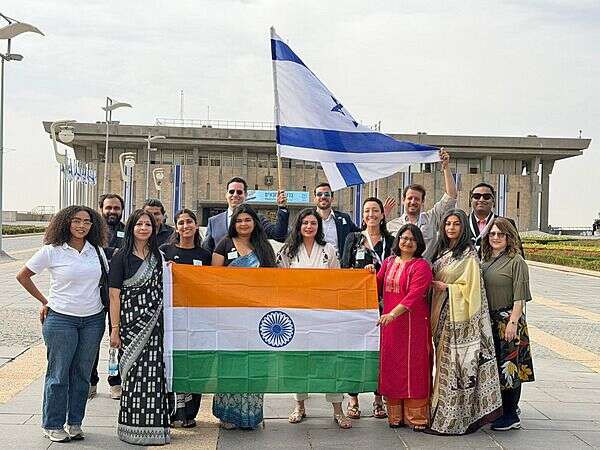
During the state visit last February, the Modi government upgraded the relationship to the level of a strategic partnership and signed 16 memorandums of understanding in the fields of artificial intelligence, quantum technology and critical minerals. During his visit to Jerusalem, Modi echoed an important message within the walls of the Knesset. In that historic speech, the Indian prime minister said: "We feel your pain. We share your sorrow. India stands firmly with Israel, with full conviction, at this moment and in the future as well."
Modi's words were more than lip service and flattery. They were a compass that could show Israel where the rising power is headed, as it proved immediately after Oct. 7 when it sent weapons and artillery shipments here while the Biden administration delayed arms deliveries to Israel. Modi's speech was one Vance apparently missed.
The alliance with India is not a substitute for America, but it is certainly an essential insurance policy in an emerging multipolar world in which America is no longer the center of gravity. Israel, as a country vital to the world's third-largest economy, will be much harder to pressure internationally, isolate diplomatically and boycott economically.