Stock markets throughout Asia experienced widespread declines on Monday as escalating energy supply risks drove oil prices significantly higher. Investors simultaneously prepared for potential central bank monetary tightening in Japan and the US later this week, according to Reuters.
Brent crude advanced 3% following renewed strikes against targets in Saudi Arabia and commercial ships navigating the Gulf. Nervousness intensified after an earlier strike on a Saudi pipeline and advancements by Houthi terrorists in Yemen raised concerns over expanding energy disruptions.
Planned talks in Oman between Iranian officials and Gulf Arab governments regarding the reopening of the Strait of Hormuz were postponed on Monday. Industry analysts warn that persistent dangers to shipping lines in the Strait of Hormuz and the Bab el-Mandeb could keep crude prices elevated over an extended period, compounding global inflation risks.
An elevated US inflation report published on Friday forced markets to price in an 86% likelihood of a 25-basis-point Fed rate increase on Wednesday. Investors also anticipate a second hike in December, which would mark the first policy tightening since mid-2023.
Speaking to Reuters, Michael Feroli, chief US economist at JPMorgan, stated, "We now expect the Fed to hike twice this year, in September and December." He emphasized, "At this stage, failing to back up words with action could put the credibility of the institution at risk."
"Whether these actions represent a limited recalibration or mark the start of a more sustained hiking cycle will depend on incoming data," Feroli stated. "We anticipate the former scenario but see risks for the latter."
Brent futures recorded a 2.6% increase to $107.36 per barrel following an almost 9% gain last week. Concurrently, US crude prices advanced 2.4% to trade at $102.48 per barrel.
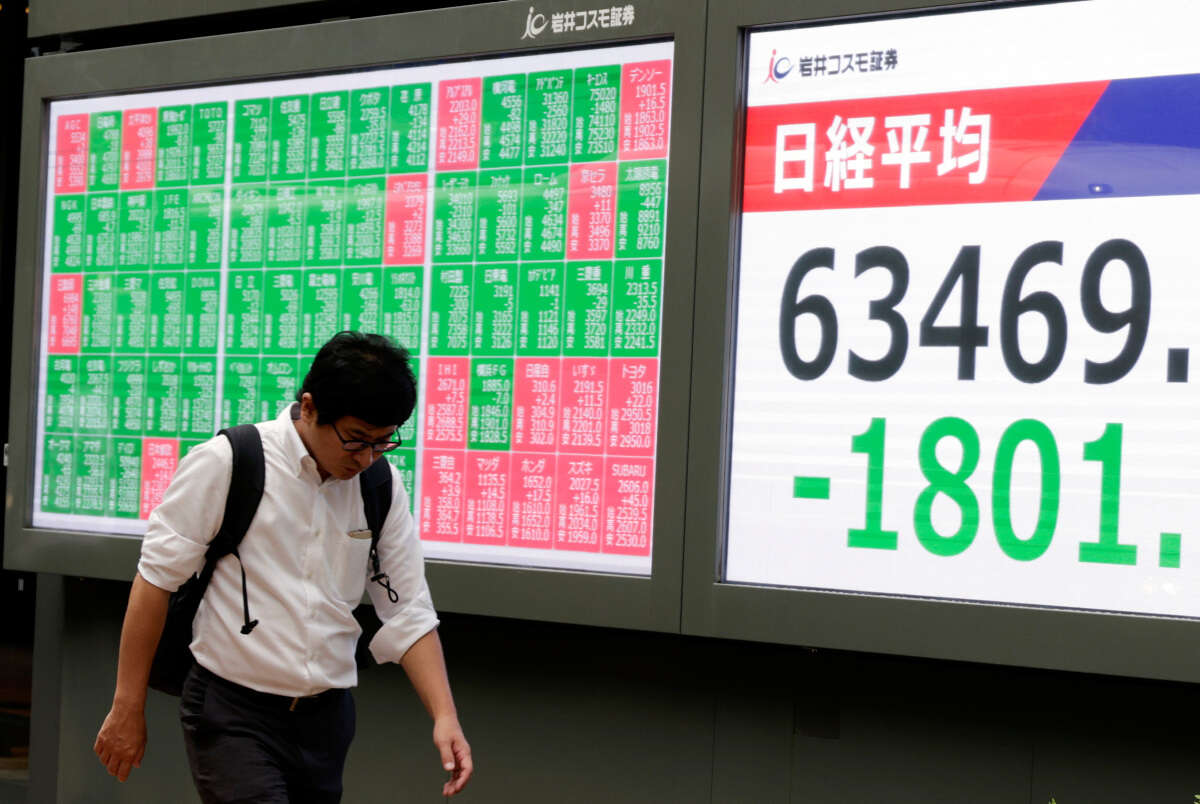
Equity benchmarks across the region stumbled, with South Korean stocks declining 3.3% and Japan's Nikkei falling 1.7%. The MSCI Asia-Pacific index outside Japan lost 0.8%.

European market futures signaled widespread weakness as EUROSTOXX 50 futures fell 0.5%, DAX futures slipped 0.4%, and FTSE futures eased 0.1%. In the US, Nasdaq futures slumped 1.1% while S&P 500 futures slid 0.5%.
Treasury yields stabilized marginally with 10-year notes at 4.967% after extended selling. During the prior week, 2-year note yields expanded 26 basis points while 10-year yields climbed 19 basis points, flattening the yield structure.
Goldman Sachs chief US equity strategist Ben Snider stated that solid corporate earnings performance should cushion Wall Street if borrowing costs continue rising.
"Equities typically struggle when the Fed starts to hike rates, but we expect the bull market to continue," Snider noted. "The S&P 500 has generated an average three-month return of -2% at the start of seven hiking cycles during the last few decades."
"Yet the S&P 500 has generated an average return of +9% during the 12 months following the first hike."
Financial markets currently reflect a 76% probability of a 25-basis-point increase to 1.25% by the Bank of Japan on Friday. Policymakers at the BOJ are expected to adopt a hawkish outlook to prevent currency depreciation after intervention helped lift the yen from 40-year lows.
In foreign exchange trading, the US dollar traded near 153.49 yen, remaining down about 4% over a two-week span and well below its July peak of 163.99. The euro stabilized near $1.1592 following Friday's support level of $1.1570.
The British pound held flat at $1.3522 as expectations pointed to the Bank of England keeping key rates at 3.75% during Thursday's session, with analysts predicting another split vote among officials, Reuters noted.
Spot gold eased 0.3% to trade at $4,336 per ounce, with elevated government bond yields undercutting the appeal of non-yielding precious metals, Reuters reported.