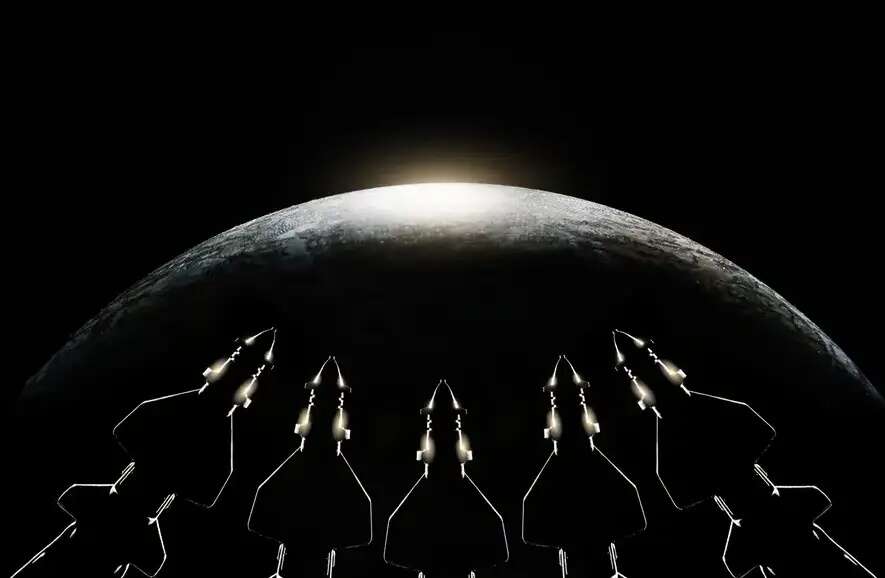
The US military has, for the first time on Monday, confirmed publicly that the Space Force has deployed weapons in orbit around Earth, as reported by The Guardian. Analysts say the disclosure risks intensifying an already dangerous arms race with Russia and China in Earth's orbit.
Troy Meink, the US secretary of the air force, disclosed that Washington maintains active "on-orbit" weapons already circling the planet. Speaking Monday at the Air, Space, Cyber Conference, Meink said, "Today, we continue to ensure we remain ready to meet the challenges of evolving threats wherever they exist. This is why the United States now has, on-orbit, space-control weapons." Meink declined to detail the "specifics" of the arsenal. A US Space Force spokesperson, however, described space control as potentially "employing kinetic [combat] and non-kinetic means to affect adversary capabilities." According to the statement, "these capabilities can be employed for offensive and defensive purposes."
China's foreign ministry answered the US disclosure by accusing Washington of "preparing for war in outer space," cautioning against turning space "into a battlefield, as well as an arms race there." Dmitry Peskov, the Kremlin spokesperson, told reporters in Moscow that Russia holds "that space must be free of any weapon," calling instead for "the complete demilitarization of space."
It has long been assumed that the US, Russia and China were developing space weapons, including signal jammers and projectile-firing "kinetic" systems, The Guardian noted. Even so, space experts caution that officially confirming such orbital capabilities for the first time could speed up a perilous arms race.
Jonathan McDowell, an astronomer who has spent decades cataloguing rocket launches, told The Guardian it was reasonable to presume Washington already possessed such weapons – probably jammers – given several satellites it has already launched with secret payloads. Following the US's announcement, McDowell said Russia and China would now "respond in kind" by deploying weapons of their own.
"In the long run, I find it questionable whether this is in the US national interest, and for sure we will see comparable systems from China, if they don't already have them," he added. Even jamming by radio alone would mark a substantial military escalation in space, according to McDowell, who retired this year from the Harvard-Smithsonian Center for Astrophysics.
Victoria Samson, chief director of space security and stability at the Secure World Foundation, told the Defence One website that Washington must now accept that China and Russia will follow suit. "Well, that's huge, because I don't think any US government official has ever said that before," she said.
Space militarization dates back to the 1950s, when both Washington and Moscow explored methods of destroying satellites. Decades of diplomacy since have tried to preserve the space around Earth for peaceful uses.
Countries including the superpowers signed the outer space treaty in 1967, prohibiting weapons of mass destruction in orbit, though the agreement's text stops short of a blanket ban on conventional weapons there. In 1967, the superpowers and other nations signed the outer space treaty, banning weapons of mass destruction in orbit, though the text does not generally prohibit conventional weapons there.
Russia drew international condemnation in 2021 for striking one of its own defunct satellites while testing a ground-based anti-satellite missile. The resulting blast scattered thousands of pieces of debris across orbit. Given that satellites travel around the Earth at thousands of miles an hour, experts fear an orbital clash could trigger a domino effect, filling near-Earth space with tiny, high-speed metal fragments.
McDowell described a broader shift underway in terms of the US's attitudes toward the peaceful use of space. "The US sees conflict in space as something that is conceptually normalized, whereas 20 years ago it was 'no, we will never want to do that,'" he said.
"I think this is wrong," he added. "I also think it is still not too late to change course on this. To work mainly with China, because they are the real competitors in space now. I hope the US establishment takes a step back and rethinks some of this."