Arash, whose name means "hero" in Persian, never liked the Islamic Revolutionary Guard Corps. A junior manager living in a large city in northern Iran, he had always preferred listening to the Beatles to sitting through another sermon by a mullah at the local mosque. But as an Iranian patriot, Arash had never actively opposed the regime. Whenever his wife left the house, he made sure to remind her to wear a hijab in case she encountered a Basij patrol, part of the regime's morality enforcement apparatus.
Even in early 2026, when crowds surged down his city's main boulevard night after night to protest the economic crisis and civil repression, Arash did not join them. A mixture of fear and resignation to the status quo held him back. Even on the evening of Jan. 8, at the peak of the demonstrations, he chose to stay home and hum a Persian lullaby to his two sons.
The next morning, he woke to discover that one of his cousins had disappeared. A few days later, he was summoned to the city hospital to identify her body. A single bullet had pierced her head. Perhaps that is why, lately, Arash has been far angrier than despondent.
Not long ago, while he was at the office, his wife called him. "We've run out of gas at home," she told him. "The gas company says they're out too. I spoke to my friend, and she said we should..." The call dropped because of a power outage. Another power outage.
The following evening, when Arash heard chants of "Death to the dictator" beneath his window, he went downstairs for the first time. As the march rounded the corner, the crowd encountered a Revolutionary Guard roadblock. Behind the barricades stood armed troops with their weapons drawn. Terrified, Arash was just about to turn around and go home when he heard a whistle. A fraction of a second later, a massive explosion shook the street. The roadblock blew apart, and the soldiers who had not been killed scattered in every direction. "Death to the dictator!" Arash heard himself shout as he surged forward with the others toward city hall.

Could this imaginary scenario become reality?
As far back as 2002, when Meir Dagan took over as Mossad director, he began working on what he called "destabilizing the regime" in Tehran. The objective was not to overthrow the ayatollahs, but certainly to make their lives miserable. At the same time, Dagan, like every successor who followed him, fought relentlessly against Iran's nuclear program, the greatest existential threat hanging over Israel.
The fight against the nuclear program and the idea of regime change have always been intertwined. That combined Israeli effort, long spearheaded by the Mossad, reached its peak on the final day of February 2026, with the launch of Operation Roaring Lion alongside the United States. The sweeping campaign included dozens of sorties against nuclear sites and ballistic missile production facilities, but its organizing concept focused on bringing down the regime.
"After we had already proved that you can mow the grass and tear up the soil in Iran and the nuclear program still won't stop, the Mossad's strategic decision was to strike at the head of the octopus," said one of the architects of the regime-change plan, who until recently headed one of the Mossad's directorates. "This was the 'Plan B' that emerged from our inability to eliminate the nuclear program. The argument was that as long as this regime remains in power, they will keep racing toward nuclear weapons."
At the heart of the plan, devised by Mossad Director David Barnea not long after taking office, was a lengthy, expensive and complicated effort to arm and train Kurdish militias and other minorities that would advance on Tehran and draw the masses behind them. "I'm talking about boots on the ground, an invasion," said an official intimately familiar with Barnea's plan. "Tens of thousands of people armed to the teeth, combined with young anti-regime Iranians and a snowball effect rolling through the Kurdish cities, all under massive Israeli Air Force cover."
The official claims the plan remained viable. "Everything is ready and waiting for the order," he said. "All we need is for Trump to give us the green light."
Yet, not everyone is convinced. "Overthrowing the regime is nonsense. Trying to do it at all is nonsense," said a former senior Mossad official who spent years working on Iran and left the agency before Barnea's tenure. "The Kurds in Iran, or the other ethnic groups, are not going to pick up weapons and bring down the regime. It's a grandiose fantasy. You cannot overthrow a regime from the outside."
Another former senior security official said that "overthrowing the regime is the right idea, but when it is done in such an amateurish way, it can only cause harm. "I strongly support regime change as a solution to the nuclear issue, but this is not something we Israelis excel at. We failed with the Phalangists in Lebanon, we have even failed more recently with the gangs in Gaza, and certainly in Iran. We fail at this again and again."
So what can be done? Are there other options that could definitively halt Iran's race toward a bomb or fundamentally change its nuclear policy? Over the past several weeks, we spoke with a series of experts in Israel and the United States in an effort to solve that puzzle.

The task proved more complicated than expected. "You're looking for an answer to the question of how to win a war in one battle. It doesn't work that way," said Eyal Tsir Cohen, until recently head of the Mossad's Tevel Directorate, which oversees international relations. "You can delay the nuclear program, disrupt it, and impose a price so that pursuing it no longer seems worthwhile. The assassination of Mohsen Fakhrizadeh, for example, who headed the nuclear program for many years, was a key moment, but even after his death Iran still had people capable of replacing him. Ultimately, if a country decides it is going to obtain a nuclear weapon at any cost, it will do so. There is no single magic bullet that can solve this problem for Israel or the world."
It is important to emphasize that, like Tsir Cohen, the other former defense establishment officials we interviewed, including very senior former Mossad and Military Intelligence officials, doubt that either eliminating Iran's nuclear program or overthrowing its regime is a realistic option.
History certainly lends weight to that view. After decades of hair-raising covert operations, enormous diplomatic efforts, one nuclear agreement, devastating international sanctions, 12 days of strikes on nuclear sites in Operation Rising Lion, upheaval in the streets of Iran and another joint war of several weeks alongside the United States in Operation Roaring Lion, Israel has still not succeeded in removing this existential threat.
"Blind the machinery of repression"
M. is an Iranian-born Israeli who, as part of his work, closely follows developments in the country of his birth. When he first heard about the Mossad plan to overthrow the regime using armed minority militias, he was aghast. "The idea that separatist groups are going to break Iran up into small political entities doesn't hold water," said M., who asked to remain anonymous out of concern for relatives who still live in Iran.
"Throughout Iranian history, there have been many terrible periods and many terrible governments. There has never been a democracy, and there has always been a dictatorship of the worst kind. Despite that, no part of the country has ever achieved, or seriously tried to achieve, independence. The separatists in Iran are a minority within a minority, even in the Kurdish, Azeri and Baluch regions. It is likely that even if those separatists entered Iranian cities, they would encounter fierce resistance.
"A revolution can come only from the broader public," M. continued. "And to make that possible, Iran's machinery of repression has to be suppressed. "During the January 2026 protests, thousands of civilians took to the streets and were massacred. Next time, they need help from Israel and the United States, which should strike Basij roadblocks, as happened here and there during Operation Roaring Lion. Israel should arm Iran's citizens, not the separatists."

That view gained further support from a recent exclusive Israel Hayom interview by Shahar Kleiman with an activist from Iran's Progressive Students organization. "In 2017, we were a handful of disgruntled students," the activist said.
"We worked hard to instill the desire for revolution among the friends who made up our initial core. Compare that situation with Iranian society today. We have reached the point where we are proposing a political alternative based on networking. We have established contact with many political forces, including parties, organizations and women's freedom groups, and we are working seriously with them. Protesters in Iranian society have good reasons to bring the revolution against the Islamic Republic to victory."
Israel, and especially the United States, naturally has ways of helping those revolutionaries.
Mark Dubowitz is chief executive of the Foundation for Defense of Democracies and is considered one of the leading US voices to have opposed former President Barack Obama's nuclear agreement. Dubowitz has testified before Congress on several occasions against nuclear negotiations and has written sharply critical opinion pieces on the issue for major publications including The New York Times and The Wall Street Journal.
In July, Dubowitz published another extensive opinion piece, this time in the Daily Mail, under the headline "Step-by-step plan to finally end Iran war with US victory." In the article, Dubowitz listed evidence of what he described as the ayatollah regime's growing weakness and urged Trump to complete what Operation Roaring Lion had failed to accomplish.
How? The first step, he argued, would be for the Americans to break through Iran's information blockade by flooding the country with smuggled Starlink terminals and satellite cellular networks, allowing Iranians to overcome the regime's deliberate internet shutdowns. The next step would be to "blind the machinery of repression," meaning strikes against the Basij and Revolutionary Guards' command-and-control centers.
Dubowitz also proposed "quiet engagement with regime elites, commanders and ambassadors, so they abandon this sinking regime rather than die for it. Start with the regular army before the Islamic Revolutionary Guard Corps, and offer mid-ranking officers and Basij commanders a structured way out, such as amnesty for defectors."
Dubowitz, who wields considerable influence in White House circles and in the Prime Minister's Office in Jerusalem, declined, as of this writing, to say whether he had met administration officials to promote his plan.
Strike at the soft underbelly
Iran experts agree that bringing the masses into the streets will not be possible unless it rests on a foundation of economic crisis. It is no coincidence that Arash, our imaginary friend, joined a protest for the first time only after the gas at his home had completely run out. Iran's oil and gas industry is the backbone of the country's economy, and thus one of the regime's greatest vulnerabilities.
Barnea understood this well. As we can reveal for the first time, during Operation Rising Lion the Mossad director asked Prime Minister Benjamin Netanyahu to order the Air Force to strike energy infrastructure in Iran alongside nuclear facilities and military forces.
Netanyahu feared that Iran would retaliate by striking Israeli energy infrastructure, as it had done in the Gulf, and blocked the move. "The Israeli public is spoiled," explained one senior Mossad official from that time. "Netanyahu understood that prolonged power outages are not something the Israeli public could live with."
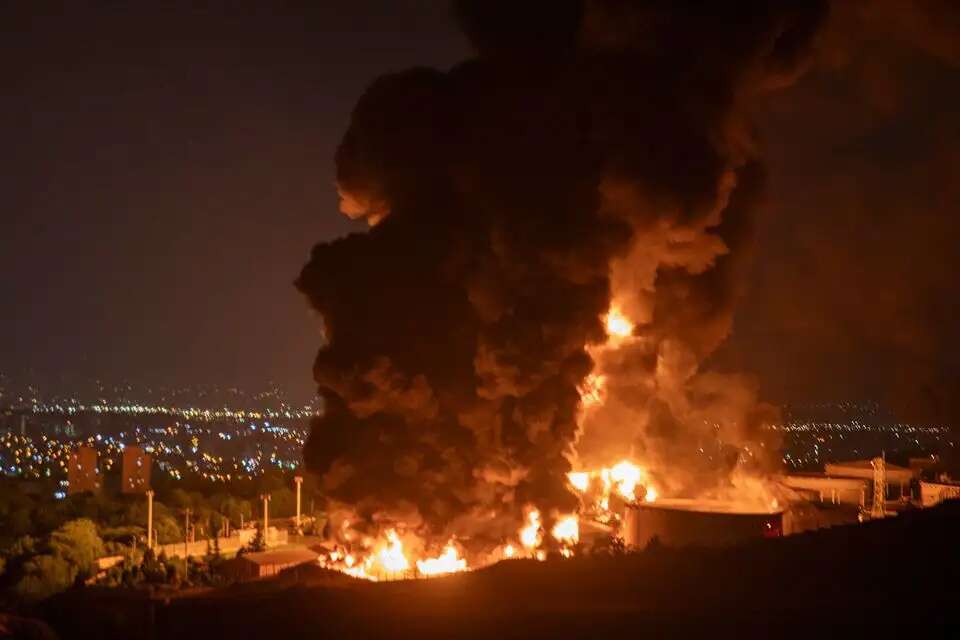
About six months later, during Operation Roaring Lion, Netanyahu did agree to authorize strikes on energy infrastructure, but this time he encountered a categorical White House veto. "During Rising Lion, we could have attacked but didn't want to. During Roaring Lion, we wanted to attack but couldn't because of the American veto," the same senior Mossad official said. "The most significant thing Trump stopped during the joint operation was an attack on energy infrastructure."
Recently, however, American impatience appears to have prompted a policy shift. As part of an exchange of strikes with Iran, the United States attacked several energy installations from the air. "The destruction of gas facilities in the southern province of Fars, for example, multiplied the severity of Iran's energy-supply imbalance," said M., the Iranian-born Israeli.
"The sudden loss of 230 million cubic meters of daily gas output sent vital arteries of the economy and public welfare into severe shock. This transformed the chronic gas imbalance from a structural management challenge into a national crisis, and the consequences of the destruction quickly became visible on an essential front: the dinner table and the welfare of households dependent on the municipal gas sector."
"The damage to Iran's fuel reserves and gas industry filters down rapidly to the broader public," added Dr. Yossi Mansharof, an Iran researcher at the Misgav Institute. "It isn't necessarily the case that a rise in fuel prices will trigger protests, but there is no question that fuel is one of the regime's most painful vulnerabilities. When fuel prices rise, the effect isn't limited to private cars or the monthly household bill. It has far broader economic consequences. If the crisis becomes drastic, there is good reason for the regime to fear that the public will take to the streets."
The problem is that even if the Iranian public eventually does take to the streets, receives direct assistance from the Israeli Air Force and US military and even succeeds in toppling the current regime, there is no guarantee that Iran's new rulers would abandon the nuclear ambition.

"Whoever leads Iran will want to turn it into a major power," said Zohar Palti, former director of the Policy and Political-Military Bureau at Israel's Defense Ministry and former head of the Mossad Intelligence Directorate. "You do that through economic power and through military and nuclear power. The shah also pursued a nuclear capability, and anyone who thinks Iran will completely abandon its nuclear ambitions is mistaken. Even if Iran joins the Abraham Accords, it will not necessarily give up the nuclear option. It may give up the intention to destroy Israel, but not nuclear power."
"Enough for a bomb or two"
Even if economic pressure does not ultimately lead to a popular uprising, it could certainly help on another front: a nuclear agreement. Israel's leadership may recoil at the very word "agreement." Under every Netanyahu government, the prospect of a nuclear agreement with Iran has been viewed as about the worst possible outcome. There is hardly any need to recall Netanyahu's famous 2015 speech to the US Congress against Obama's nuclear deal, which failed to prevent it.
When Joe Biden ran for president, one of Jerusalem's greatest fears was that, if elected, he would return to the nuclear agreement Trump had abandoned. As we can reveal for the first time, during Biden's campaign for the Democratic presidential nomination ahead of the 2020 election, Ron Dermer was dispatched to hold talks with senior figures around Biden, including Antony Blinken.
The goal was to persuade Biden not to publicly declare his desire to renew the nuclear agreement. "People around Biden knew that any such statement would ignite fierce Israeli opposition and hurt his election campaign," said a National Security Council official.
Still, heavy economic pressure could provide the leverage needed to force the Iranians to yield to the United States. "The destination should be an agreement, but a good and achievable agreement, meaning one that can be enforced and produces the desired outcome," said Tsir Cohen, who knows a thing or two about negotiations after heading the delegation that conducted hostage-release talks with Hamas in Qatar. For example, one of the problems with the 2015 nuclear agreement was its failure to address research and development. Even if the Iranians were not directly enriching uranium, advances in research enabled them to significantly shorten their breakout time. Today they have capabilities that allow them to enrich material in a much smaller space, using far fewer centrifuges. Even if that is not enough for industrial-scale production, it could be enough for a bomb or two."
Indeed, recent months have revealed that the Iranians are preparing a new enrichment facility for precisely that purpose at Pickaxe Mountain, not far from Natanz.
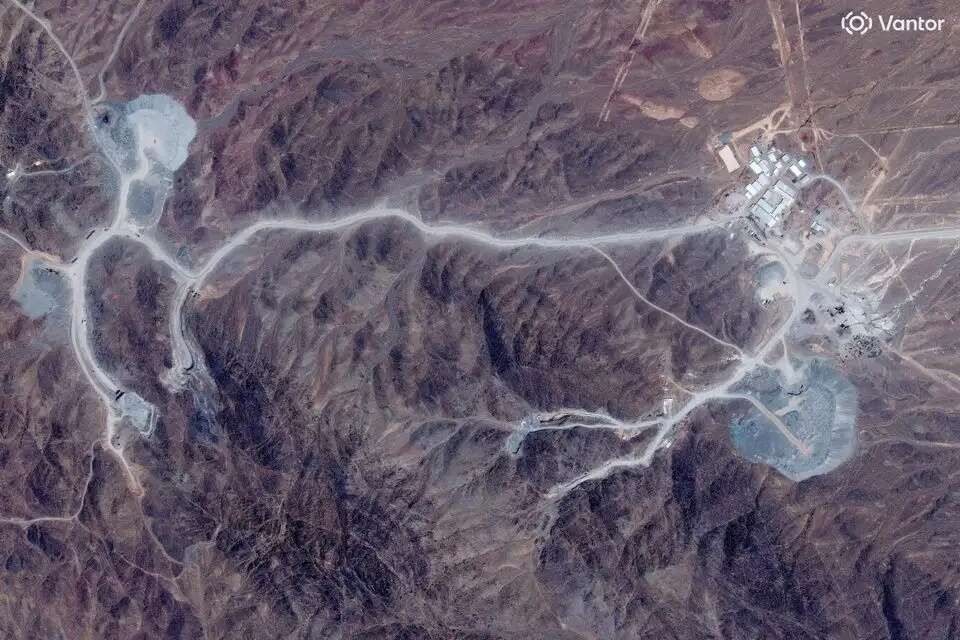
According to reports in US media, Israeli intelligence believes Iran has moved thousands of centrifuges into tunnels dug deep inside the mountain. "This is a facility deeper than Fordow, where the Iranians may try to operate centrifuges that could take the enriched uranium already in their possession to the military-grade level of 90%," said David Makovsky, a senior fellow at the Washington Institute for Near East Policy who served as a senior State Department adviser during the Obama administration.
"That is why the main issue at the heart of the negotiations between the United States and Iran right now is the fate of the enriched material. The buzzword in Washington these days is 'downblending.' In other words, the Iranians would dilute the 450 kilograms of enriched uranium they possess from 60% back down to 3.67%."
Makovsky believes Israel would be unwilling to accept dilution alone. "The Israelis will want the diluted material removed from Iran altogether and transferred to a third country," he said. "They don't trust the Iranians, and rightly so, not to re-enrich material left in their possession behind the back of the International Atomic Energy Agency or any other inspection mechanism. I think that in the end the Iranians will give Trump a small victory and agree to downblend the uranium, but they will insist that it remain inside Iran. That way they will always retain the option of enriching uranium again, whether under an agreement or in secret."
Isolation, decay and uprising
Israel has always focused on Iran's nuclear facilities, but during Operation Rising Lion, as well as in the years leading up to it, operations targeting senior scientists in the nuclear program intensified sharply.
The assumption was that those scientists represented a bottleneck that could prevent the program from advancing. "Killing Iranian nuclear scientists is nice, even great," said P., a retired two-star US Air Force general who asked to remain anonymous because of his sensitive former role in the US nuclear establishment. But ultimately, all it does is throw sand into the gears of Iran's nuclear machine."
To illustrate the point, P. recalled a visit about 20 years ago to the headquarters of the US Department of Energy, which oversees the US nuclear weapons complex, including nuclear weapons development. "They brought me into a classified room and showed me a machine they were using to secretly scan documents from the Manhattan Project of the 1940s, which developed the first atomic bomb. The scientists on the project documented everything, and to this day American scientists use those documents in their work on nuclear projects. In short, you cannot destroy knowledge."
That is why, in his view, the real game changer is regime change. "The most radical leadership Iran has ever had is in power now, and until this regime disappears, the danger of a nuclear Iran will not disappear," the general said.
He argued that Iran should face economic sanctions and that a coalition should be formed for that purpose that would include Russia and China, "and everything necessary should be done to ensure that this regime is isolated and withers until, at some point, the people rise up."
What about overthrowing the regime through a US ground invasion?
"That is the least likely option. Israel has been through a great deal with Hamas and the Gaza Strip, and the IDF understands very well the high cost of occupying and controlling hostile territory. The Americans understand it too. Across the American system, from the public in the street to military commanders and soldiers, there is strong opposition to ground action unless there is a clear and immediate danger. That is not the situation with Iran at present. It would be very difficult for Israel to persuade the Americans to undertake a massive ground operation inside Iran."
"We toured around Fordow"
The ground-invasion option only proves the complexity of the Iranian threat. To understand the depth of the strategic trap, one must return to the road map that shaped Israel's thinking.
Israel has never reconciled itself to the nuclear programs of its enemies. In 1981, it destroyed Iraq's nuclear reactor in a single strike. In 2007, it destroyed the reactor then being built in Syria. But, Iran's nuclear program is an entirely different opera.
Maj. Gen. (res.) Amos Gilad first presented the Iranian nuclear threat to Prime Minister Benjamin Netanyahu in 1996, when Gilad headed the Research Division of IDF Military Intelligence. "The Iranian regime is determined to destroy the State of Israel as a state. In their view, we must not be allowed to exist," he said. "That idea is not new. What is new with Iran is its determination. They turned the destruction of Israel into a strategy. In nuclear terms, Iran is like a person who wants to jump two meters high, so he builds a 1.90-meter ramp and waits for the right opportunity."
For years, the Mossad sought to lower that ramp through a series of covert operations. The goal was to defeat Iran's nuclear program on points, not by knockout. "There were countless discussions about this. Billions were invested in Mossad programs, but even then the maximum achievement anyone expected from them was a delay of only two years," said a former senior intelligence official. "At a certain point, the assumption was that Iran would eventually have nuclear weapons and the only question was when."
As a result, in 2011 Israel's defense establishment began considering a military strike. The Mossad collected extensive intelligence on the two principal nuclear sites, Natanz and Fordow. "We toured around Fordow," former Mossad Director Yossi Cohen recently said.

Based on the intelligence received, the Israeli Air Force had already prepared detailed operational plans. "We knew a tremendous amount about what was happening at those sites, and the idea was to carry out just one strike, against both sites simultaneously, using an enormous formation of fighter jets and refueling aircraft," said a person involved in the discussions at the time. "We went over every kilogram of every bomb and knew exactly where it had to hit. Then-Air Force commander Amir Eshel had already begun training for a special method of penetrating the bunkers at Fordow. He even warned that not every aircraft would return safely from the mission. Even so, we were prepared to go. What prevented the strike was that the United States wasn't with us, and when the United States isn't with you, you don't undertake something like that."
Several years later, when Obama signed the nuclear agreement in 2015, the military option finally came off the table. The Mossad continued doing what it could, but by 2018 its assessment was that Iran was only two years away from a bomb. "It was clear that their move underground, along with developments in research and development, had shortened the hourglass very significantly," Tsir Cohen said.
Trump's withdrawal from the nuclear agreement that same year reshuffled that deck. Israel feared Iran would exploit the new situation to break out toward a bomb, and the defense establishment revived the military option, allocating enormous resources to Military Intelligence and the Air Force.
This time, however, the military plan looked very different. "The shift Military Intelligence made toward Iran," as one senior official from the period described it, "led to the realization that it was necessary and possible to strike all three legs of the Iranian nuclear program simultaneously: the enrichment facilities, the senior scientists and the ballistic missile array."
That ambitious plan was put into action during Operation Rising Lion in June 2025. According to studies published by the Washington-based Institute for Science and International Security, headed by respected nuclear expert David Albright, the operation destroyed Iran's centrifuge program, bringing uranium enrichment to a halt; severely damaged sites connected to nuclear weapons and ballistic missile production; and caused the loss of key knowledge related to nuclear weapons development and production, as a result of strikes on nuclear scientists, many of whom were killed in the opening blow. President Donald Trump subsequently claimed that Iran's nuclear program had been completely destroyed.
Israel's security establishment agrees that the nuclear program suffered a "devastating blow," but some officials rolled their eyes at Trump's declarations. "Even when we discussed Operation Narnia," the operation to kill the nuclear scientists, "it was clear that this was only a delaying action. The figure discussed in the room at the time was six months," said a Military Intelligence official serving during that period.
"Iran has excellent scientists and some of the world's leading universities. Even if we killed the professor, he has teaching assistants who are not necessarily any less intelligent. The nuclear scientists were killed because reality left us little choice, because we understood that Iran had already advanced very far along the enrichment track and that we could not roll it backward."
Still, some believe Israel should settle for the current situation. For Dr. Eli Levite, former deputy director general of the Israel Atomic Energy Commission, today's reality is the least bad option, so much so that he believes Israel should seek to preserve it. "In my view, the only realistic course Israel should pursue today is to settle for just three demands: The Iranians make no changes whatsoever to the situation on the ground; they permit comprehensive IAEA inspections of all nuclear sites; and in return, the United States and Israel do not rule out changes to the existing situation, but only on condition that there is a binding coordination mechanism ensuring that Iran takes no unilateral steps and that anything it does is exclusively for peaceful purposes.
"The bottom line of all these demands is a verified freeze of the existing situation," he said.
As long as the enriched uranium remains buried underground, Levite added, "the principle should be that instead of telling them, 'Dismantle your nuclear facilities,' 'Hand over the enriched material,' 'Downblend it,' or 'Never enrich uranium,' and so on and so forth, you tell the Iranians: 'You have enriched material? Fine. Just don't go near it.' The military track has limited prospects in any event when it comes to eliminating Iran's nuclear program," agreed Dr. Ephraim Asculai, a former member of the Israel Atomic Energy Commission and a senior fellow at the Institute for National Security Studies and the Institute for Policy and Strategy.
"Even now, after two rounds of attacks, satellite imagery shows the Iranians beginning to rebuild nuclear sites. Perhaps the Americans dealt Fordow a devastating blow, but Fordow is only one stage in the process of producing a weapon, and that same stage can be carried out elsewhere. I think the diplomatic track can produce far better results than another attempt to damage the program through kinetic means. Iran has to be forced into negotiations through economic and military means. We have to be very tough with them and proceed from the assumption that they are cheating all the time. The problem is that the US administration at the moment does not appear willing to go all the way with such a draconian agreement."
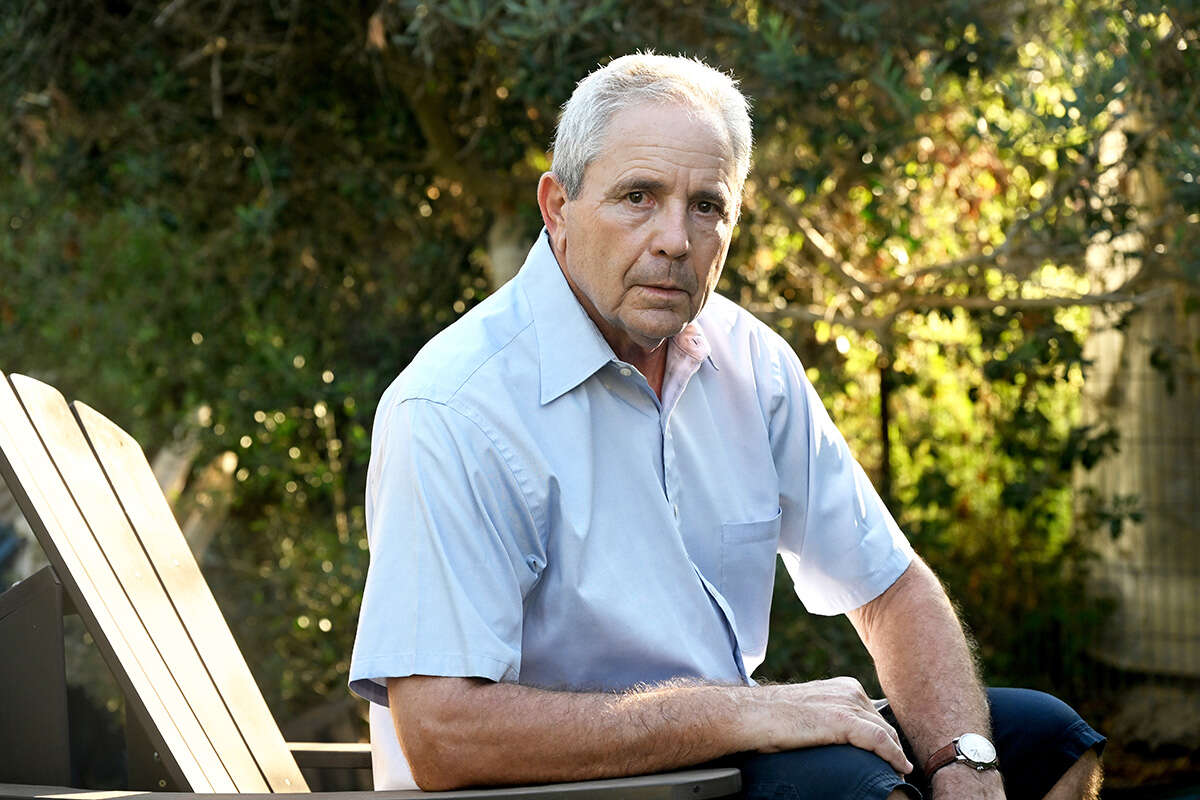
Jeremy Issacharoff, a former deputy director general and head of the Strategic Affairs Division at Israel's Foreign Ministry, similarly said that "for many years, diplomacy, combined with stringent political and economic sanctions and other pressure, succeeded in constraining Iran's nuclear program."
Issacharoff still remembers how, in 1996, while serving as minister at the Israeli Embassy in Washington, "reports began coming in about significant cooperation between Iran and Russian elements in the missile field. "As a result, intensive diplomatic efforts were launched over a period of years together with the United States. In 2002, they expanded into the nuclear sphere after the Iranian opposition exposed the two nuclear sites at Natanz and Arak. From the outset, when we dealt with the Iranian nuclear issue, it was clear that diplomacy had to be backed by a credible military threat. But the use of military force was the last option, to be used only if there was no alternative. Before that came sanctions, heavy economic pressure, the freezing of overseas accounts, restrictions on oil sales, a ban on arms supplies to Iran, and so forth. That diplomatic effort succeeded in preventing Iran from breaking out to a nuclear weapon for more than two decades."
An end to ambiguity?
Despite everything, when it comes to its nuclear program, the Iranian leadership's appetite only appears to be growing. Michael Singh, who served as senior director for Middle East affairs on the US National Security Council, describes this as the "Iran paradox": The weaker Iran becomes, the stronger its nuclear ambition grows and the faster it moves toward a bomb.
Perhaps it is not a paradox at all. One widely held view among commentators and strategic experts is that Iran is now more determined than ever to obtain nuclear weapons, and for understandable reasons. The fact that it was attacked head-on not only by Israel but also by the United States undoubtedly increases the regime leadership's incentive to obtain an atomic bomb that could deter future attacks.
And Iran is not alone. Saudi Arabia recently signed an agreement with the United States that will allow it to establish a civilian nuclear program on its own soil, while the United Arab Emirates and Qatar are also looking in the same direction. "The Iranian nuclear program isn't the only thing that should worry the Israeli government," said a former senior intelligence official. "In the long term, what should concern it is the nuclear arms race across the entire Middle East. Egypt, too, has been flirting with Russia for some time over obtaining nuclear technology, and we haven't even mentioned Turkey."
According to the official, Netanyahu has even expressed concern in closed-door discussions about a nuclear missile being launched at Israel from China.
Another country stirring the pot is Muslim-majority Pakistan, which already possesses nuclear weapons. For years, it turns out, Israeli intelligence has been trying to verify claims that Pakistan secretly keeps nuclear bombs in storage that could, if necessary, be transferred to Saudi Arabia.
During one meeting between a senior Israeli defense official and a senior Gulf figure, the Gulf official waited until he and the Israeli were alone in the room. "I was asked to pass a message to you from Pakistan," he said. "They promise they will not transfer nuclear weapons to any other country."
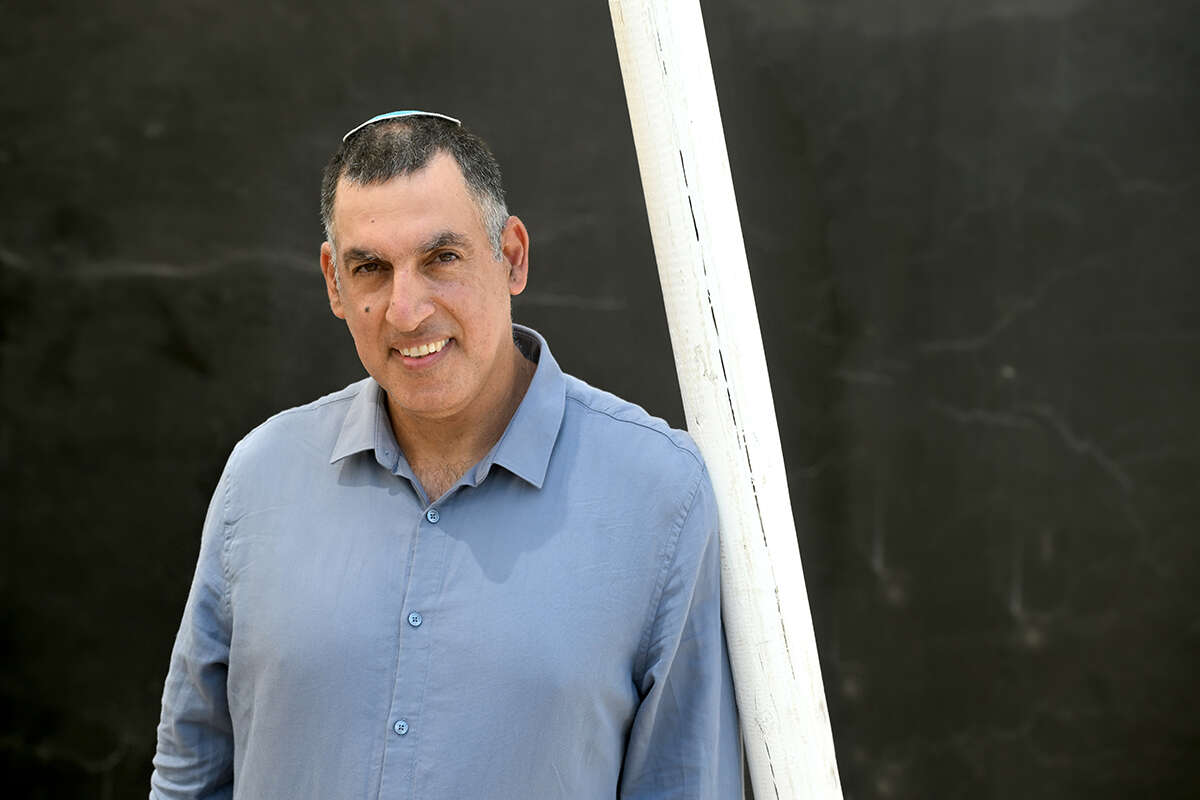
"Today every country wants nuclear weapons, or more precisely, wants to become a nuclear threshold state," the former senior official said. "Iran, or any other country, doesn't actually have to acquire a nuclear weapon. It only has to make Israel believe that it is on the verge of acquiring one. That desire isn't a product of a fundamentalist regime. Saudi Arabia and the Emirates, whose leaders are considered moderate Sunnis, some of them even friendly toward Israel, are also interested in nuclear programs. They want civilian nuclear programs so they can accumulate knowledge and build infrastructure, and when the day comes, when Iran breaks out to a bomb, they too will be able to go nuclear. Israel is accused of possessing nuclear weapons, and it is not considered a fundamentalist state. That is why, incidentally, any other regime in Iran would also eventually want a nuclear program."
For precisely that reason, the former official said, Israel must strengthen not only its regional alliances but also its relations with nuclear powers outside the Middle East, such as India and China. "The aim is for them, as nuclear powers, not to sell technologies and materials to Iran," he said.
Yet even all of that would not necessarily prevent a nuclear bomb from appearing in Iranian hands. Several international experts we spoke with suggested that Israel develop its own nuclear deterrence, for example by strengthening its "second-strike" capability. "That doesn't mean only buying submarines, as Israel is already doing, but also stationing air squadrons outside the country's borders, squadrons whose aircraft could take off and strike even if a nuclear bomb had detonated inside Israeli territory," one of them said.
Another possibility raised in these discussions is for Israel to abandon its policy of nuclear ambiguity. "The moment you reveal your nuclear capabilities, it creates deterrence," said one international official.
A strategic crossroads
Caught between fears of a regional arms race engulfing the Middle East and the realization that a diplomatic arrangement will require painful compromises and unprecedented inspection mechanisms, Israel finds itself at a strategic crossroads.
Arash, our protagonist, and millions of Iranians like him may ultimately decide to overthrow the government from within, because the gas has run out, prices have soared or repression has become intolerable. But until that happens, if it happens at all, Jerusalem will have to continue balancing firm deterrence, close cooperation with the United States and a clear-eyed recognition of the limits of power.
The Iranian nuclear challenge is not a problem with a definitive endpoint. Trying to define it as one distorts reality. It is a continuing strategic and management challenge, one that will occupy Israel's defense establishment for many years to come.