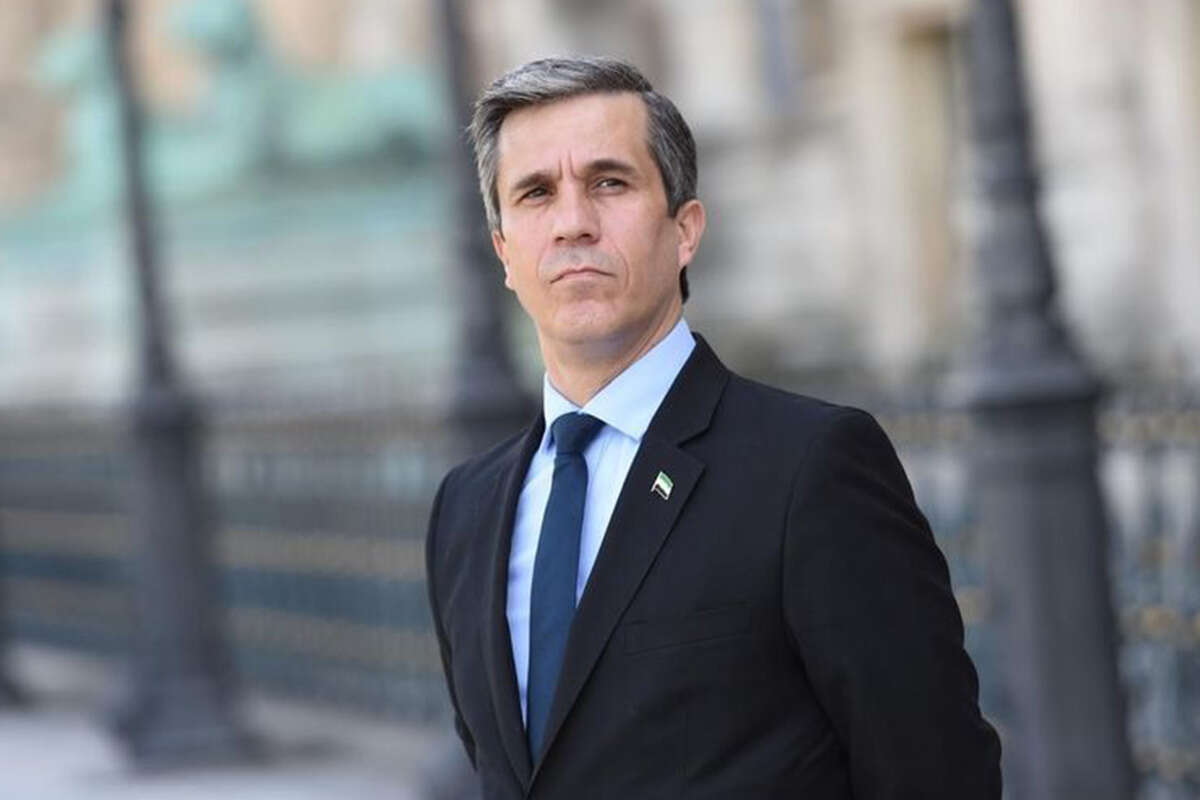
Fahad al-Masri, president of the Syrian Liberal Party, one of the opposition movements that took part in the struggle against the Assad regime, has emerged as a candidate for prime minister in Syria with reported support in the West. For now, President Ahmad al-Sharaa has preferred to retain power in his own hands, perhaps in part because of al-Masri's position in favor of establishing peace with Israel.
In a rare interview with Israel Hayom, al-Masri said Israel should recognize the transformation al-Sharaa has undergone and argued that Damascus could become a gateway to regional peace.
What are the chances of establishing a stable government in Syria?
"Syria stands before a historic opportunity: to move from rule by individuals to rule through institutions. It is only fair to acknowledge that the leadership under President Ahmad al-Sharaa, with Arab, regional and international support, has succeeded within a relatively short period in navigating several major risks, distancing Syria from Iranian influence and beginning to rebuild its international standing.
"I believe the establishment of a broad Syrian government that brings together the country's diverse political and social sectors is both possible and necessary at this stage. The real question is whether we can move from a mentality of factional representation to a mentality of state-building.
"That is precisely why we launched the 'Republican Call,' with a clear vision of rebuilding state institutions on the basis of competence, professionalism and accountability rather than political loyalty. What we seek is one sovereign Syrian state, equal citizens, one national army and one law."

What is al-Sharaa's policy toward Israel? And how would you respond to Israeli skepticism given his jihadist past?
"In international politics, we should not judge states or leaders solely by their statements, nor solely by their past. We must judge them by their actions.
"In this context, President Ahmad al-Sharaa and Foreign Minister Asaad al-Shaibani have made unprecedented efforts to reduce tensions with Israel.
"Israel should see this moment as an opportunity, not a threat. Damascus can become a gateway to regional peace rather than a source of regional insecurity. Since Assad's fall, has the Syrian state threatened Israel's security? No. So why weaken what remains of Syria's defensive capabilities, seize additional Syrian territory and strike the country? Does weakening the Syrian state really create sustainable Israeli security?
"I believe the opposite is true. A stable Syria serves Israel's security; an unstable Syria threatens not only Israel but the entire region. I also believe Israel's intervention in Suwayda was a strategic mistake. We categorically reject attacks against the Druze, Alawites or any other Syrian community. But protecting all Syrians is the responsibility of the Syrian state and the rule of law.
"As for al-Sharaa's jihadist past, I do not minimize its significance, nor do I ask anyone to forget it. But politics must also recognize transformation. A man who once understood that environment from within, if he can now contain it, prevent the return of transnational jihadism, reject terrorism and attacks against civilians, and establish channels of dialogue with Israel, must also be judged on that record.
"I believe Israel missed a historic opportunity. With Iranian influence significantly reduced, Hezbollah weakened and the regional balance of power fundamentally transformed, including through the pager operation and the elimination of key Hezbollah leaders, there was an opportunity to build a new strategic relationship with Syria and Lebanon. That opportunity, however, has not disappeared.
"Israel therefore should not merely look for an individual in Damascus whom it can trust. It should look for a strong and stable Syrian state capable of honoring its commitments and ensuring that they endure beyond any individual leader. And perhaps this is where the paradox lies.
"Al-Sharaa's past, which understandably has been a source of concern, could, if his transformation into a state-building leader is demonstrated in practice, become part of what enables him to make peace. Peace does not require a man without a past.
"It requires a man capable of building a different future. Peace is not made by speaking only with our friends. Peace is made when we find the courage to speak with our enemies."

How can rapprochement between Syria and Israel be advanced under these circumstances? Foreign Minister Gideon Sa'ar has said that because sanctions have already been lifted, the diplomatic leverage has diminished. Do you agree?
"I see the issue very differently. The relationship between Syria and Israel should not be reduced to the question of whether sanctions have been lifted or whether Israel has somehow lost diplomatic leverage. In fact, the opposite is true. A stronger and more stable Syria is not a concession to Damascus; it is in Israel's own strategic interest.
"Lifting sanctions helps the Syrian state recover economically, rebuild its institutions and restore its ability to provide security. A state capable of governing its territory is a far more reliable security partner than a state weakened by isolation and instability.
"I understand that there have been discussions within the US administration about establishing liaison offices and practical coordination mechanisms between Damascus and Tel Aviv without granting them formal diplomatic status. I believe that could be an important first step. But ultimately, institutions matter more than symbolism. What we need is a permanent channel through which both sides can communicate, manage incidents, test intentions and gradually build trust.
"Because genuine rapprochement cannot be built through statements alone. It requires direct and sustained communication, reciprocal confidence-building measures, clear and verifiable security arrangements, and a political process capable of addressing the deeper issues between the two countries. Security can prevent war. By itself, it cannot produce peace.
"That distinction matters. I believe Israel faces a historic strategic choice. It can seek security by keeping Syria weak, divided and under pressure, or it can help create the conditions for a strong, stable and sovereign Syrian state that has both the capacity and the incentive to make peace and honor its commitments. I believe the second path is far more sustainable.

"A weak Syria may appear less threatening in the short term, but a weak state is ultimately less predictable, harder to secure and harder to negotiate with. A strong Syrian state is a far more reliable security partner.
"That is why we reject territorial occupation, interference in Syria's internal affairs and actions that undermine state institutions. Such measures may produce short-term tactical gains, but they do not create a sustainable regional security architecture.
"And when it comes to sanctions, I would reverse the argument: If Israel wants a Syria capable of delivering on security commitments, then it should want a Syria capable of functioning as a state. Lifting sanctions does not weaken the diplomatic channel. It can strengthen it, because diplomacy works best when the state on the other side of the table has the institutional capacity to make commitments, implement them and ensure that they survive changes in political leadership.
"Ultimately, Israel should not ask whether Syria is weak enough to be contained. It should ask whether Syria can become strong enough to make peace and stable enough to preserve it. That, in my view, is the real strategic opportunity."
Is the current framework for resolving the Kurdish issue the right one, and can it last?
"The Kurdish issue in Syria cannot be resolved through military arrangements, nor should it be used as a pretext for partitioning Syria or leaving parts of the country outside state authority. Syrian Kurds are an integral part of the Syrian people, and their rights are not a favor granted by anyone. They are national and constitutional rights that must be fully protected. We want one Syria. But a united Syria does not mean a Syria in which the majority imposes its will on everyone else.
"At the same time, we must be equally clear about what that means for the state itself. Protecting Kurdish rights does not mean creating a state within a state, maintaining a parallel army, conducting an independent foreign policy or pursuing any project aimed at dividing Syria. Syria must remain one sovereign state, with one national army, unified state institutions and one foreign policy.

"The real solution, therefore, is not another temporary arrangement between armed factions. It is a political and constitutional settlement that moves the Kurdish question away from the logic of armed power and toward citizenship, rights and institutions.
"I believe the current framework can provide a genuine opportunity, but only if it moves decisively in that direction. We should not deceive ourselves: Any agreement confined to factional leaders and armed groups will remain fragile, and any arrangement that fails to integrate all Syrians into state institutions will ultimately prove inadequate as a lasting solution.
"We reject the use of the Kurdish issue, or the grievances of any other Syrian community, as an opening for foreign intervention or as justification for redrawing Syria's borders," he said, referring to Turkish involvement in northeastern Syria. "But we equally reject the use of Syria's territorial integrity as an excuse to deny legitimate rights to any Syrian.
"And that is ultimately the test: Can Syria build a political order in which Kurdish rights are protected, national unity is preserved, and no community needs an armed force or a foreign patron to secure its place in the country?"
What is the appropriate solution for the Druze community, and can Israel be part of it?
"The Druze in Syria are Syrian citizens. Their security, political rights and future must be guaranteed within Syria, not determined by another country. They should have full political representation, equal citizenship and effective security guarantees. And the same principle must apply to every Syrian community without exception.
"We also believe local police forces, recruited from among the residents of each province and operating within their own communities, should work alongside the national police and general security forces. This can provide an important layer of local security and strengthen public confidence while strictly preserving a unified national security framework.

"This should be complemented by the establishment of a national gendarmerie, or national guard, capable of responding to security challenges across the country while operating under unified national command and law. This is how we reconcile two principles that should never be presented as contradictory: a strong and united Syrian state alongside meaningful local governance.
"Israel can be part of the solution, but it cannot be the authority that determines the future of Syria's Druze. The future of the Druze in Suwayda must be determined by Syrians within a sovereign Syrian state. Israel has legitimate security concerns, and those concerns can and should be addressed through direct political and security channels. But protecting the Druze does not require turning them into a political or security dependency of another country.
"There is, however, another bridge that should not be overlooked: the Druze of Suwayda and the Golan Heights, together with Syrian Jews in Israel and throughout the diaspora, can become a genuine human and social bridge between Syria and Israel. These historic and social ties should never be exploited as tools of division, territorial claims or political interference. Instead, they can become channels for dialogue, confidence-building, humanitarian engagement and people-to-people contact, supporting a broader political process toward peace."
Would you be willing to meet official Israeli representatives?
"The question is not whether I am willing or unwilling to engage in dialogue.
"Whenever politicians or officials from two countries meet, each side comes to the table with a clear agenda and defined objectives. Today, the Syrian state and Foreign Minister Asaad al-Shaibani are maintaining contacts with Israeli officials, and no political actor genuinely committed to bringing the two countries closer should undermine those efforts.
"I do not currently hold a position of power, but I place all my capabilities at the disposal of the Syrian state for any effort that serves the national interest and strengthens security and stability.
"Dialogue is not a reward for the other side, nor is it an admission that its positions are correct. It is a political tool for testing intentions, understanding interests, reducing the risk of miscalculation and opening doors when they are closed.
"I am a Syrian politician, and therefore my first responsibility is to defend Syria's interests, its sovereignty and the rights of its people. But defending the national interest does not mean rejecting dialogue.
"For 10 years, beginning long before Assad's fall, I worked to build bridges between the Syrian and Israeli peoples. Those efforts came to a halt and were severely damaged by Israel's military intervention in Syria after Assad's fall.
"If a single meeting can prevent a war, open a path toward an agreement or reduce the possibility of miscalculation between two countries, then I believe it is a politician's duty to sit down at the table.
"And if we truly want to change the history of this region, then at some point we must have the courage to speak with those with whom we disagree, not only with those with whom we agree. Because peace is not made by speaking only with our friends. Peace is made when we find the courage to speak with our enemies."
How do you view Turkish involvement in Syria and Ankara's leverage over al-Sharaa?
"Turkey is an important regional power, and it has real influence in Syria, particularly in the north. That is a reality. But influence does not mean guardianship, and legitimate security interests do not give anyone the right to determine Syria's future.
"Turkey has legitimate security concerns relating to its borders, terrorism and refugees. It is in Syria's interest to address these issues with Ankara through direct cooperation.
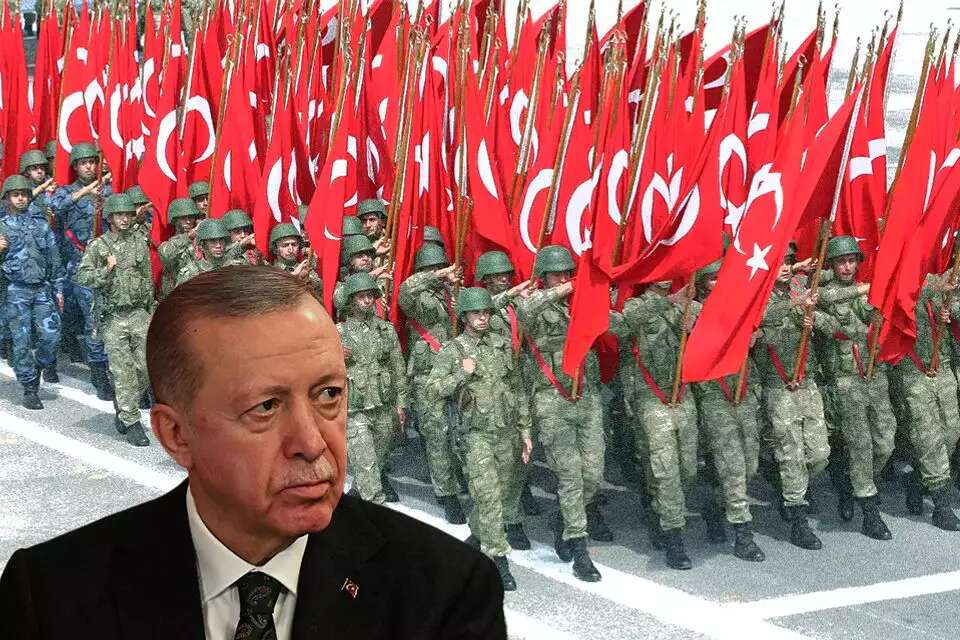
"But one principle must remain clear: Syria must be shaped by Syrians. Its government, institutions, policies and alliances must reflect the will of the Syrian people, not the will of any foreign capital. And that principle applies not only to Turkey, but to everyone.
"So when people say Turkey has influence over President al-Sharaa, I would say: Yes, Turkey has influence and interests. But political influence is not the same as exercising guardianship over Syrian decision-making. The Syrian president must be accountable to his people and his country's institutions, not to any foreign power.
"Syria should not be an arena in which others compete. Syria must be a partner, never a proxy; a sovereign state, never a sphere of influence. It must choose its partners, define its interests and make its own decisions."
Will Syria really move toward democratic parliamentary and presidential elections?
"Democracy cannot simply be proclaimed by decree; it must be built through institutions, political culture and practice. It requires a modern education system, open and independent media, and an environment in which citizens are free to think, choose and hold their leaders accountable.
"Syria needs a new constitutional framework, an independent election commission, a neutral judiciary, full freedom of political organization and expression, and genuine guarantees for peaceful political competition. Elections alone do not create democracy. Holding elections without these foundations may change the names and slogans, but it does not change the nature of the system.
"As for the timetable, I believe we must be ambitious but also realistic. A democratic transition cannot simply be rushed to meet an arbitrary deadline. At the same time, it should not become an open-ended process with no clear destination. I would expect the transition to take several years, not a decade, with the necessary constitutional, legal, judicial and electoral institutions being established in parallel with genuine political participation at the local level.
"The goal is clear: a defined transition, a credible institutional process and elections once the conditions exist for those elections to be genuinely free and meaningful."