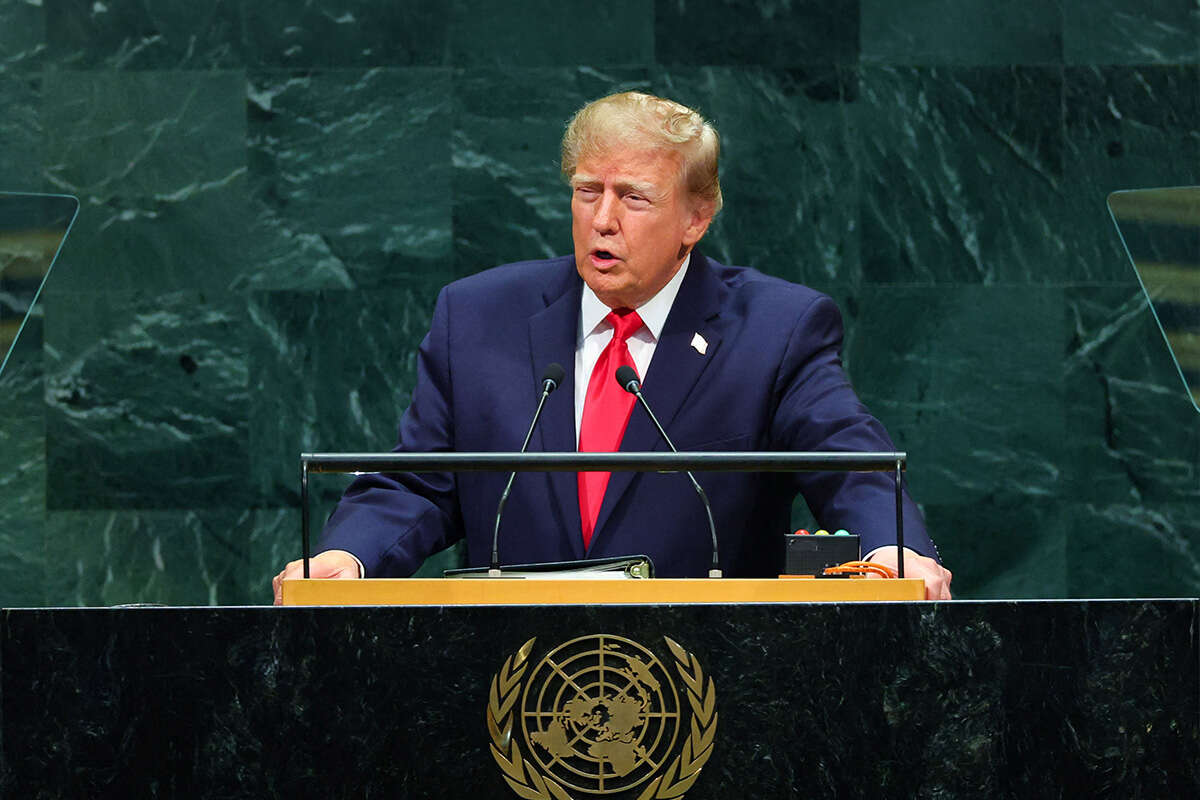
The general debate of the UN General Assembly opened Tuesday in New York, with US President Donald Trump taking center stage as the second speaker after Brazil. For the next week, several square miles of Manhattan will become the capital of international diplomacy, hosting more than 150 presidents, prime ministers and foreign ministers, along with hundreds of meetings behind closed doors, in hotels and at various events. The war with Iran, the future of Gaza and the battle over the future of the United Nations itself are expected to dominate the discussions.
Trump opened his remarks by touting the state of the US economy. He said the poverty rate among Hispanic Americans was the lowest in the country's history and claimed investment in the United States was higher than anywhere else in the world. He also pointed to his administration's immigration policies and said no illegal immigrants had entered the country over the past 16 months.
Trump then turned to his foreign-policy record, contrasting his actions with leaders who, he said, merely talked about peace and courage. He portrayed the United States as confronting problems that had gone unresolved for years.
Turning to Iran, Trump described the Islamic Republic as the world's leading state sponsor of terrorism and said it had spread death across the Middle East and beyond. He also repeated a formulation he has used throughout the year: "One thing is certain: I will never allow the world's number one sponsor of terror ... to have a nuclear weapon." Trump said he had previously offered Iran economic cooperation in exchange for abandoning its nuclear ambitions, but that Tehran had rejected the opportunity. He cited Operation Midnight Hammer, the US strike on Iranian nuclear facilities, and said Iran subsequently continued pursuing its nuclear program. Trump also warned that Iran had developed missiles capable of reaching Europe and said European governments should recognize the threat.
🚨 BREAKING: President Trump tells the UN he has a "BIG DECISION TO MAKE" on Iran on blowing them to smithereens, or striking a deal...Iran's delegation is watching him
"They're waiting to see how I do in the midterms. WHAT THEY DON'T REALIZE IS I'M NOT RUNNING!"
"Will a deal… pic.twitter.com/wzBOZM9vTS
— Eric Daugherty (@EricLDaugh) September 22, 2026
Trump referred to the approaching third anniversary of the Oct. 7, 2023, Hamas attack on Israel, in which some 1,200 people were killed and about 250 were taken hostage. He accused Iran's leadership of celebrating the attack.
He then touted the results of Operation Epic Fury, the US campaign against Iran launched in 2026. Trump said Iran's navy had been devastated and its missile and drone production capacity badly damaged. He also cited the country's severe inflation as evidence of the pressure on Tehran. Trump called on other countries to maintain pressure on Iran and focused particularly on the Strait of Hormuz, a critical route for global energy shipments. He presented Iran with a choice between rebuilding and developing the country or continuing a confrontation with the United States.
"When it comes to Iran, one thing I can promise," Trump said, again stressing that Tehran would not be allowed to obtain a nuclear weapon.
Trump also rejected claims that the United States was running short of munitions, saying the country had substantial stocks and was producing ammunition at a faster pace. He said additional major munitions plants would also be opened.
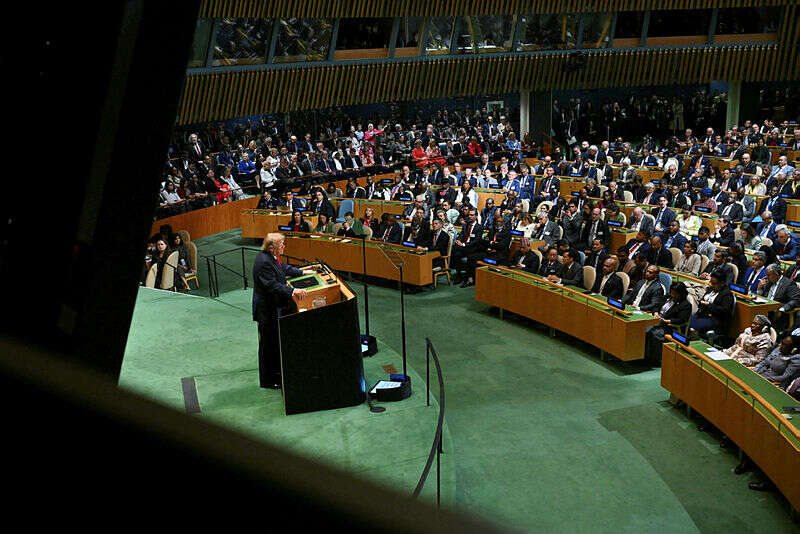
Trump argued that unified international pressure could finally end what he described as 51 years of threatening Iranian behavior and could help bring oil prices down.
He then turned to Gaza, recalling that a year earlier the war was continuing and hostages were still being held by Hamas. He credited his administration's diplomatic efforts with ending the war and securing the return of the hostages, both living and deceased. Trump also thanked the UN Security Council for backing his administration's 20-point plan for Gaza.
After the speech, Trump is scheduled to hold separate meetings with the prime ministers of Britain and Japan, followed by a group meeting with the leaders and foreign ministers of the six Gulf Cooperation Council states. The administration's "day after" plan for the war with Iran, the blockade and shipping through the Strait of Hormuz, and efforts to reach an agreement are expected to be at the center of the discussions.
Trump will leave New York later that evening because Chinese President Xi Jinping is due to arrive in Washington on Wednesday for a state visit, and Trump intends to greet him personally at Joint Base Andrews. As a result, Trump and Prime Minister Benjamin Netanyahu will not overlap in New York.