
This month, as Israel marks three years since the Oct. 7 massacre, the International Court of Justice in The Hague is expected to issue a ruling that will not mention Israel even once, yet could finally demolish the legal conception that has guided us for decades.
That conception held that if only we followed every rule of international law to the letter, the world would allow us to defend ourselves. Just as we believed Qatari money would buy quiet, that the physical barrier would prevent infiltration and that the sensors would provide warning in time, we believed that if we followed the instructions of our legal advisers and maintained judicial independence, in keeping with the principle of complementarity, we would be protected on this front as well.
Since Oct. 7, however, those hopes have steadily been dashed. The final collapse may soon come in a case concerning ethnic cleansing thousands of miles away: The Gambia v. Myanmar. At its heart is a question that sounds technical but is critically important: What evidence is required to prove an "intent" to destroy a people?
Until now, the Genocide Convention has required proof of a specific intent to destroy a group "in whole or in part." In the absence of direct proof, intent could be inferred from a pattern of conduct on the ground, but only if genocide was the only reasonable inference that could be drawn from it.
That is the moral and legal line separating a brutal war, which invariably inflicts unbearable suffering, from the gravest crime in human history. And it is precisely that line that Israel's enemies are now working to erase. Even though there is ample evidence in the case of Myanmar's military junta pointing to an intent to commit genocide against the Rohingya, The Gambia is asking the court to abandon the "only reasonable inference" test and replace it with a vague, "holistic" assessment of the totality of the circumstances.
One of those pushing in that direction is Navanethem Pillay, the judge ad hoc appointed by The Gambia in the case. Until recently, she chaired a UN commission of inquiry that concluded in 2025 that Israel was committing genocide in Gaza. In other words, the conclusion is already there. All that is missing is the legal tool that would allow the court to reach it.

Ignoring Oct. 7
This would constitute a revolutionary legal change. The intent test has required a state seeking to avoid a genocide finding to make every effort to prevent genocide. A system that calculates in advance, strike by strike, how much collateral damage is expected and uses that assessment to determine what may and may not be attacked, the kind of system the documentary NAZA claims to expose, is therefore the very opposite of evidence of genocide.
You cannot argue that someone intends to destroy an entire group while, at the same time, that person is constructing an elaborate mechanism designed to minimize harm to it. Under the proposed "holistic" test, however, none of that matters. If the focus is solely on the outcome, the only thing that counts is the damage actually caused, not the intention behind it and not the efforts undertaken to minimize it.
More than that, any test that examines intent must stop and consider Oct. 7 itself, what came before the present situation and who attacked whom. A test that looks only at the situation as it exists now, stripped of the context that produced it, terrorists who carried out a massacre and then ran to hide among civilians, can ignore Oct. 7 altogether.
It is the same shift from intent to conduct, from context to outcome, from what happened before to what the picture looks like now. And once that shift is accepted, not only in law but also in journalism and at film festivals, the original victim disappears, simply because that victim is no longer part of the frame being examined.
It is therefore no coincidence that The New York Times recently published an analysis expressing a kind of bewilderment at the fact that Israelis "still" regard themselves as victims of Oct. 7, as though this were a mistaken subjective perception in need of correction rather than something that actually happened. It is the same maneuver, because Israel's haters know there is no genuine evidence of genocide, they want to change the law. First somewhere no one is watching, then apply the new rule to their real target. In that sense, Myanmar is merely the laboratory. Israel will be the testing ground.

Israel's adversaries enjoy another advantage in this court. The ICJ can issue orders only against states, not against organizations such as Hamas or Hezbollah. That was also the case with the provisional measures issued against Israel, which restricted Israeli military action while explicitly acknowledging that the court had no jurisdiction over the organization that started the war. In effect, this asymmetry is built into the institution.
Add to that the fact that at least 90 countries now recognize what is known as "universal jurisdiction" over genocide, meaning a claim rejected in The Hague could potentially be accepted by a domestic court in another country, and what emerges is an international legal mechanism that every democracy, not only Israel, should fear.
That is precisely the conclusion reached by law professor Orde Kittrie and Andrés Muñoz-Mosquera, NATO's former senior legal adviser, in a recent joint column in The Wall Street Journal. They warn that lowering the threshold for genocide would undermine the ability of law-abiding democracies to wage war against terrorism without exposing themselves to genocide proceedings in any foreign court that recognizes universal jurisdiction. They, too, understand that the timing is no accident.
Those who seek to destroy Israel are prepared, in pursuit of that goal, to trample the entire body of legal rules and achievements created 80 years ago to prevent genocide. What matters is that Israel be defeated. The distortion is particularly jarring in light of history.
The term "genocide" was coined by Raphael Lemkin, a Jewish jurist who fled a Europe in flames after losing most of his family in the Holocaust. Lemkin combined the Greek word genos, meaning a people or group, with the Latin-derived suffix -cide, meaning killing, because he wanted to define precisely the horror inflicted on him and his people, on us: systematic killing intended to wipe an entire people off the map.
In 1948, that word, born from the most Jewish of ashes, became the basis of an international convention. And now jurists are sitting down and stretching the boundaries of that very word so that it can be applied specifically to the people it was originally created to protect.
The legal bulletproof vest failed
This is not the first time Jews have placed their hopes in the law. On Jan. 30, 1933, the day Adolf Hitler was appointed German chancellor, the leadership of the Centralverein, the largest organization of German Jews, issued a reassuring statement declaring that its members' constitutional rights could not be harmed. That confidence was no surprise. Ever since Germany's Jews received civil equality in 1869, they had regarded the legal system as a bulletproof vest protecting their lives against antisemitism.
Less than a month later, German jurists began interpreting old laws in accordance with Nazi ideology, paving the way for the abolition of the Jewish communities' public status and the trampling of their members' rights. The legal bulletproof vest in which the Jews had placed their hopes turned out to be a broken reed.
This is precisely the process that has been unfolding before our eyes since Oct. 7. From the earliest days, Israel's most senior legal officials were brought into operational consultations ahead of the start of the ground maneuver. Legal advisers participated in deliberations down to the division level, while the senior legal leadership sat in the IDF's underground command center. The IDF recruited dozens of lawyers and expanded its International Law Department into a brigade.
It was an enormous strategic investment, based on an assumption strikingly similar to the one held by German Jews, and no less infuriating: Because it was understood that we Jews would in any case be held to a far higher standard than any other people, operational restrictions were imposed on Israeli troops that would be unthinkable in any other Western military.
And yet, once again, it did not work.
This is not a comparison between the legal bulletproof vest of that era, on which a yellow star was eventually pinned before it was set ablaze, and the legal protections provided by today's Israeli legal system. The comparison is only between the hopes placed in them. In both cases, Jews were handed a legal shield. In both cases, it failed them.

Every soldier knows there is only one test for a bulletproof vest: Does it stop the bullet? How it looks or how much it weighs is irrelevant. And the legal armor worn by Israeli soldiers in this war has been unbearably heavy and cumbersome. Lawyers' involvement in drafting orders and approving individual operations added layers of bureaucracy that slowed the forces and, at times, even put them at greater risk. Yet, whenever the legal vest was put to the test, the bullet went straight through.
And this truly was an advanced and sophisticated vest. Israel, for example, went to extraordinary lengths to avoid harming civilians: telephone calls, text messages and "roof knocking," in which a warning munition was fired before a strike. The international legal community was unimpressed. International law experts argued that providing a warning does not exempt a belligerent from its other obligations and that even warning munitions can kill.
Another example was Israel's evacuation order for northern Gaza, which was intended to move civilians out of the combat zone. A UN special rapporteur described it as forcible displacement and a crime against humanity. Not only did the additional precaution fail to protect the IDF legally, even as soldiers themselves were put at risk while securing civilians' passage southward, but it earned Israel another accusation.
The same absurdity took over the issue of humanitarian aid. In January 2024, the International Court of Justice ordered Israel to ensure the flow of supplies into Gaza, effectively requiring it to provide food to the enemy that had attacked it while Israel was laying siege to that enemy. Israel presented detailed figures showing that it was complying with the order.
Yet, arrest warrants were subsequently issued in The Hague that included the unfounded allegation that starvation had been used as a method of warfare. Once again, the mechanism that was supposed to protect us legally became evidence against us. Those warrants were not withdrawn even after UNICEF itself published figures showing that Gaza's malnutrition rate during the relevant period was lower than rates measured during the same period in Egypt, Jordan and Syria. The facts changed, the allegation remained.
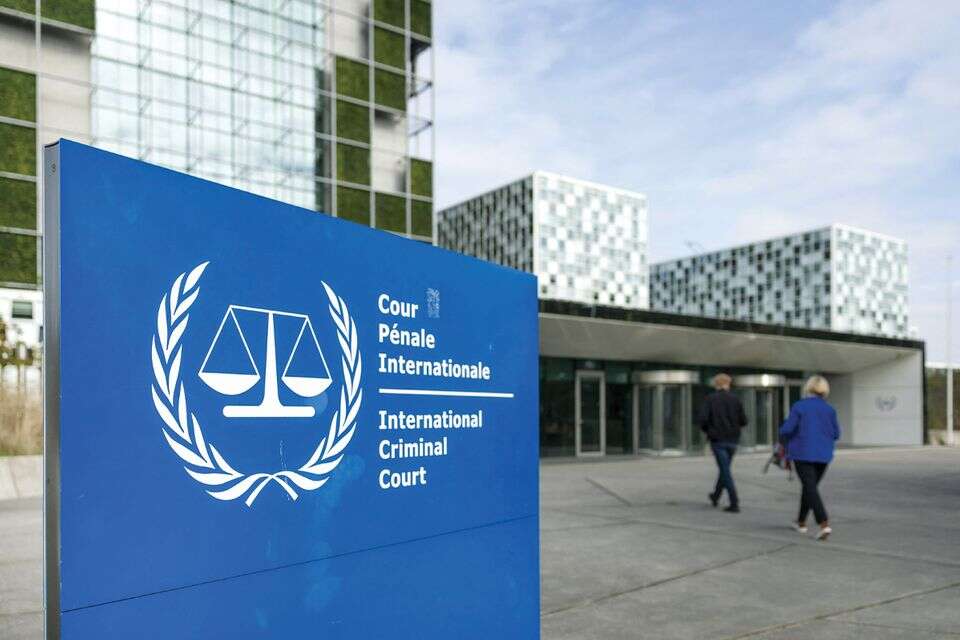
The same fate befell the principle of complementarity on which the entire legal shield rested: If you investigate yourself, no one else needs to investigate you. Proceedings before Israel's High Court of Justice and the dozens of investigations opened by the Military Advocate General's Corps did not stop legal proceedings against Israeli soldiers.
According to reports, more than 80 criminal complaints have been filed in more than 25 countries against IDF soldiers, alongside nearly 1,000 separate complaints submitted to the International Criminal Court. Most have so far been rebuffed, but Yuval Vagdani, a survivor of the Nova music festival massacre who went on to fight in Gaza, was forced to flee Brazil after proceedings were initiated against him. He later said the legal persecution felt like a bullet to the heart when he discovered that the legal bulletproof vest he had carried offered him no protection at all.
Caution after the conception
So what do you do with a bulletproof vest that does not stop bullets, but weighs you down and can sometimes cost the life of the person it was supposed to protect? That same question was asked about other conceptions that collapsed on Oct. 7. And rightly, no one proposed that Israel stop gathering intelligence or shut down the sensor systems along the border barrier. The question was how to stop placing excessive faith in those tools.
The same question now confronts us when it comes to the legal bulletproof vest. We cannot, and should not, take it off. The IDF's principle of purity of arms is a domestic Israeli obligation, not merely part of a bargain with the outside world. The legal armor is worn for ourselves as well, when we turn toward the mirror in which we judge our own conduct. Ideally, it will protect us abroad, too. But only ideally.
That is precisely the difference between a conception and caution. A conception promises immunity. Caution demands that you do the right thing. Anyone who learns that lesson will continue wearing the legal bulletproof vest, but no longer under the illusion that the world will protect him. He will wear it simply so that he remains worthy of victory.