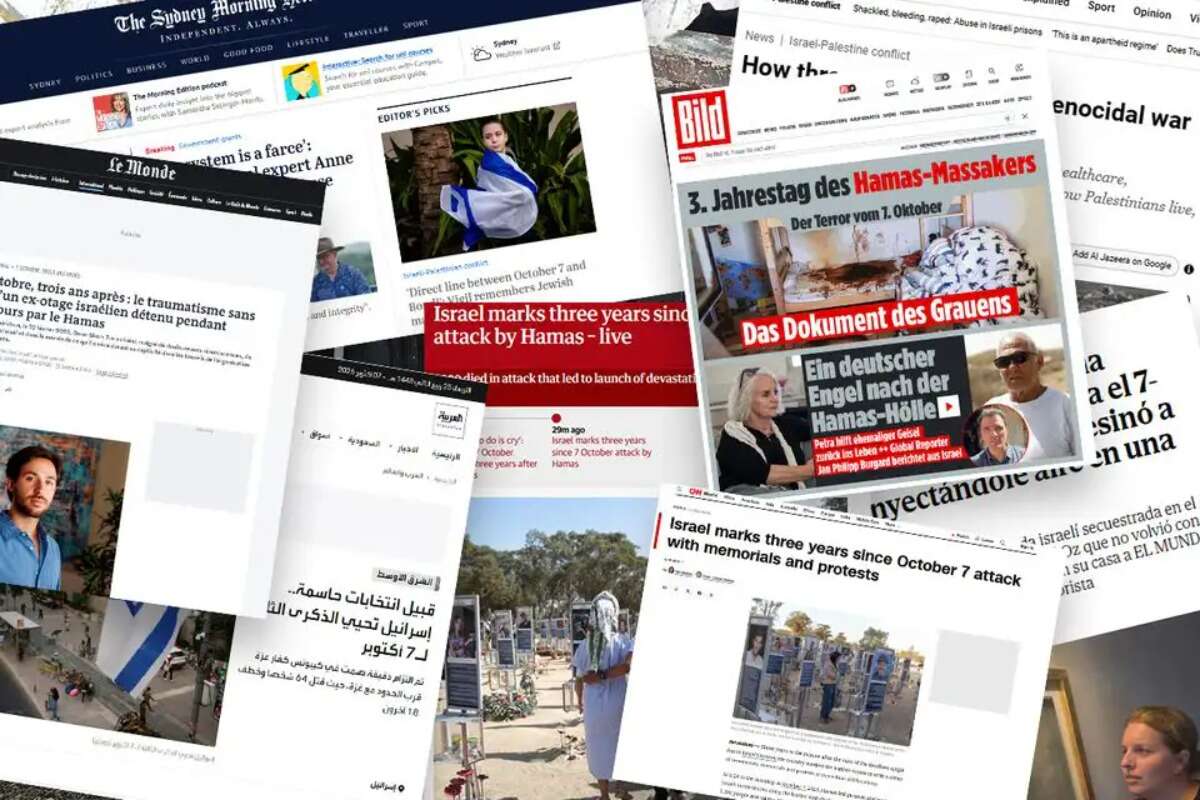
Three years after the October 7 massacre, media outlets worldwide devoted extensive coverage to the anniversary on Wednesday. The gaps in framing stood out in nearly every outlet. Alongside testimonies from former hostages, bereaved families, and reconstructions of the massacre, some coverage placed Israel at the center of criticism, framed the war through accusations of genocide, and even presented Israel as the side that started the conflict.
Arab and Iranian media took an even sharper line, partly adopting Hamas's narrative and casting October 7 mainly as the starting point of the war in Gaza. Other outlets, by contrast, focused on Israel's trauma, on remembering the victims, and on the massacre's impact on the upcoming election.
Germany's Bild, known for its pro-Israel stance, devoted its lead story to the third anniversary of what it called the "Hamas massacre." In the piece, which reconstructs the events of the day the war in Gaza broke out, the newspaper wrote, "Chronology of a massacre, October 7, 2023. This was the worst terror attack in Israel's history. Bild describes the barbaric acts here in detail. This is unbearable, but necessary, so that we never forget."
Alongside the article, the newspaper presented a special project describing the final moments of those killed in the massacre through the last messages they sent.
The testimonies and the trauma
The Guardian published an interview with Keith and Aviva Siegel, who were abducted from Kfar Aza, under the headline "All I want is to cry, the trauma of October 7 survivors three years after the attacks." The piece covers the couple's story along with that of other residents of the border region, and of communities torn between rebuilding their lives and remembering friends and family members they lost.
In its coverage of the national memorial day on Monday, when flags were lowered to half-staff, the newspaper wrote, "Israel denies the accusations of genocide, but the war, which continues despite a symbolic ceasefire, has left it isolated on the world stage."
Le Monde featured a prominent interview with Omer Shem Tov, under the headline "The endless trauma of a former Israeli hostage held 505 days in Hamas captivity." According to the newspaper, since his release in February 2025, Shem Tov has chosen, despite painful memories, to testify in Israel and around the world about what he went through in Gaza's tunnels. In the interview, he describes how the trauma still follows him.
El Mundo interviewed Adi Marciano, mother of the late Noa Marciano, who was murdered in Hamas captivity at Shifa Hospital in Gaza. "A doctor in Gaza murdered my daughter by injecting air into her vein," the mother is quoted as saying in the headline. The newspaper noted that Noa was the only one of the female soldiers abducted from the Nahal Oz base who did not return from captivity alive.
In the interview, Marciano talks about her daughter and about the period of captivity up until the murder. "When she entered the hospital, she probably thought they were going to treat her wounds, which were not life-threatening," she said. "Doctors at Shifa studied in Israel, and in the end they murdered our children. I once believed in coexistence, and today, unfortunately, I believe in it less."
Italy's La Repubblica highlighted IDF figures showing that since the war broke out, the military has struck roughly 100,000 targets across all fronts, including about 65,000 in the Gaza Strip, about 28,000 in Lebanon and Syria, about 4,500 in Iran, and about 80 in Yemen. Throughout the day, the site updated a live report on the anniversary events, including a moment of silence in the Knesset and memorial and protest events across Israel.
The popular Dutch newspaper Algemeen Dagblad noted on its front page that "the nation is honoring the memory of the 1,200 victims of the Hamas attacks," alongside a photo of the destroyed home of two of those killed in the massacre in Kfar Aza. Under the headline "On October 7, 2023, Israel broke," it wrote that "Israel, exactly three years after Hamas' bloody attacks, is still in collective shock."
Dutch newspaper de Volkskrant referred on its front page to remarks by author Etgar Keret, who said, "We keep reliving that terrible day, which simply never ends." The lead story dealt with the election, under the headline "Israelis abroad could tip the scales," alongside a photo of a Likud campaign sign in Netanya. Its front page stated that the Hamas attack is, three years later, "a sensitive issue in Israel's election."
Brazil's O Globo marked the anniversary on its front page, with a photo of a woman paying respects to victims of the Nova festival at the memorial site. Under the headline "Trauma from the October 7 terror attack reflected in Israel's election," it wrote that "the collective trauma will play a role in the election at the end of the month, as at least nine people who were directly affected, or whose family members were killed or abducted, will run for the Knesset."
At Al Jazeera and in Iran, a different narrative
At Al Jazeera, by contrast, the framing was completely different. The network's English edition published a prominently placed piece under the headline "How three years of Israel's genocidal war changed Gaza." The opening of the article presented Israel as the side that started the war, stating, "Three years after Israel launched its genocidal war on Gaza following the Hamas-led attack on October 7, 2023, the Palestinian enclave has changed beyond recognition."
The Tasnim news agency, which is affiliated with the Revolutionary Guard, circulated a statement released Tuesday night, saying that "Al-Aqsa Flood" marked "the beginning of the end of Zionism" and shattered the myth that the Israeli military is invincible.
The Al Arabiya website linked the anniversary to Israel's election, writing, "Ahead of decisive elections, Israel marks the third anniversary of October 7." The piece also described the moment of silence at Kibbutz Kfar Aza, where 64 residents were killed and 18 were abducted.
Israel's election at the center of coverage
America's CNN published a piece headlined "Israel marks three years since the October 7 attack with memorial events and protests," and devoted extensive space to the political angle, writing, "The anniversary falls less than three weeks before the October 27 election, in which the question of accountability has become a central issue in the campaign."
It further wrote that "Netanyahu's rivals have stepped up their criticism and turned the anniversary into the focus of their campaign, especially after a series of media reports claiming Israel received advance warnings from the United Arab Emirates and Egypt before the attack."
Australia's Sydney Morning Herald placed its piece on the anniversary prominently on its site, and linked October 7 to the deadly attack at Bondi Beach.
Australia's Daily Telegraph ran the front-page headline "Sydney's day of shame" and criticized a "Remembrance for Gaza" rally planned for that evening at the Sydney Town Hall, under the slogan "Don't let Israel steal the date." The front page stated, "Now, on the anniversary of the cowardly October 7 massacre, they are gathering again, both to celebrate and to present themselves as victims."
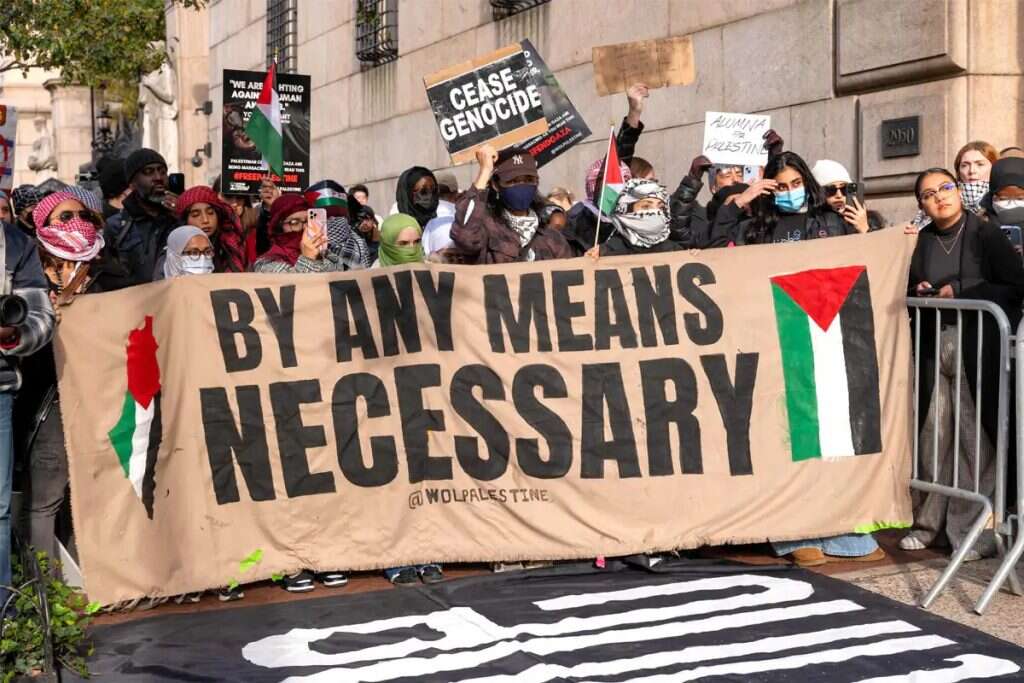
The New York Post devoted the front page of its evening edition to the anniversary under the headline "Soulless," adding, "On the third anniversary of the October 7 terror attacks, anti-Israel protesters plan to march – in support of Hamas."
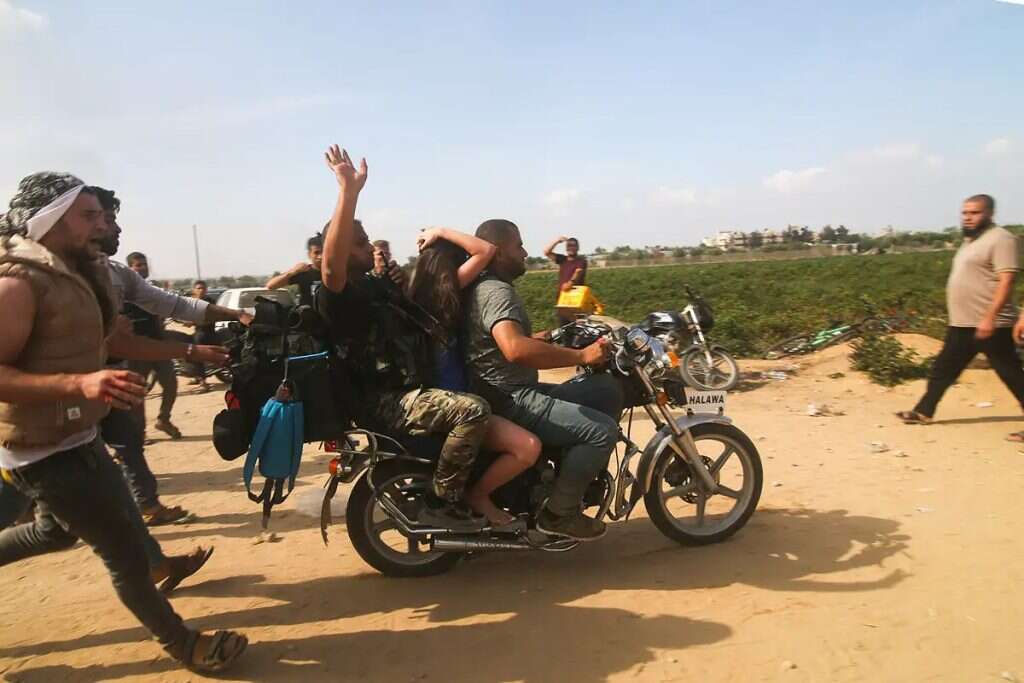
Alongside the headline, the Post published a photo of Hamas terrorists on a pickup truck from October 7, and in a box beside it mentioned the late Shani Louk, whose body was taken into Gaza. "The demonstrations planned for today in New York, shamefully, will not condemn Hamas, but Israel," the paper wrote.
Later in the day, additional protests against Israel are expected in European capitals.
European leaders mark the anniversary
Alongside the media coverage, European leaders also issued statements Wednesday morning marking the anniversary. German Chancellor Friedrich Merz said that "Germany stands firmly by Israel's side," and that the commitment to Israel's security and existence is "a lesson from the Holocaust and part of German identity." He pledged to fight antisemitism "in all its forms, new and old," and reiterated his support for establishing a Palestinian state alongside Israel.
French President Emmanuel Macron wrote on X that "three years later, we forget neither the names nor the faces," and recalled the 51 French citizens killed in the massacre. "To fight antisemitism and terrorism, everywhere and always, to work for peace and security for all, that is France's commitment," he wrote.
The EU's foreign policy chief, Kaja Kallas, wrote on X that "the October 7 attacks were an act of barbaric terror," and called for the firm rejection of any form of antisemitism in Europe. "Hamas must disarm to allow the Gaza peace plan to move forward," she added.
London Mayor Sadiq Khan wrote that October 7 "reawakened fears and trauma" among London's Jews, but added that "today is also a moment to reflect on the unimaginable suffering and killing of Palestinians over the last three years, in Gaza and the West Bank." Khan also praised the British government, saying it "is right to condemn the reprehensible actions of the Israeli government."