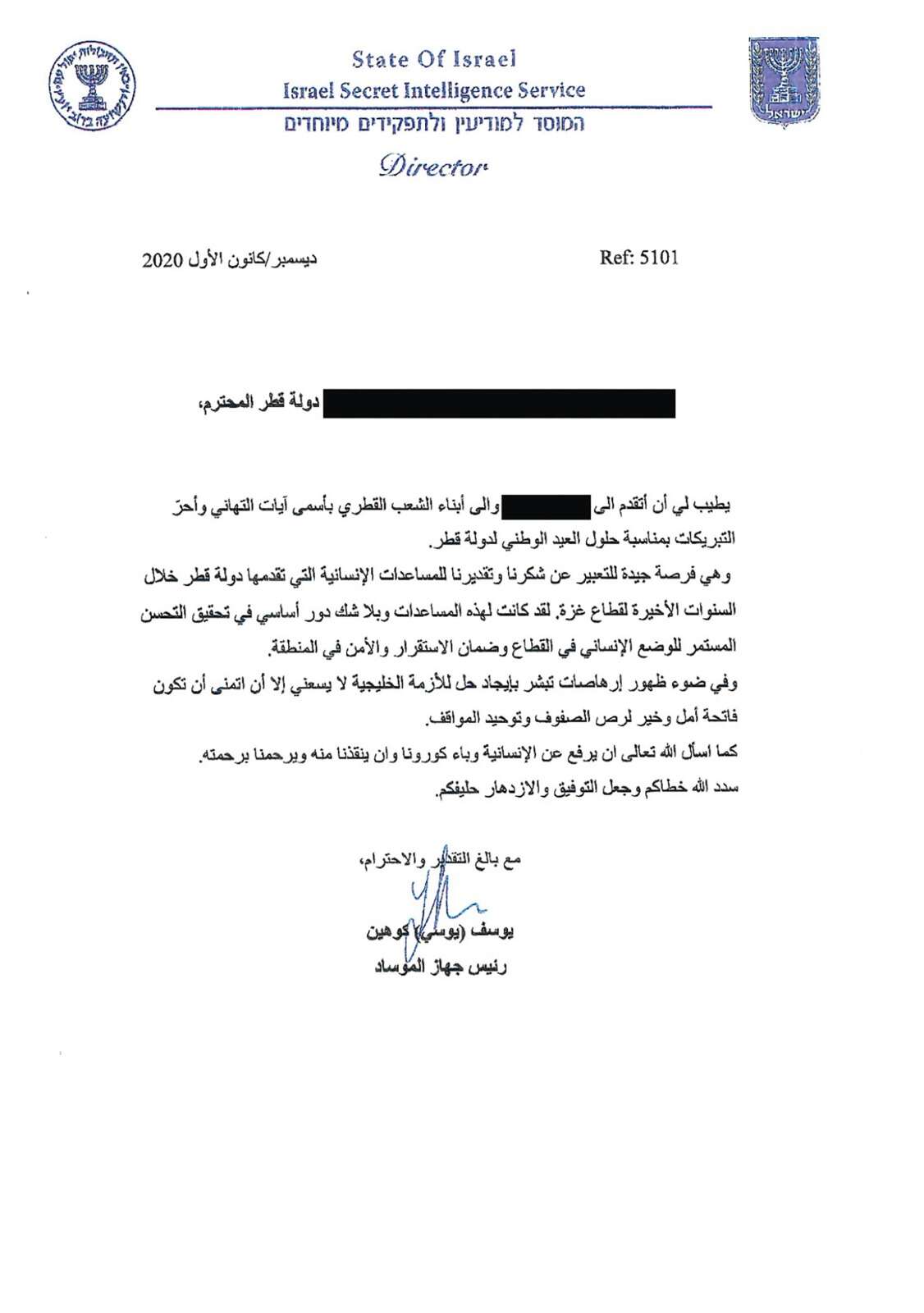
Documents published by the TIME magazine reveal that Prime Minister Benjamin Netanyahu's government asked Qatar to continue sending money to the Gaza Strip, even as senior Israeli officials publicly criticized the Qatari funding. Among the documents is a letter sent in December 2020 by then-Mossad Director Yossi Cohen, expressing gratitude and appreciation for Qatar's humanitarian assistance to Gaza and its contribution to regional stability and security.
"Undoubtedly, these humanitarian efforts have played a crucial role in improving the humanitarian situation within the Gaza Strip, and ensuring stability and safety in the region," Cohen wrote.
The letter came against the backdrop of years of cooperation between Israel and Qatar in transferring funds to Gaza, an arrangement that was eventually formalized through mechanisms involving the UN.
According to TIME, Qatar began transferring funds to Gaza in 2007, when Ehud Olmert was prime minister and Hamas violently seized control of the territory from the Palestinian Authority. Initially, the Israeli government was not directly involved in facilitating the assistance, but that changed after Netanyahu returned to power.
Israel's involvement in Qatari aid
By 2012, according to TIME, Netanyahu's government had approved a mechanism giving Israel a direct role in facilitating Qatari assistance to Gaza. That involvement included delivering food and medical supplies, determining which Palestinian families were eligible for aid and distributing the funds, as well as approving Qatari financing to expand the territory's electricity supply. The details were confirmed by Israeli and Arab officials and official documents obtained by the magazine.
Initially, the arrangement was informal. Qatar transferred the funds with Israel's approval, while senior Israeli officials publicly criticized Doha for financing Hamas. According to a senior official in the first Trump administration, however, the discussions behind closed doors told a very different story. Israeli officials would publicly condemn the payments while privately asking Doha to continue them, the official told TIME. According to the report, the contradiction between Israel's public criticism and its private requests angered the Qataris.

Qatar demanded a written agreement
By 2018, Qatar had sought written documentation of the Israeli government's role in the Gaza aid arrangements. The cooperation was subsequently formalized through a trilateral mechanism involving Qatar, Israel and the UN, designed to administer the assistance under Israeli and international oversight.
On Oct. 2, 2018, Israel and Qatar signed an agreement with the UN to finance fuel deliveries to Gaza. The agreement formed part of efforts to formalize aid mechanisms after years in which the transfers had taken place with Israel's approval but without an official framework.
TIME also revealed details of the behind-the-scenes dealings in 2019. In January of that year, Netanyahu briefly suspended the Qatari payments, seeking to use the prospect of their resumption as leverage to pressure Hamas to stop firing rockets. Yet correspondence obtained by the magazine indicates that Netanyahu's aides were simultaneously working to preserve the aid arrangements.
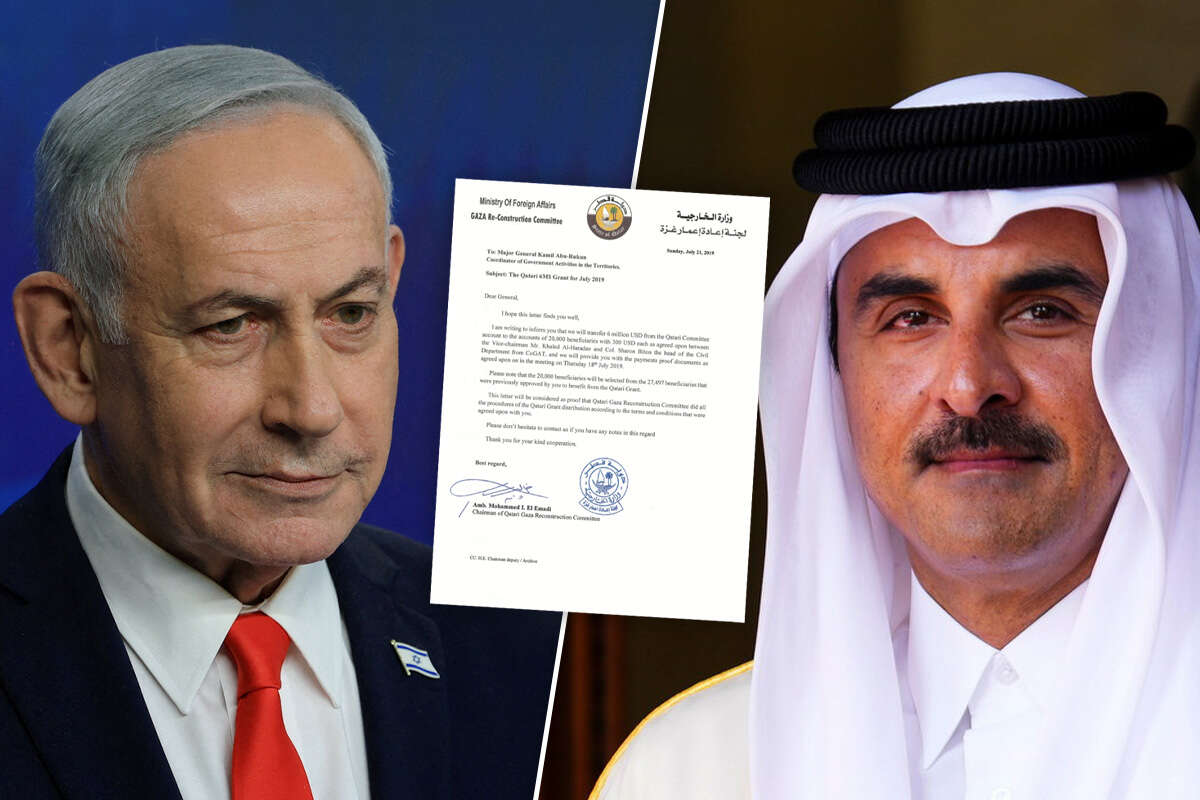
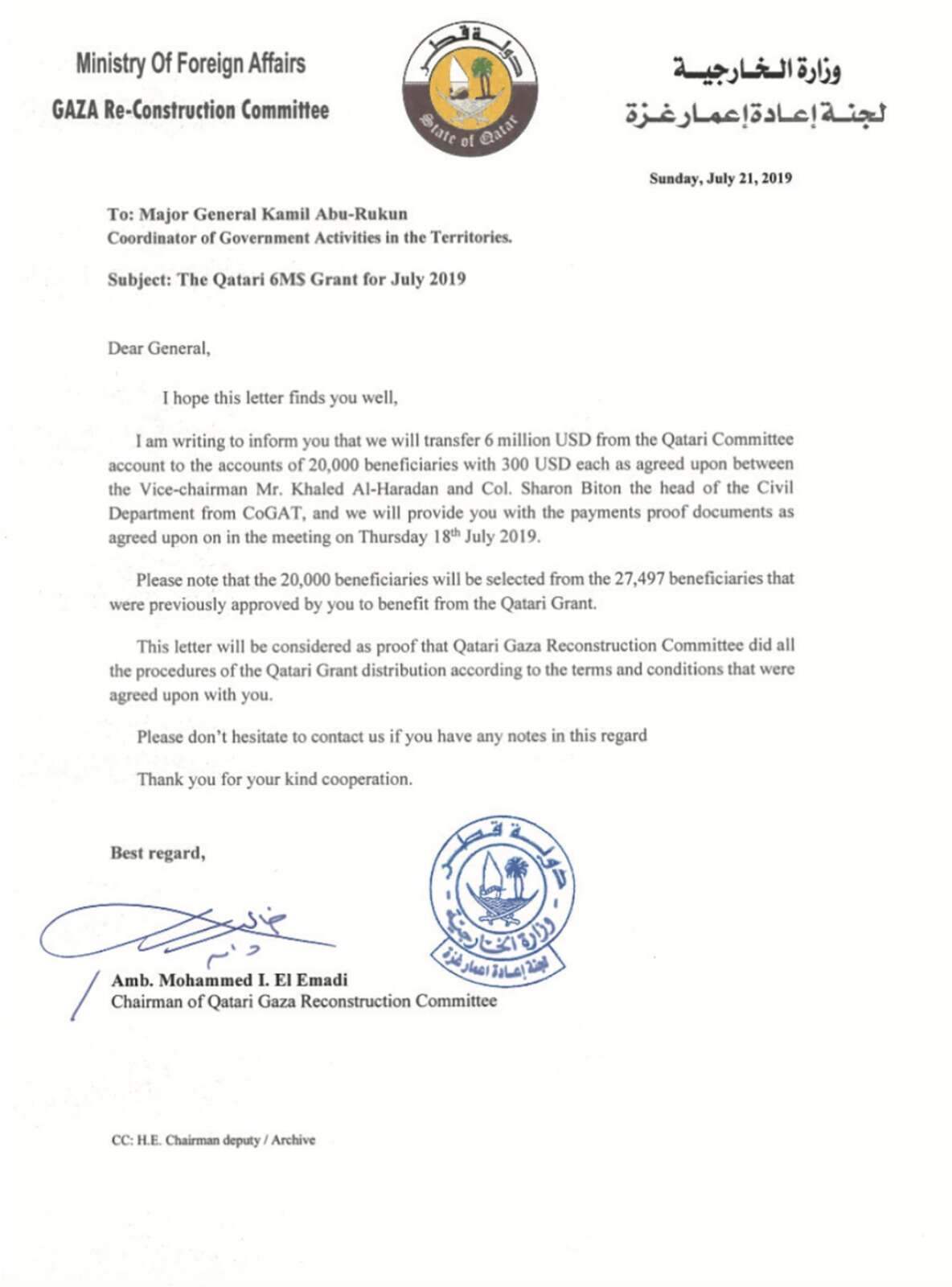
In a July 2019 letter, Qatar notified Netanyahu's government that it was transferring $6 million to 20,000 Gaza residents, each of whom would receive $300. The letter detailed the amount of assistance and the number of recipients, months after Netanyahu had temporarily frozen the payments.
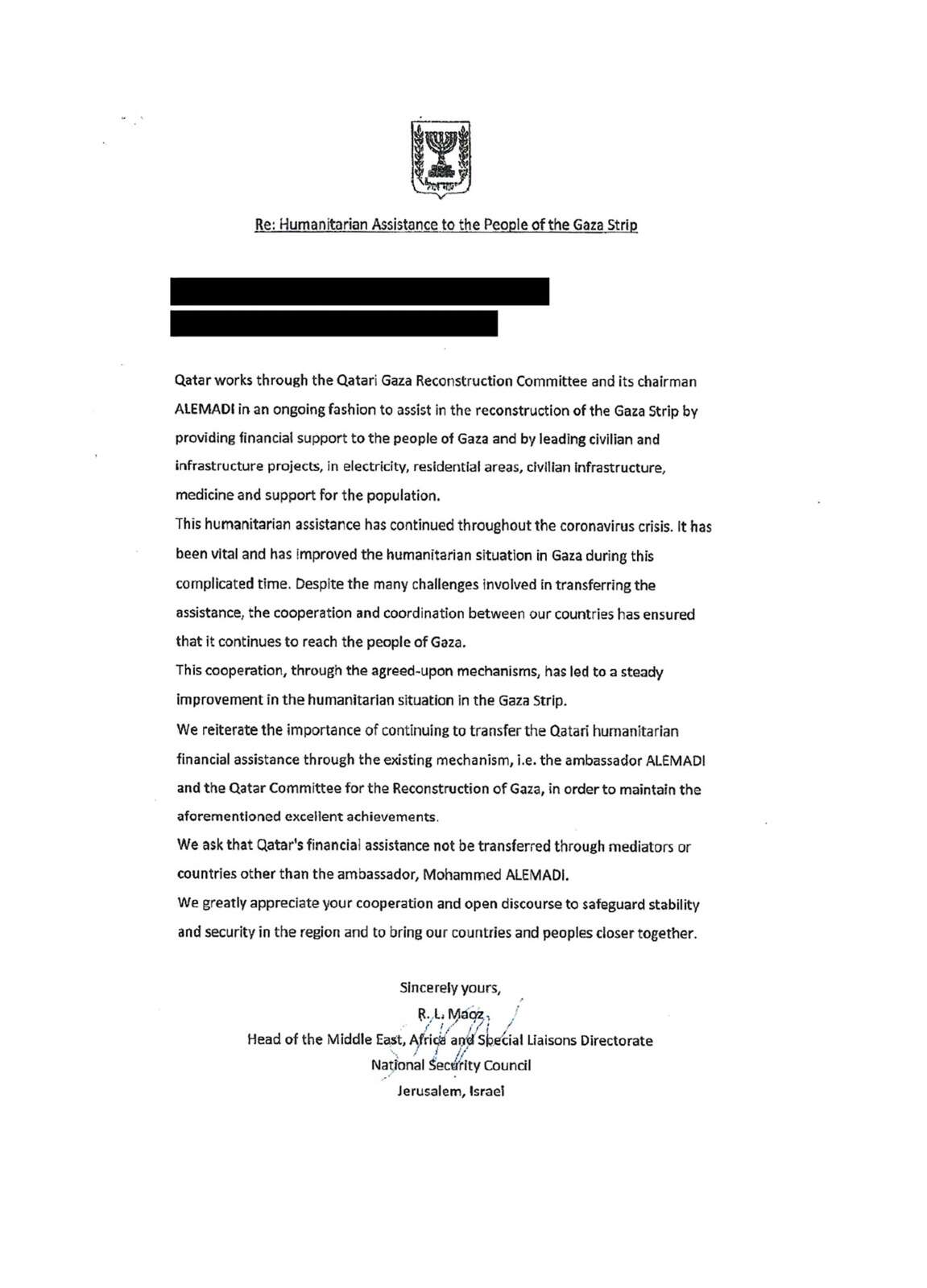
The investigation also revealed that in 2020, during the coronavirus pandemic, R. L. Maoz, a member of Netanyahu's National Security Council, urged senior Qatari officials to continue transferring funds to Gaza despite the Israeli government's public criticism.
"We reiterate the importance of continuing to transfer the Qatari humanitarian financial assistance through the existing mechanism," Maoz wrote.
Maoz went on to request that the funds be transferred through Qatari envoy Mohammed Al-Emadi, chairman of the Qatari Committee for the Reconstruction of Gaza, rather than through intermediaries or other countries.
"We greatly appreciate your cooperation and open discourse to safeguard stability and security in the region and to bring our countries and peoples closer together," he added.
Aid continued under Bennett
The cooperation continued even after Netanyahu left office. In August 2021, under the government led by Naftali Bennett and Yair Lapid, Qatar signed another agreement committing $40 million to a financial assistance program. The program was intended to provide approximately 100,000 Palestinian families with $100 a month for four months. The arrangements were subsequently extended.
According to a diplomat familiar with the discussions, Qatar wanted to ensure that the United States understood the details of the aid mechanism and how it operated. Doha's objective was to prevent a situation in which Israeli officials might later accuse Qatar of financing Hamas, despite the funds having been transferred through arrangements in which Israel itself had participated.
TIME also reported that following criticism from Bennett, who succeeded Netanyahu as prime minister in the summer of 2021, Qatar prepared for the possibility that the aid program would be terminated. In practice, however, only the delivery of suitcases filled with cash was halted. Qatari assistance to Gaza continued through other mechanisms.
About two weeks before the Oct. 7, 2023, massacre, Mossad Director David Barnea traveled to Doha and asked Qatar to renew the funding, as previously reported by foreign media outlets. According to TIME, senior Qatari officials agreed to the request but warned that it would be the final extension, reflecting their desire to change the existing model.
Officials familiar with the discussions said Barnea requested a two-month extension, based on the assessment that continued assistance would give Hamas "something to lose" and preserve Israel's leverage over the terrorist organization. At the end of that period, the parties planned to reassess Hamas' conduct and develop an alternative mechanism for delivering aid.