Israel Hayom is a media organization founded on the belief that the Israeli public deserves better journalism—more balanced, more accurate, and more reliable. Journalism that speaks rather than shouts. Journalism that is trustworthy, objective, and matter-of-fact. A different kind of journalism, offered free of charge.
The first print edition was published on July 30, 2007, and in 2010 Israel Hayom became the Israeli newspaper with the highest weekday readership. The newspaper’s publisher is Dr. Miriam Adelson. Its Editor-in-Chief is Omar Lachmanovitch, and its founding editor is Amos Regev.
Israel Hayom’s Hebrew and English websites, as well as its Android and iOS applications, provide around-the-clock news coverage, exclusive content, breaking news and updates, analysis and commentary, video, podcasts, and live broadcasts.
The digital platforms of Israel Hayom include news and opinion channels covering culture and entertainment, lifestyle, technology, sports, business and consumer affairs, health, military affairs, food, Judaism, tourism, and automobiles.
In 2021, a new Hebrew-language website and mobile application were launched to provide users with a fast, up-to-date, secure, and convenient experience.
The content of the newspaper’s print edition is also available online through a daily digital edition and can be received via newsletter.
“The Israel Hayom Clique,” the publication’s exclusive benefits club, offers website users discounts and special promotions on products and services.
Israel Hayom welcomes feedback, criticism, and suggestions for improvement from its readers. You can contact the organization by email at hayom@israelhayom.co.il
Like many presidents before him (such as John F Kennedy in his approach to Gamal Abdel Nasser's revolutionary Egypt in the early 1960s), Trump views the Middle East, which bubbles with hostility toward the West, through the practical lens of a businessman convinced that every problem has a fair solution and that there exists a universal definition of "rationality."
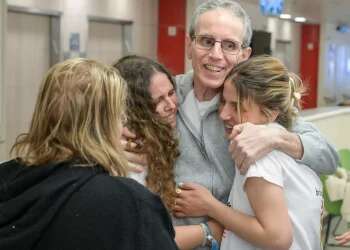
The three hostages were held in severe conditions, according to their testimonies. For most of their captivity, they were given very little food and kept in underground tunnels without exposure to daylight. They stated that they had no way of knowing whether it was summer or winter outside.
The heart that so desperately wanted to rejoice, to celebrate the release of Ohad, Eli, and Or, became paralyzed for a few moments in a wave of true collective fear. The three return after 491 days in captivity at the hands of these animals: emaciated, exhausted, broken. As time passes, the images will only become even harder to bear.
The release of three hostages Ohad Ben Ami, Eli Sharabi, and Or Levy, after 491 days in Hamas captivity, evoked deep distress. The Israeli negotiation team is now facing a critical question: Should efforts be accelerated to secure a second phase of the deal and bring the remaining hostages home?
Or Levy, Ohad Ben Ami, and Eli Sharabi were transferred from Hamas captivity to Red Cross personnel in a cynical ceremony, appearing frail and emaciated. Professor Hagai Levine: 'Medical teams must examine them and translate their appearance into diagnoses and treatment.'