


The power of "NAZA," the film by Yuval Abraham and Rachel Szor, lies in the seals of quality and legitimacy stamped all over its packaging. It was greeted with applause at the Venice Film Festival as though the audience were attending the Soviet Writers' Congress in Stalin's Moscow in 1934. One of its creators says its investigative work was carried out in cooperation with Britain's Guardian newspaper. Its producer is the director of "The Zone of Interest," about the commandant of the Auschwitz death camp.
But the central issue is that the film forms part of the broader campaign to delegitimize the State of Israel, a campaign whose ultimate objective is Israel's destruction. Just days ago, the world marked 25 years since the Sept. 11, 2001, terrorist attacks in Manhattan. A few days before those attacks came the notorious Durban Conference, a kind of Wannsee Conference of the international Left, whose purpose was to lay out a plan for eliminating Israel through isolation, boycotts, sanctions, delegitimization, lawfare, diplomatic warfare and support for the Palestinian struggle, meaning terrorism.
All of those objectives are achieved through a frenzied program of hatred toward Jews. Without that, it does not work. Hatred of Jews, or active antisemitism for short, does not arise on its own. Abraham and Szor's film belongs to that department. It received its applause because it met the expectations of that program, point by point.
Entirely by chance, I found a document in the Israel State Archives, among police records from the period of the Eichmann trial: a letter written by Heinrich Himmler to "my dear Kaltenbrunner."
The letter is a smoking gun showing that at the very top of Nazi Germany, hatred of Jews was treated as an international strategic instrument, not merely as an ideology rooted in racial doctrine. Israel's experience demonstrates that creating an atmosphere in which the Jewish blood is considered fair game, including expressions of admiration and identification with the Nazis, is a clear warning sign.
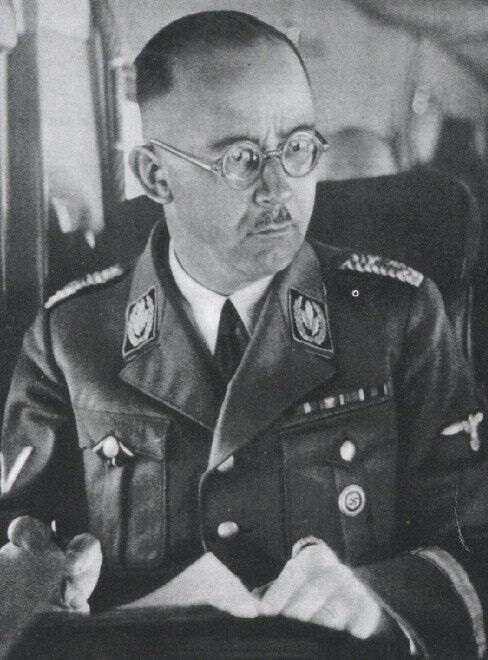
Himmler's letter dates from May 1943, at the height of the Holocaust. In it, Himmler describes the usefulness of spreading blood libels based on myths of "Jewish ritual murder." A book on the subject was being distributed by Himmler and his men among SS officers. Himmler proposed establishing "an illegal, purely antisemitic radio station for England and America."
The idea was to comb police and court records for cases of missing children and tell audiences in England and America that "a child has gone missing and it is probably a case of Jewish ritual murder." Himmler continued that he believed they could "enormously activate antisemitism throughout the world" through intensive propaganda centered on the ritual-murder libel.
Times have changed, and the way to fill the ancient myth with contemporary content is through targeted reports in "respected" newspapers and dark propaganda films constructed around a succession of "testimonies." The phenomenon surrounding this film recalls the Muhammad al-Dura affair at the outbreak of the Second Intifada, the Palestinian uprising that began in 2000. The episode was called "the first blood libel of the 21st century."
The wave of hatred that followed the incident, in which the Palestinian boy was said to have been shot by the Israel Defense Forces, fueled Islamist terrorism. Its best-known victim was Jewish journalist Daniel Pearl. Pearl was indeed murdered in a ritualized atrocity by Islamists. It can also be assumed that the attack on the Twin Towers drew inspiration from the campaign of hatred surrounding al-Dura, who was purportedly shown dying in his father's arms.
One of Israel's most fateful mistakes at the time came when Prime Minister Ehud Barak and senior IDF commanders accepted responsibility for the boy's death immediately after news of the incident emerged in late September 2000. Investigations conducted in subsequent years concluded that the boy was not shot by IDF fire.

The Palestine Liberation Organization, Hamas and the international Left specialize in generating waves of hatred. Since the start of the War of Revival, the campaign has been accompanied by several blood libels designed to produce strategic results. First came the rocket that struck the hospital. Then came the "Force 100" affair, followed by the starvation campaign, which continues to reappear in different forms. From the very beginning of the war, academics began accusing Israel of committing genocide in Gaza.
Israel's enemies seek its destruction with Iranian, Turkish and Qatari backing. Propaganda such as films that put the IDF in the dock seeks to invert the truth. Israelis, who have not initiated a war since 1982, are accused of creating a mechanism for killing innocent people. It is entirely possible to argue that systematically disseminated blood libels helped create the deterrent effect that prevented Israel from launching pre-emptive operations to eradicate terrorism. Yuval Abraham and Rachel Szor's film, too, cannot obscure the history of wars of aggression against the State of Israel from 1948 through Oct. 7, 2023.
But this is an argument with a film that Maggie Gyllenhaal has seen and we have not yet had the chance to watch. That is precisely why Israel should not place obstacles in the way of the film being screened here. No censorship. Let the film be shown.


