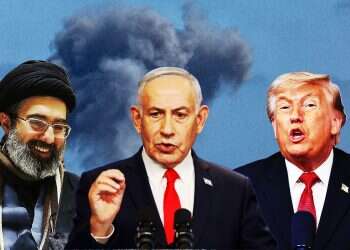
U.S. President Donald Trump's decision to withdraw American troops from Syria shocked many in the United States and the Middle East.
While in Israel most of the public discourse revolves around the challenges in this process, we seem to be largely ignoring the question of what opportunities it may present. For one, could Israel, as compensation, secure a pledge from Washington to help it in times of war and on other vital diplomatic issues?
Given the recent discovery of Hezbollah's grid of terror tunnels and Iran's attempts to upgrade its offensive capabilities, it is reasonable to assume that Israel is closer than it has ever been in the last decade to a war in the northern sector. This could prove highly complex from a military standpoint and even a legal-diplomatic one: Most of Hezbollah's arsenal of 130,000 projectiles is hidden under civilian homes. Neutralizing them would require investing considerable military resources and likely entail large civilian losses.
It is important to remember that in the last four military campaigns since 2006, Israel has had to ask the United States for additional ammunition, and it would probably have to do the same in a future war. Israel would also likely need diplomatic and legal backing to defend it against condemnations in the U.N. Security Council and the International Criminal Court.
The same opportunity exists regarding the situation opposite Hamas in the Gaza Strip: Israel can win a U.S. commitment for the post-Hamas era there. Naturally, the IDF is capable of removing Hamas from the Gaza Strip on its own, but the question is who would take its place.
Understandings could be reached with the U.S. – and through it, the Sunni world – on Gaza's rehabilitation and the establishment of an economic infrastructure for the civilian population there.
As Israel prepares for military campaigns in its north and its south, as part of my position as deputy minister for public diplomacy at the Prime Minister's Office, I am promoting a first-of-its-kind initiative to develop the Golan Heights.
The goal is to have more than 100,000 Israelis move to the area over the next decade, thereby increasing the Israeli population there by five times, and establish the necessary industrial and transportation infrastructure.
My efforts have already gained widespread support domestically and internationally.
Now, given the fragile situation in Syria, Israel must reach a comprehensive understanding with the U.S. on recognizing Israeli sovereignty over the Golan Heights. This would send a message to our enemies about the decisive American position on the eternal Israeli ownership of the Golan Heights.
It would be a good idea to make a large portion of these commitments public in multiple languages. Such a move would bolster the U.S.'s somewhat bruised image in the Middle East and even reinforce its ability to promote diplomatic processes and its position as a very effective mediator in possible peace negotiations.
It is no secret that during the Obama administration, the U.S. lost some of its status in the region. The Trump administration has taken several steps – from striking Syrian assets in response to Syrian President Bashar Assad's use of chemical weapons to pulling out of the 2015 nuclear deal with Iran – to improve this situation.
A commitment to aid Israel would be a continuation of this policy of improvement, presenting multiple possibilities not only for Israel but also for the Trump administration.
The recent changes in the region present a one-time opportunity for Israel, and we should take advantage of it.