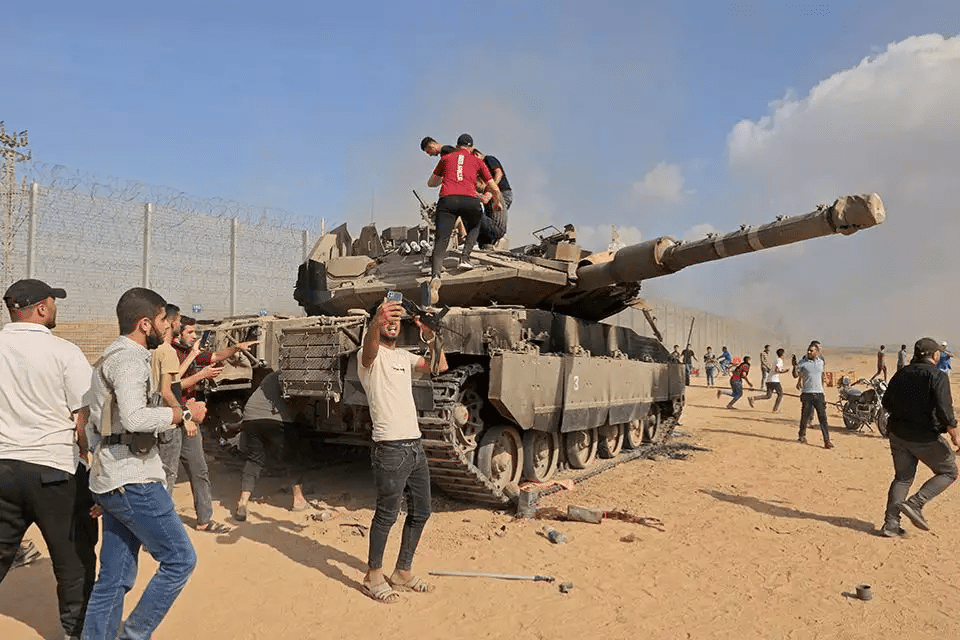
Today we mark the passage of a thousand days since Oct. 7. A round number invites summaries and ceremonies, but disasters are not measured in round numbers. The calendar knows how to count days. It cannot count longing, anxiety, waiting or loss. It can say how much time has elapsed, but not how much of it has truly passed.
For many, Oct. 7 has already become a historical event, documented in investigations and debates. For others, it is still the present: an empty home, a wounded body, an answer never given, a life split in two. We say "since Oct. 7" as though that day is behind us, but there are those whose time continues to revolve around it.
The philosopher Henri Bergson distinguished between time measured by the clock and time experienced in consciousness. An hour in a cafe is not an hour in the waiting room outside an operating room. In the same way, a thousand days for those who have returned to routine are not the thousand days of those whose lives have stopped.
That is why this milestone should not be another ritual of counting, but a moment of soul-searching: Have we learned to carry the memory, or only to live alongside it?
Habituation allows us to function within an impossible reality, but it can turn into moral numbness. This is not a matter of cruelty, but of a human process: What repeats becomes familiar, and what is familiar loses its power to shock. That is how another person's pain becomes background noise. Here, too, names, numbers and images pass through the news cycle.
People and names have become "evacuees," "the wounded," "survivors," "hostages" or "the bereaved." The words are necessary, but they can conceal faces. And when the faces disappear, responsibility weakens.
Emmanuel Levinas argued that morality begins in the encounter with the face of the other, with a human being who demands that we not look away. It is easier to talk about strategy, cost and considerations than to look at the person from whom the price has been exacted.
The public debate, too, sometimes turns disaster into raw material. Each camp chooses what to remember and what to use in order to prove its own righteousness. Instead of deepening responsibility, memory hardens positions and pushes people farther apart. Memory that does not give rise to responsibility becomes an empty ritual. "We will not forget" is only the beginning of the obligation.
Memory must compel us to demand the truth, repair the systems that failed, accompany the wounded and the families even after the cameras disappear, and rebuild trust, community and security. Establishing blame is essential, but it must not become a substitute for action.
Returning to life is not betrayal. A society does not honor its dead by ceasing to live, but by building lives that are more worthy. It is possible to rejoice without forgetting, to build without denying the devastation, and to move forward without claiming that the past is over. Hope is not a promise that everything will work out, but a decision to act even without certainty.
A thousand days are not a finish line. They are a moment in which we must ask whether we have become more sensitive and more responsible, or merely more skilled at blame and repression. The calendar will say that a thousand days have passed. The moral question is whether knowledge of another person's pain is still capable of making us, even for a moment, set down our meal.