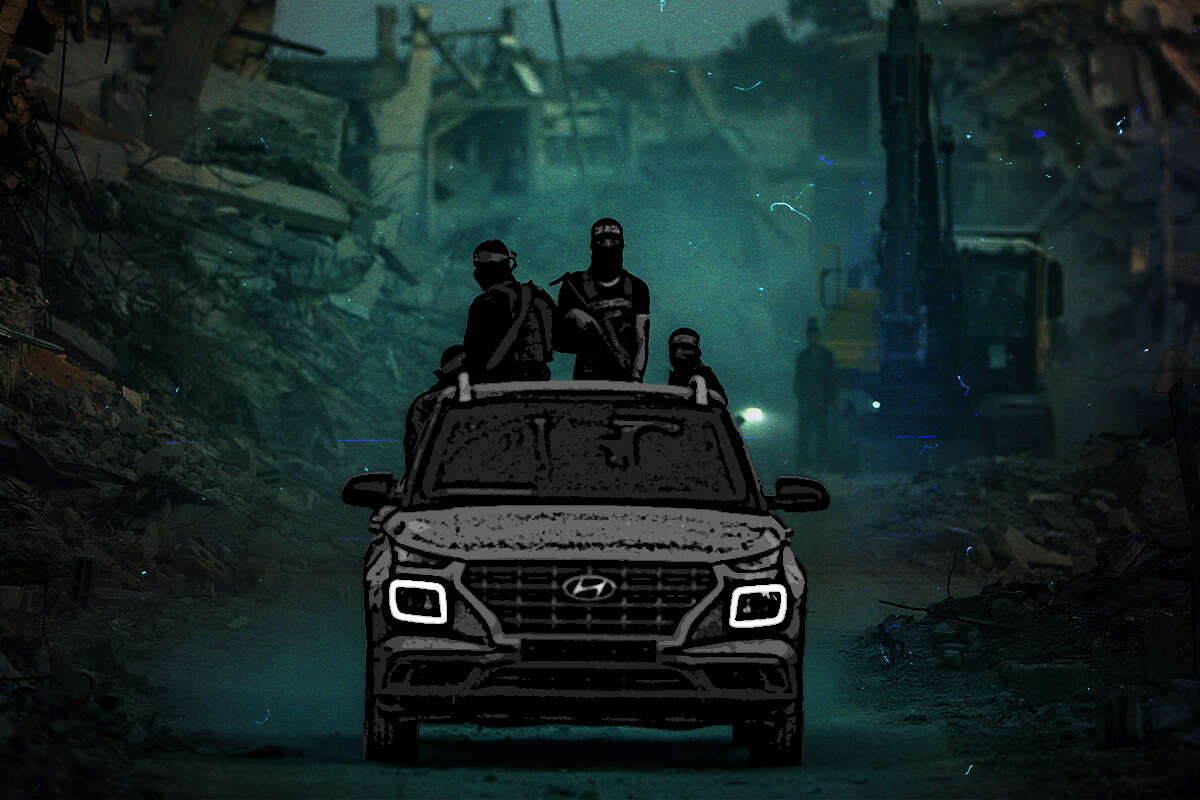
In October 2025, nearly a year ago, the ceasefire agreement between Israel and Hamas took effect, brokered with the personal involvement of US President Donald Trump. The American president was quick, as usual, to proclaim "peace on earth," bringing an end to the bloody conflict in and over the Land of Israel.
In reality, however, the Gaza Strip has not seen a single day of quiet since Trump's declaration and the ceasefire agreement that followed. Hamas, battered and weakened, has largely refrained from attacking Israel or Israel Defense Forces troops deployed inside the Strip and along its border. At the same time, however, it has shown no sign of disarming or relinquishing its rule over Gaza. Quite the opposite, in fact. Evidence from the ground points to an effort by the terrorist organization to tighten its grip on the Strip, rebuild its strength and recruit new personnel into its fighting force.
Anyone wondering where Hamas is really headed received a clear answer about a month ago, with the election of Khalil al-Hayya as the organization's leader. His selection showed that, in Hamas, nothing has really changed. Al-Hayya is among the most hard-line of the senior Hamas leaders who remain, holds views close to those of former Hamas leader Yahya Sinwar, and has close ties to Iran.

But neither the world nor the US appears particularly interested in such details. From their perspective, the big picture, and how developments are portrayed in the media, matters more than the reality on the ground.
And so the international community, with Trump at the forefront, is pressing ahead. The Board of Peace was launched in January 2026 to oversee a process intended to establish a Palestinian local administration backed by an international force, demilitarize the Gaza Strip and lead its reconstruction. The body was formally established by Trump in January as part of the implementation of his comprehensive Gaza plan.
The Board of Peace has now published a roadmap that calls for an end to Israeli military operations in Gaza and a gradual withdrawal of Israeli forces. It then provides for the Palestinian National Committee for the Administration of Gaza to assume responsibility for the Strip, supported by an International Stabilization Force, while Gaza is demilitarized and reconstruction gets underway.
Publication of the roadmap sparked a fierce debate in Israel. Amid all the noise, however, little attention has been paid to what Hamas itself is saying, in Arabic and to a Palestinian audience, rather than merely to what the mediators acting on its behalf are explaining or promising Israel.
Hamas, it turns out, is prepared to allow a Palestinian administration in Gaza to take care of sewage and garbage collection, provide food and health services to the local population, and even deploy traffic police to direct cars on the streets. But Hamas has no intention of giving up its weapons, and in practice, no intention of relinquishing its grip on the ground.
The model it presumably has in mind is Hezbollah in Lebanon: an organization that formally recognizes the existence of a Lebanese government, army and police as long as they do not interfere in its affairs, do not move to disarm it and, in practice, accept its continued existence while submitting to its dictates.

Hamas cannot afford to disarm. This is not only because of its ideological commitment to the struggle against Israel, which lies at the very heart of its purpose, but also because the moment it gives up its weapons, its Palestinian rivals, and there are many of them, could launch a bloody campaign of revenge against Hamas members for everything the terrorist organization has done to them during its two decades of rule in Gaza.
Hamas' plan is simple: Israel will halt its operations against the organization and begin withdrawing from the Gaza Strip. An international force will deploy as a buffer between Israel and Hamas, making it more difficult, or perhaps impossible, for Israel to operate against it.
In return, Hamas would be willing to place its heavy weapons, assuming it still has many left, into storage. But it would not surrender its rifles, rocket launchers and, apparently, its anti-tank missiles. Those weapons would be kept for the right moment, whenever it comes, even if Hamas has to wait months or years.
When that opportunity arrives, Hamas will turn those weapons against anyone who threatens its rule in the Gaza Strip and restore itself to its former position as Gaza's ruler. This ticking time bomb, placed on Israel's doorstep, must be defused, preferably sooner rather than later, before facts are established on the ground, whether by our friends or by our enemies.