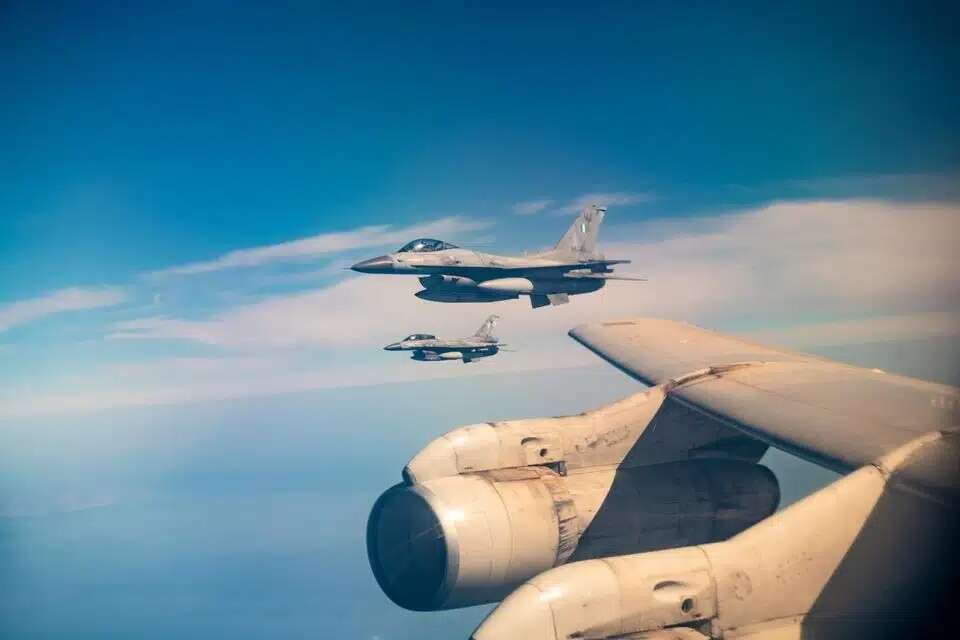
On August 31, Israel and Greece signed the €3 billion Achilles' Shield agreement.
Israel will build for Greece a national, multilayered architecture against ballistic missiles, aircraft and drones, integrating Israeli systems, radars and unified national command and control. The agreement also expands industrial cooperation and transfers technology to Greek industry.
The strategic product is not interception but decisional sovereignty: time to choose under fire.
If Ankara seeks simultaneous pressure around Cyprus, the Aegean, Greek territory or critical infrastructure, Athens is building the architecture to preserve strategic latitude under pressure.
That freedom of decision matters most if deterrence fails. If Turkey turns its military presence in occupied northern Cyprus from strategic depth into an operational base against Israel, the problem no longer ends with the weapons fired from it. The occupation itself becomes part of the threat architecture.
Poseidon's Wrath is the doctrine for that moment. Its trigger is narrow and its end state fixed: once Turkey uses the occupied north as an instrument of war against Israel, the conflict ends with the termination of Turkish military occupation and the restoration of effective sovereignty to the Republic of Cyprus.
Achilles' Shield is therefore a pillar of Poseidon's Phase Zero.
Abu al-Duhur established the preventive logic. In August, Israel reportedly struck the Syrian airbase before Turkish troops and systems could deploy there: denial before emplacement. Cyprus is harder because the Turkish military presence is already entrenched.

Batteries, aircraft and command systems can be replaced; a ceasefire that destroys yesterday's launcher while permitting tomorrow's return is not conflict termination but replenishment.
Israel's first task is defensive: neutralise the immediate threat and prevent its reconstitution. Ankara will then seek to reconnect and sustain its forces in the north, opening a reinforcement contest shaped by Turkey's military depth, proximity to Cyprus and capacity for attrition. Israel cannot base strategy on indefinite isolation; the opening matters only if it changes Ankara's calculus before attrition takes over.
Israel therefore enters such a contingency with air and missile defence, coastal protection, redundancy, repair capacity, stocks and industrial depth sufficient to withstand the expected Turkish response. Greece preserves strategic latitude through resilience. Cyprus, smaller and more exposed, requires greater endurance.
Common technology creates interoperability but also shared supply risk. Technology transfer therefore builds Greek production, maintenance capacity, stocks and sovereign technical control. Without industrial depth, common architecture can create common scarcity.
Before activation, the Republic of Cyprus is politically aligned with that end state, capable of preserving state continuity and prepared to assume effective control.
A doctrine that ends in Cypriot sovereignty cannot begin with Cypriot surprise.
Cyprus prepares to receive the opening; Greece prepares not to close it.
An Israel–Turkey confrontation around occupied Cyprus would present Greece with a historic choice. Athens could call the crisis somebody else's war, demand restraint, accept the earliest ceasefire and watch Turkey rebuild the position whose collapse created the first serious opening in decades.
Standing aside is the safest decision for a week and the costliest for a generation. Non-belligerence is a sovereign choice; passivity is not.
Marios Efthymiopoulos, professor of international security and strategy and co-founder of Strategy International, recently called for Greece and Cyprus to become Israel's "allies by choice" as their security environments converge.
There can be no weak capital. Cyprus is especially coercible because critical infrastructure and exposed sectors are concentrated: aviation, ports, energy, communications, finance and tourism. Ankara does not need to defeat the Republic; it needs Nicosia to decide that immediate quiet matters more than changing the outcome.
Greece offers another route. Pressure in the Aegean, around the islands, against infrastructure or along its land frontier can force Athens inward and make Cyprus appear an unaffordable strategic commitment.
Turkey need not conquer either state; coercing Athens or Nicosia back into the logic of 1974 would suffice. That is why Jerusalem, Athens and Nicosia cannot enter one war with incompatible termination criteria while Paris, London, Washington and Brussels operate on different clocks.
The three core capitals need a termination compact before the crisis: stopping the shooting will become urgent; restoring the military order that caused it remains unacceptable.
Internal cohesion is insufficient if the external framework drives the ceasefire back toward the status quo.
Israel has learned the treaty map. NATO's Article 5 has geography: Turkish forces stationed in occupied northern Cyprus do not turn the territory into Turkey. Cyprus has Article 42(7), the EU's mutual-assistance clause. The diplomatic battlespace is therefore European, not NATO. Israel denies Ankara the NATO frame it will seek.
The Republic of Cyprus is an EU member state. EU law is suspended in the areas where its government does not exercise effective control; its sovereignty did not disappear with that suspension.
If Turkey confines the war to Israel, Europe retains economic, industrial and diplomatic leverage without becoming a belligerent.
If Turkey attacks the Republic of Cyprus, Article 42(7) can be invoked without an Ankara veto. If Turkey attacks Greece, the Franco-Greek mutual-defence clause comes into play and NATO's internal crisis deepens. France is already embedded in Cypriot security architecture through its strategic partnership and defence arrangements with Nicosia.
Europeanisation is prepared, never manufactured: Article 42(7) is a consequence, not a trap. Turkey may choose the branch, not the destination.
Britain sits outside the EU frame but inside the Cyprus settlement. The United Kingdom retains sovereignty over the Sovereign Base Areas of Akrotiri and Dhekelia and remains one of the three guarantor powers under the 1960 settlement that created the Republic of Cyprus. In 1974, the guarantee system failed while the bases survived. Britain cannot preserve the rights of 1960 while archiving its obligations.
British sovereignty over the bases is not at issue; British responsibility under the settlement that preserved it is. London therefore forms part of any settlement that restores Cyprus's internationally recognised sovereignty, with access, sovereignty and responsibility aligned.
Neutralisation opens the gate; restoration defines victory. The guns need not wait for the last Turkish soldier to depart. They wait until his departure becomes irreversible.
That requires verification, a timetable, binding milestones, guarantees and enforcement. A ceasefire may precede completion of withdrawal; it cannot restore Ankara's power to decide whether withdrawal is completed.
Ankara may receive a dignified exit. It cannot receive a renewable veto. Irreversible withdrawal resolves the military question, not the constitutional one.
The indigenous Turkish Cypriot community is not the adversary; Turkish military occupation is. Its security, rights, property and constitutional standing survive the transition. Post-1974 settlers from mainland Turkey are a separate legal category, addressed through repatriation where lawful, subject to individual legal and humanitarian safeguards.
Conflating the two populations legitimises the demographic consequences of occupation; punishing the indigenous community restores Ankara's strongest argument for remaining.
Restoration looks less like conquest than administration. From the first morning of restored control, the Republic re-establishes public order, policing, services and local government, provides relief, and works with the European Union toward the reapplication of EU law, with European and United Nations support.
The price may be severe: lives, national strain and economic disruption. Poseidon exists to ensure that price does not buy a return to the status quo.
Shay Gal is Founder and Principal of Line of State, a strategic practice working with governments, institutions and decision-makers on strategy, risk, access and security decisions in high-stakes environments.