The Eastern Mediterranean has a missing state. It is not on the Mediterranean. Israel, Greece and Cyprus already form one strategic triangle; Greece, Cyprus and Armenia form another. Athens and Nicosia sit in both. Jerusalem and Yerevan do not.
That missing link leaves Turkey's eastern perimeter intact. Ankara's reach does not stop at the Aegean, occupied northern Cyprus, Syria, Libya or the Red Sea. It extends into the Caucasus, where Armenia is the hinge. Turkey turns geography into gates, gates into leverage, and leverage into veto.
Turkey closed its land border with Armenia in 1993. Ankara and Yerevan agreed in 2022 to open it at least to third-country nationals; four years later it remains closed, even after Turkey removed barriers to direct bilateral trade. The two governments describe normalization as proceeding "without preconditions," while Turkey's foreign minister says it is conducted "in close coordination with Azerbaijan" and links progress to Baku's concerns. Ankara calls the process unconditional while giving Baku the driver's seat.
Ankara can constrain Armenian choices without annexing Armenian territory. It can keep the western gate closed, synchronize its opening with Baku and expand routes towards Azerbaijan and Central Asia while Yerevan bargains for access to the market across its own border. Westward alternatives weaken that leverage; east-west transit for others while Armenia remains blocked strengthens it.
The gate exists; Ankara sets its usage price. Armenia once mispriced its own leverage. After the first Nagorno-Karabakh war, Armenian-backed forces controlled Azerbaijani districts beyond Nagorno-Karabakh. The UN Security Council demanded withdrawals in 1993, but battlefield advantage hardened into stasis instead of a final settlement, open routes, and durable security. International mediation contained rather than resolved the conflict while Armenia deepened its dependence on Russia.
The alternative was not invisible in Washington. In 2014, economist David Grigorian, editor-in-chief of Armenia and the West: A New Vision for the Caucasus, helped put a more independent, transatlantic Armenia before an Atlantic Council audience that included State, Pentagon and National Security Council officials. The idea entered Washington's policy debate. It never became strategy.
Yerevan is now unwinding its Russian dependency. Armenia has frozen participation in the Russian-led Collective Security Treaty Organization and legislated a path towards EU accession, while remaining outside candidate status and inside the Russia-centric Eurasian Economic Union. Prime Minister Pashinyan acknowledges that eventual membership in both unions is impossible.
Peace with Azerbaijan and normalization with Turkey are Armenian interests, not concessions. The sequence is backwards. Pashinyan has declared peace established before securing a signed treaty. The initialed agreement already recognizes the former Soviet republican boundaries as international borders and forecloses territorial claims, yet Baku still conditions final signature on constitutional changes absent from the agreed text.
Armenia's Constitutional Court has found that its constitutional order permits recognition of those borders. Yerevan points to comparable historical references in Azerbaijani constitutional texts; Baku rejects the parallel. Only Armenia is being asked to amend its constitution.
Yerevan also joined Baku in dismantling the OSCE Minsk Process, the three-decade mediation framework for Nagorno-Karabakh. The battlefield settled the territorial question before diplomacy settled the peace. Baku kept the constitutional condition.
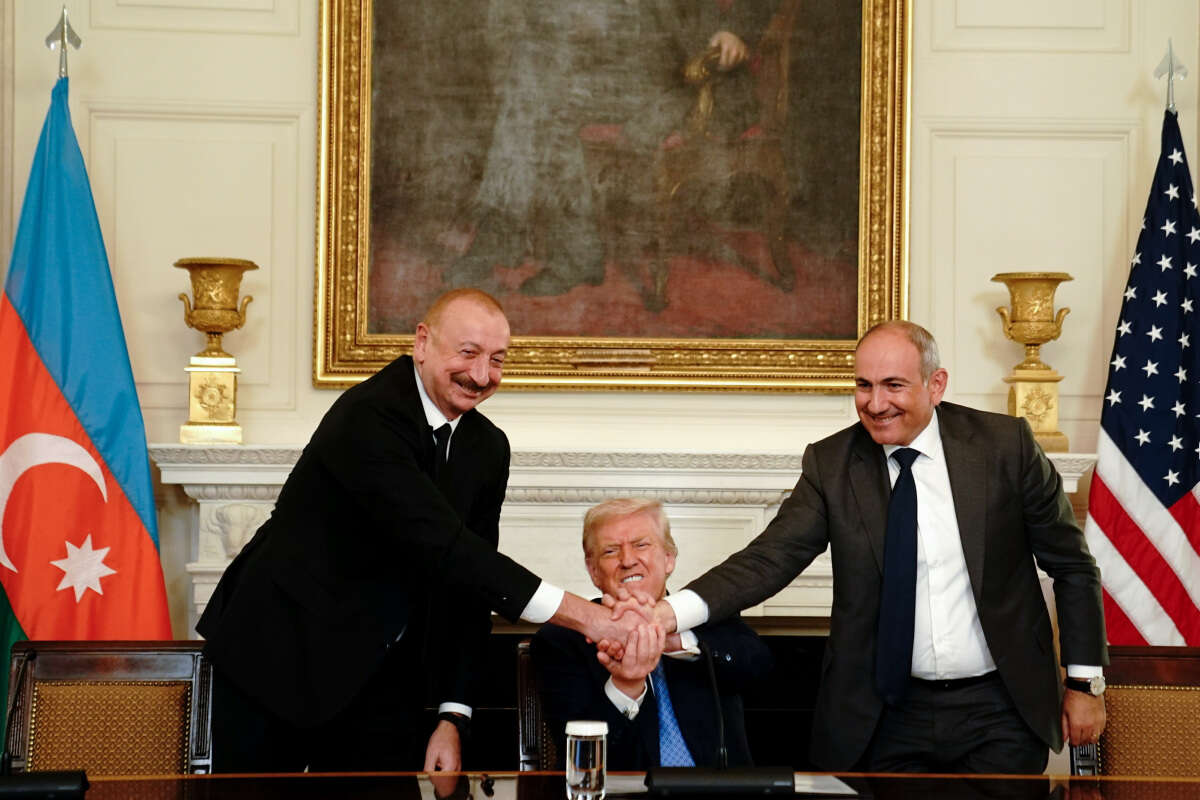
The Trump Route for International Peace and Prosperity, TRIPP, places southern Armenia on the land route linking mainland Azerbaijan, its Nakhchivan exclave and Turkey. Armenia retains sovereignty and border control, but the development company would be 74% US-owned and 26% Armenian-owned, with exclusive land-use and development rights for an initial 49 years, extendable by another 50. A one-year termination clause preserves legal exit, yet American capital, long-term concessions, and regional traffic raise the cost of exercising it.
The route crosses the 43-kilometers Meghri Strip along Armenia's Iranian frontier, separating mainland Azerbaijan from Nakhchivan. No treaty can repeal geography. Making Meghri indispensable gives stronger actors an interest in Armenia's stability, but also in uninterrupted transit through it. Protecting the route is not protecting Armenia's freedom of action.
Reciprocity is non-negotiable. Baku cannot receive dependable access west through Armenia while Armenian access west through Turkey remains at Ankara's discretion. Turkey cannot gain another route to Azerbaijan and Central Asia while keeping its Armenian border closed four years after agreeing to open it.
Otherwise Armenia unlocks Nakhchivan before unlocking itself; History is not currency.
In November 1920, Woodrow Wilson issued an arbitral award under the post-World War I Sèvres settlement defining a vastly different Armenia-Turkey frontier and providing Armenia access to the Black Sea. Its present legal force is disputed. Pashinyan's "Real Armenia" doctrine defines another map: the internationally recognized 29,743 square kilometers of the present republic, bounded by the 1991 Alma-Ata principle and stripped of territorial claims beyond them.
His government has also removed international recognition of the Armenian Genocide from Armenia's foreign-policy agenda. Closing the map does not close memory. Recognition redraws no border; refusing to weaponize history does not require disarming it.
On June 30, Israel elevated a historical claim Yerevan itself had demoted – and mapped the region's future without Armenia. Foreign Minister Gideon Sa'ar announced the government's decision to recognize the Armenian Genocide; Defense Ministry Director General Amir Baram described a new regional architecture stretching from India through the United Arab Emirates to Greece and Cyprus.
Israel cannot approach Armenia as if the post-2020 order was shaped without Israeli arms. Israel has according to foreign sources armed Azerbaijan for reasons of state: energy security, defense cooperation, Caspian and Central Asian access, and proximity to Iran. Those reasons endure.
So does loyalty. A Jewish state does not discard an ally that stood with it under pressure. Between 2016 and 2020, Israel reportedly supplied 69% of Azerbaijan's major-arms imports. According to foreign sources, Israeli loitering munitions, reconnaissance drones, guided missiles and ballistic missiles were deployed extensively in the 2020 war and there were reports that before Azerbaijan's September 2023 offensive, military cargo flights repeatedly linked the two countries.
That record creates responsibility, not repentance. Israel meets Armenia as a participant in the order that emerged. Opening to Yerevan must not come at Baku's expense; loyalty to Baku cannot become a veto on Yerevan.
The 2021 Shusha Declaration formalized Turkey-Azerbaijan allied relations and institutionalized foreign-policy and defence coordination under the official "one nation, two states" doctrine. Baku's response to Israel's recognition of the Armenian Genocide exposed the risk: Azerbaijan inherited no Ottoman responsibility, yet its Foreign Ministry adopted Ankara's denial lexicon and demanded that Israel reconsider.
"One nation, two states" must still mean two foreign policies. Otherwise alliance becomes subordination. If Baku becomes Ankara's extension, Yerevan becomes the alternative that keeps Ankara from monopolizing Israel's eastward access. Armenia does not replace Azerbaijan; its value rises as Azerbaijani autonomy falls.
Escaping Russian dependence cannot mean accumulating new dependencies and calling the sum autonomy. Armenia entered 2026 seeking strategic partnership with Iran; on February 24 its defense minister discussed deeper defense cooperation in Tehran. Three months later, Yerevan signed a Comprehensive Strategic Partnership with Washington spanning defense, security, energy, critical minerals and emerging technology.
They converge at Meghri. Pashinyan calls his policy "balanced and balancing"; without hierarchy, balance becomes exposure.
Washington already has a stake in Meghri through TRIPP, where the Baku-Nakhchivan-Turkey route intersects Armenia's potential extension of the Israel-Greece-Cyprus structure. Until the two connect, Armenia remains transit for Baku and Ankara before becoming a node for Jerusalem, Athens and Nicosia.
For decades Ankara has converted indispensability into veto: the Bosphorus, NATO, occupied northern Cyprus, migration and now the Caucasus. A connected Armenia breaks the pattern.
Jerusalem, Athens and Nicosia are the Mediterranean core. Yerevan is its missing eastern node. Baku belongs beside it, not beneath Ankara.
Shay Gal is Founder and Principal of Line of State, a strategic practice working with governments, institutions and decision-makers on strategy, risk, access and security decisions in high-stakes environments. He is on X at @shayGal84.