

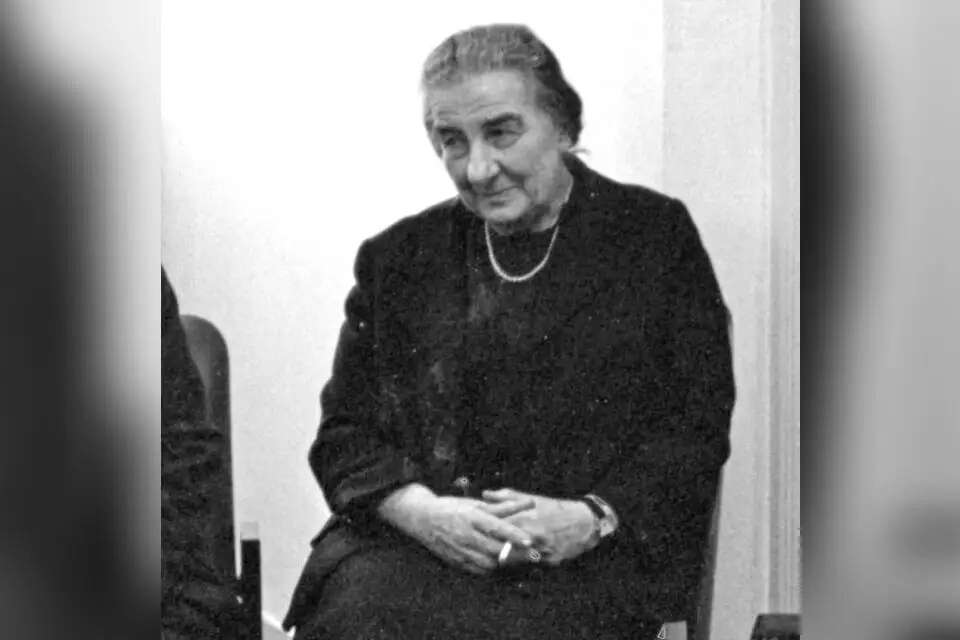
The Israeli opposition seeks to do to Prime Minister Benjamin Netanyahu what was done to Prime Minister Golda Meir: turn a strategic victory in war into a political defeat. It hopes the public will remember only the opening of the war, and ignore the success in turning the tables.
Israel is in a position of advantage similar to the one Golda handed down to Yitzhak Rabin, and there is reason to hope that we will overcome Iran just as we overcame Egypt.
Golda was brought down specifically after she won the election at the end of December 1973, albeit with a loss of five Knesset seats. Netanyahu's opponents hope to bring him down in the election itself. Golda was toppled by protesters, most of whom belonged to her rivals within her own movement: the "doves" in Israel's Labor Party and Mapam. They argued that she was to blame for the 1973 failure, not the Israel Defense Forces chief of staff and the head of Military Intelligence, as the Agranat Commission had determined.
They rejected the commission's conclusion that she bore only "ministerial" responsibility for the failure, but was not to blame for it. Netanyahu's supporters, by contrast, have largely stuck with him, even in the face of broad and sometimes violent protests, and in the face of an obstructionist opposition during wartime. That is why they are contemptuously called "Bibists," meaning citizens supposedly devoid of judgment, whom the allegedly enlightened citizens hope to defeat at the ballot box.
The protesters of 1974, like the Kaplan protesters, also struggled to recognize Israel's strategic breakthrough. At the time, it seemed that Anwar Sadat, the oil cartel and a hostile Europe were about to subdue Israel.
When reality changed
Three years later, reality changed, but almost no one still credited Golda with forcing Egypt to sign a separate peace and abandon Gamal Abdel Nasser's dream of a pan-Arab empire. Rabin and Shimon Peres replaced her and Moshe Dayan in 1974, without an election, and lost to Menachem Begin in the 1977 election. The "doves" took control of the Labor Party. When Sadat came to Jerusalem, almost no one understood that this was the result of Israel's victory in 1973, under Golda's leadership, and of her government's insistence, followed by the Rabin and Begin governments, on the demand that Egypt dismantle its imperial dream. The success in forcing it to abandon the "Palestine question," which had served as Egypt's ladder to becoming the dominant power in the Middle East, was a somewhat delayed result of the 1973 victory.
The "doves" of that era, from the Labor movement, share the current opposition's same diplomatic worldview: Everything begins and ends with the Palestinians and their supposedly unresolved issue. If only Golda had accepted the Arabs' so-called "peace proposals," the losses of 1973 would have been avoided. Those proposals were not peace proposals, but proposals for Israel's phased destruction. But to hell with the facts.
In the same way, if only Netanyahu had not pursued a "divide and rule" policy between Fatah and Hamas, and if he had returned Mahmoud Abbas to the Gaza Strip, the atrocity of Oct. 7 would have been prevented. This is a baseless claim. Israel did not separate Gaza from Ramallah, and Israel did not throw Fatah supporters from rooftops in the Strip in 2007. That is why the claim must be "reinforced" with low accusations such as "funding Hamas." Never mind that the Qatari money transfers were a result of the Palestinian split, which occurred before Netanyahu returned to power, and that they continued when the current opposition was in power. Never mind that the alternative to Qatari money was a bloody invasion and occupation of the Gaza Strip in order to return Abbas there, an action that almost no one in the public, or among its rival leaderships, even contemplated.
The opposition's claims have sunk to the low point of accusing Israel's leadership of treason in the midst of war. Unlike in 1973, this time the citizens will decide in an election. They must see that the Agranat Commission was right in principle: The blame borne by the commanders of the army and intelligence at the time was distinct from the government's responsibility.
Failure to distinguish between blame and responsibility does harmful work. It absolves, or blurs the blame of, the commanders of the army and the Shin Bet security agency for the functional collapse on the night of Oct. 7 and during that day of horrors, for the intelligence failure to open its eyes, and for the failure in building and deploying force. These are not failures of a prime minister, despite the fact that Netanyahu bears responsibility for them and for appointing those to blame for them. Most Israelis understand this.


