

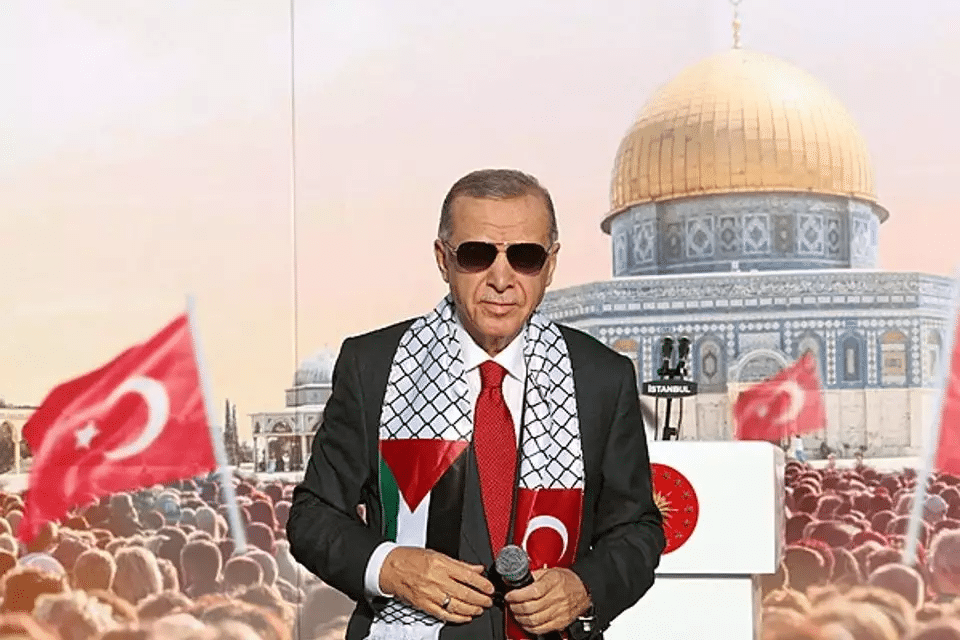
Following the October 7 catastrophe, relations between Israel and Turkey collapsed to the point that some believe they are beyond repair. In recent months, fears have also grown that the hostility and rivalry between Israel and Turkey could deteriorate into an open military confrontation. Those concerns were reflected in remarks by US President Donald Trump, who said Turkey had been on the verge of entering the war against Israel during the conflict with Iran and had refrained from doing so only because of his intervention.
Admittedly, Trump's declarations need not be taken seriously, since they often bear little relation to reality. Nevertheless, someone apparently briefed or warned him about the mounting tensions between Ankara and Jerusalem. Prime Minister Benjamin Netanyahu himself complained to Trump about Turkish President Recep Tayyip Erdogan and tried to persuade the US president not to sell Turkey the new F-35 stealth fighter. Yet Trump's bottom line was that Erdogan was a dear friend and ally, while Netanyahu was reduced to the rank of an errand boy whose sole task was to carry out the orders of his boss, Trump.
Turkey was the first Muslim-majority country to recognize the State of Israel, doing so in 1949. Since then, however, relations between the two countries have experienced ups and, above all, downs. For many years, ties remained deeply frozen because Ankara feared antagonizing the Arab states. In the late 1950s, however, Turkey joined Israel, Iran and Ethiopia in establishing the Periphery Alliance as a counterweight to Egyptian President Gamal Abdel Nasser.
The peace process that began in the region in the early 1990s brought an unprecedented flourishing of relations between the two countries, along with economic, diplomatic and, above all, security cooperation. As it once did with Iran, Israel displayed appalling shortsightedness by helping to develop Turkey's security services and defense industry.
All this changed after Erdogan came to power more than two decades ago. Erdogan seeks to turn his back on the legacy of Mustafa Kemal Ataturk, the founder of modern Turkey, not only regarding the country's secular character but also, and especially, in foreign policy. Turkey's traditional focus on Europe has been replaced by an orientation toward the Arab and Islamic worlds. Turkey has consequently aligned itself with Qatar, the Muslim Brotherhood and Hamas, using hostility toward Israel as a lever to advance its standing in the Arab and Muslim worlds.
Even after Erdogan took power, however, relations between the two countries continued, particularly in the economic sphere. That remained the case until October 7, after which Turkey sided with Hamas in both words and deeds, bringing about a complete rupture between the two countries, although the Turkish Embassy continues to operate in Tel Aviv.
Following the takeover of Syria by Turkish protégé Ahmad al-Sharaa, Ankara gained a foothold in the country and effectively replaced Iran as its dominant foreign power. This heightened concerns in Jerusalem that Syria could become an arena for confrontation. There were even reports of near-clashes between Turkish and Israeli aircraft. Nevertheless, a hotline between the Israeli and Turkish air forces was established through Azerbaijani mediation to prevent incidents in Syrian airspace.
Ultimately, Ankara wants to lead the region. Standing in its way are Shiite Iran, which Erdogan has described as the principal threat facing Turkey, and Israel.
Erdogan is an indefatigable talker, but when it comes to using force, few are more cautious. A confrontation between Israel and Turkey is therefore not inevitable. Both countries are close US allies and depend heavily on Washington, meaning tensions with Turkey can be contained.
Israel must safeguard its national honor and interests, but it should do so as part of a broader diplomatic, regional and international initiative. This could include cooperation with Arab countries that also fear Turkey.
Such an effort, however, requires Israel to have a vision and a comprehensive strategy. That is apparently not a priority for a leadership consumed with political survival. Repairing relations with Turkey is possible, but it will take time and will probably have to await better days in both Ankara and Jerusalem.


