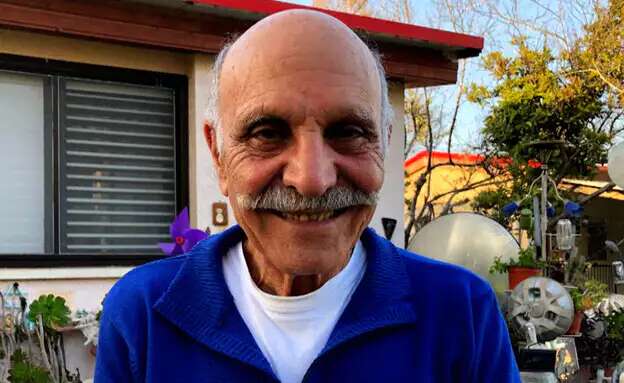
On Tuesday this week, it was confirmed that Shlomo Mantzur, an 87-year-old native of Baghdad, was murdered by Hamas. On October 7, he was kidnapped from his home in Kibbutz Kissufim, where he had lived with his wife Mazal (78) for more than 60 years, raising their five children together. Mazal managed to escape to a neighbor's house and survived. She waited for him all this time. But after months of agonizing uncertainty, the family's hopes were shattered.
For Mantzur, a survivor of the Farhud pogrom in Iraq, the events of October 7 underscored a painful truth: if a person experiences the horrors of genocide twice in his lifetime, he is likely a Jew.
A survivor of the Farhud
Mantzurimmigrated to Israel with his parents when he was 13, carrying with him the scars of one of the most violent atrocities against Jews in the Muslim world. The Farhud, a mass pogrom against Baghdad's Jewish community, is now recognized as part of the broader Jewish Holocaust. But Jews had faced violent persecution simply for being Jewish long before the Holocaust—and tragically, long after as well.
The Farhud erupted on the eve of Shavuot, on May 1, 1941. Iraqi authorities did not intervene, allowing Muslim rioters to brutalize the Jewish community at will. At least 179 people were murdered, thousands were wounded—many maimed for life, including women, children, and the elderly. The rioters looted the property of approximately 50,000 Jews.
Mantzurwas just three and a half years old when Muslim attackers stormed his home, beat his parents, and shot his beloved dog before his eyes, as recounted by his sister, Hadasa Lazar, in a special Knesset hearing on Holocaust survivors last October.
The little boy climbed onto his rooftop and watched the chaos unfold. He saw men, women, and children slaughtered, bodies mutilated, women assaulted, synagogues torched, and Torah scrolls desecrated.
One of the memories burned into Mantzur's mind bears a chilling resemblance to the atrocities committed on October 7. "He saw Arabs take a Jewish woman's infant and toss the baby back and forth between them. She pleaded for them to return her child, but they impaled him before handing him back to her," his daughter recounted in an interview.
Mantzur was among the founders of Kibbutz Kissufim, his life a living testimony to the bloody history of Jewish existence under Muslim rule.
For centuries, Jewish communities moved across the Middle East, an ancient region once free of national borders. Many engaged in extensive trade networks, with Jewish presence documented in Israel, Lebanon, Syria, Egypt, Iraq, Iran, and even Afghanistan as early as the 7th century. Today, little remains of these once-thriving Jewish centers, and the few remaining Jewish holy sites require heavy security.
Throughout history, alongside moments of peaceful coexistence, Jewish communities faced expulsions, persecution, and massacres. Even under the Ottoman Empire, which claimed to protect Jews and their property, the threat of mass slaughter never disappeared. In the 18th century, Jews were expelled from Jeddah (in present-day Saudi Arabia) and fled to Yemen; Jewish communities in Tetouan, Morocco; Baghdad, Iraq; and Mashhad, Iran faced brutal massacres.
European colonial rule provided some protection to Middle Eastern Jews, but the violence never ceased. As Arab nationalism emerged alongside Jewish Zionism, Muslim mobs carried out yet another wave of savage massacres against Jews—pogroms in Iraq, Tripoli, Aden, Aleppo, and Morocco's Oujda and Jerada riots, among others.
October 7 was a moral collapse of unparalleled brutality, an atrocity beyond human comprehension. But history shows that such horrors at the hands of Muslims have been part of the Jewish fate for thousands of years.
Yet, unlike past massacres and pogroms, October 7 could have been prevented—easily. That is why the sense of abandonment and helplessness remains so unbearable.
This could have been the moment that rewrote history: a Jewish people that is strong, protected, and sovereign in its own land. Instead, it became another chapter in the long, blood-stained story of Jewish survival.