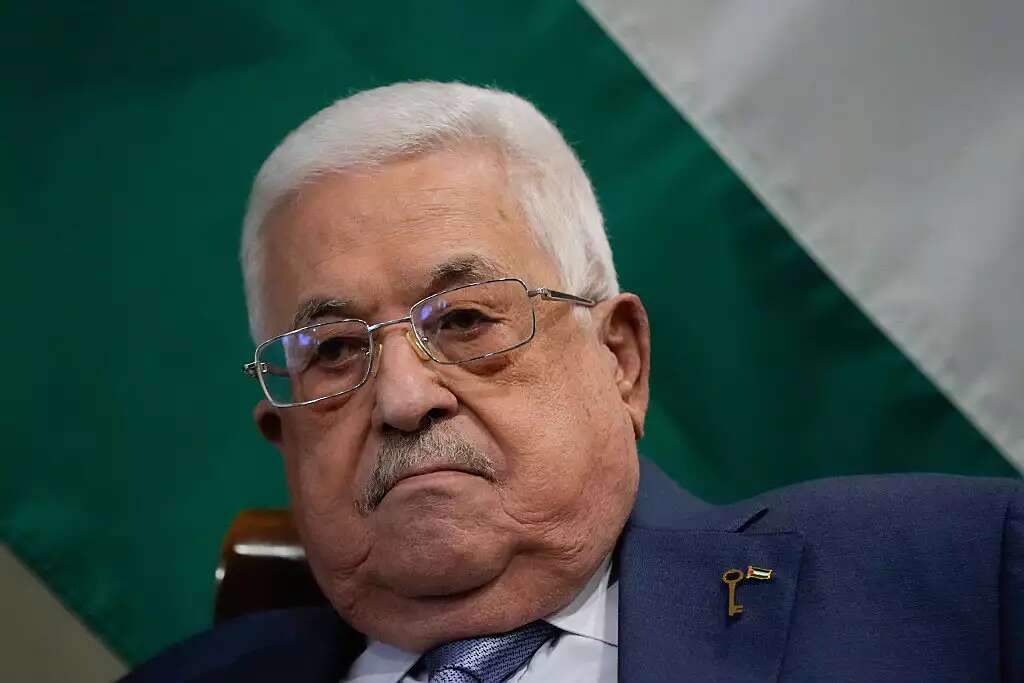
In mid-November, Palestinian Authority President Mahmoud Abbas marked his 90th birthday, and this coming January he will mark 21 years since being elected to office following the death of Yasser Arafat. Many are asking what will happen the day after the aging Palestinian leader leaves the scene. It is entirely possible that his death would ignite Judea and Samaria, amid succession struggles over the future of Palestinian leadership in the West Bank.
While in the Gaza Strip Israel's central objective is to dismantle Hamas, the terrorist organization, and strip it of its weapons, alongside the return of the body of slain hostage Ran Gvili, the US administration is seeking to advance the establishment of a technocratic government to manage the day-to-day lives of Palestinians in the enclave. At the same time, it is important to remember that Judea and Samaria remains a significant security challenge for Israel.
The US administration is indeed concerned about the possible collapse of the Palestinian Authority and is therefore pushing for aggressive reforms as part of an effort to create a political horizon for the Palestinian issue. Arab capitals also view such reforms as an important condition for expanding the Abraham Accords. However, when examining Palestinian public opinion in the West Bank, it appears that the road to positive change there remains very long.
Surveys conducted since the outbreak of the war by the Palestinian Center for Policy and Survey Research, led by Professor Khalil Shikaki, paint a clear picture of attitudes within West Bank Palestinian society. According to the most recent survey, conducted in October 2025, a majority of 59 percent of West Bank Palestinians believe Hamas' decision to launch the October 7, 2023 attack was the right one. This marks a decline from the first poll conducted after the massacre, in December 2023, which showed 82 percent support.
This pattern of declining support for armed struggle is also evident when respondents are asked about the most effective way for the Palestinian people to achieve their national aspirations. In December 2023, 68 percent of West Bank Palestinians believed armed struggle was the preferred means, compared with 18 percent who favored negotiations. By October 2025, those figures had shifted to 43 percent and 37 percent, respectively.
One might think that the decline in support for armed struggle reflects a growing desire for peace among West Bank Palestinians. However, continued support for Hamas over Fatah only reinforces the argument that the Palestinian ethos centered on the destruction of the State of Israel has not changed.
Another survey, conducted in September 2023 shortly before the massacre, found that if elections were held for the Palestinian parliament, Fatah would win 54 percent compared with 32 percent for Hamas. By October 2025, a reversal is expected, with Hamas projected to win 53 percent versus just 38 percent for Fatah. This is despite the fact that in the Gaza Strip the balance of power between Hamas and Fatah has barely changed.
According to the October 2025 survey, Hamas enjoys 51 percent support in Gaza compared with 33 percent for Fatah, while in September 2023 the figures stood at 52 percent for Hamas and 38 percent for Fatah. This suggests that the decline in support for armed struggle and for the October 7 massacre stems primarily from fear of the Israeli response against those calling for Israel's destruction, with the ruins of the Gaza Strip serving as a bitter lesson.
In conclusion, while the Gaza Strip has been almost entirely devastated along with most of Hamas' military capabilities, the next Palestinian challenge is expected to come from Judea and Samaria. There, a generation has grown up that did not experience Operation Defensive Shield, Israel's 2002 military campaign. A confrontation with Palestinians in the West Bank could, God forbid, also spill over to Arab Israelis, who possess hundreds of thousands of illegal weapons that could be turned against Jews when the order is given. In such a scenario, scenes experienced by Jewish residents of southern Israel on October 7 could be repeated in Jewish communities in the north and center of the country.
The positions held by Palestinians in the West Bank clearly illustrate whom Israel is facing, and above all, who is likely to become the future leadership there on the day after Mahmoud Abbas' departure. It is therefore essential to prepare accordingly.