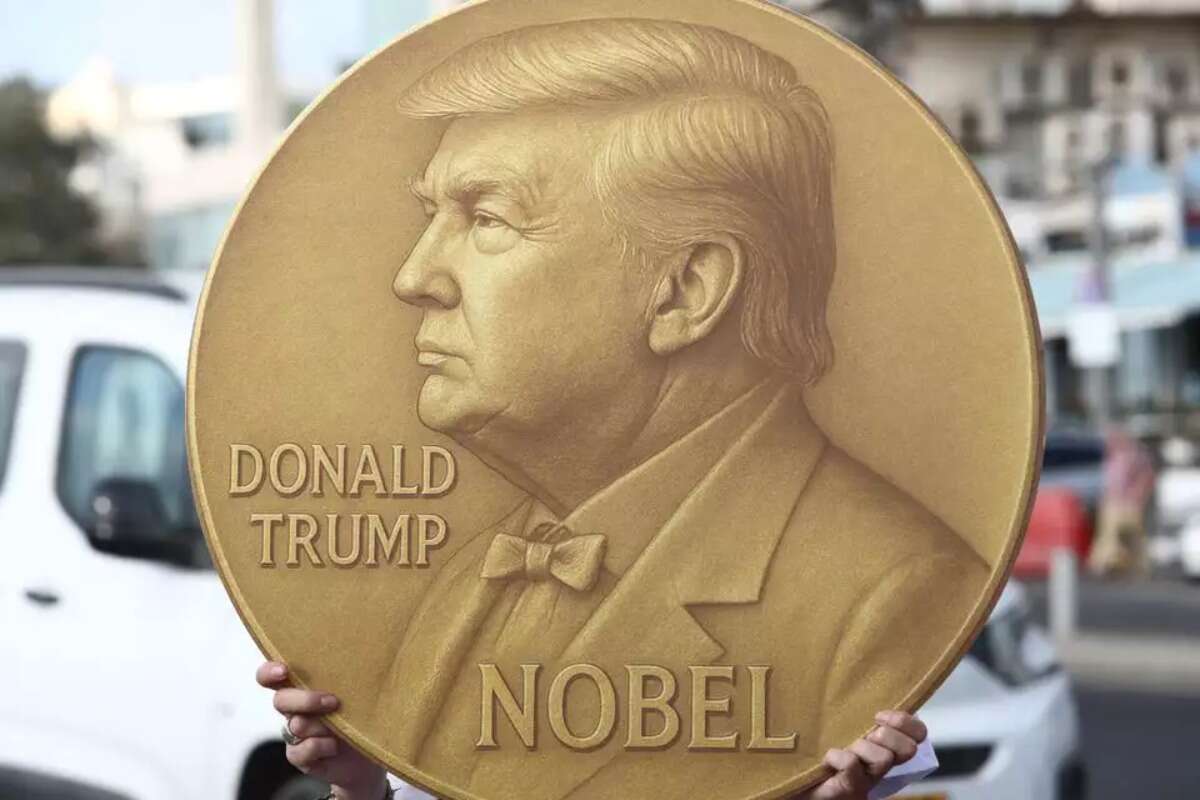
"The recipient of the Nobel Peace Prize should be the person who has done the most or the best work for fraternity between nations," wrote dynamite inventor Alfred Nobel in his 1895 will, laying the groundwork for one of humanity's strangest traditions: waiting each year for the announcement of the laureate, only to immediately argue about how absurd the choice is. This year's decision to award the prize to Venezuela's opposition leader María Corina Machado—and not to US President Donald Trump—has sparked more debate than usual.
There is no doubt that the committee's dismissal of Trump's global peace achievements was deliberate, exposing once again the prize's inherent bias. The contrast is striking when compared with the committee's treatment of Barack Obama, who, as many recall, received the 2009 Peace Prize simply for being Obama.
Unlike two earlier American presidents who won the prize while in office, such as Theodore Roosevelt in 1906 for mediating the end of the Russo-Japanese War and Woodrow Wilson in 1919 for founding the League of Nations, Obama contributed nothing to "fraternity between nations," unless one counts his conciliatory speech to the Muslim Brotherhood at Cairo University, which did little to make global jihadists warm to America.
And Obama wasn't even the committee's low point. In 1939, Swedish parliamentarian Erik Gottfrid Christian Brandt recommended Adolf Hitler for the Peace Prize, describing him as "a fighter for peace" who would "pacify Europe, and perhaps the entire world." Brandt even praised Hitler's book Mein Kampf as "one of the best works ever written."
True, Brandt's proposal was likely meant as satire, criticizing the world's silence in the face of Nazi crimes. Yet another tyrant, Joseph Stalin, was seriously nominated for the prize at least twice.
As for actual laureates, the most disgraceful case came in 1994, when the prize was given to mass murderer Yasser Arafat—alongside Yitzhak Rabin and Shimon Peres. Committee member Kåre Kristiansen resigned in protest, reminding the world that Arafat was the planet's most notorious arch-terrorist. The rest simply pretended not to see the rivers of blood on his hands.
Because the Nobel Peace Prize has become so politicized, it has long reflected the fleeting fashions of one political camp, the global left. The same pattern is evident now, in the committee's refusal to recognize Trump's role in advancing peace, with one exception.
The committee's desire to snub the American president it loathes led it, unintentionally, to choose a truly worthy laureate.
María Corina Machado embodies every noble value the Peace Prize is meant to represent. She is a courageous freedom fighter, a genuine conservative, and the leading voice against the repressive dictatorship of Nicolás Maduro—a regime aligned with Iran and hostile to Israel. Machado is also a staunch friend of the Jewish state, pledging that once she defeats Maduro, she will move Venezuela's embassy to Jerusalem.
The Nobel Committee came to curse Trump, and ended up blessing Machado.