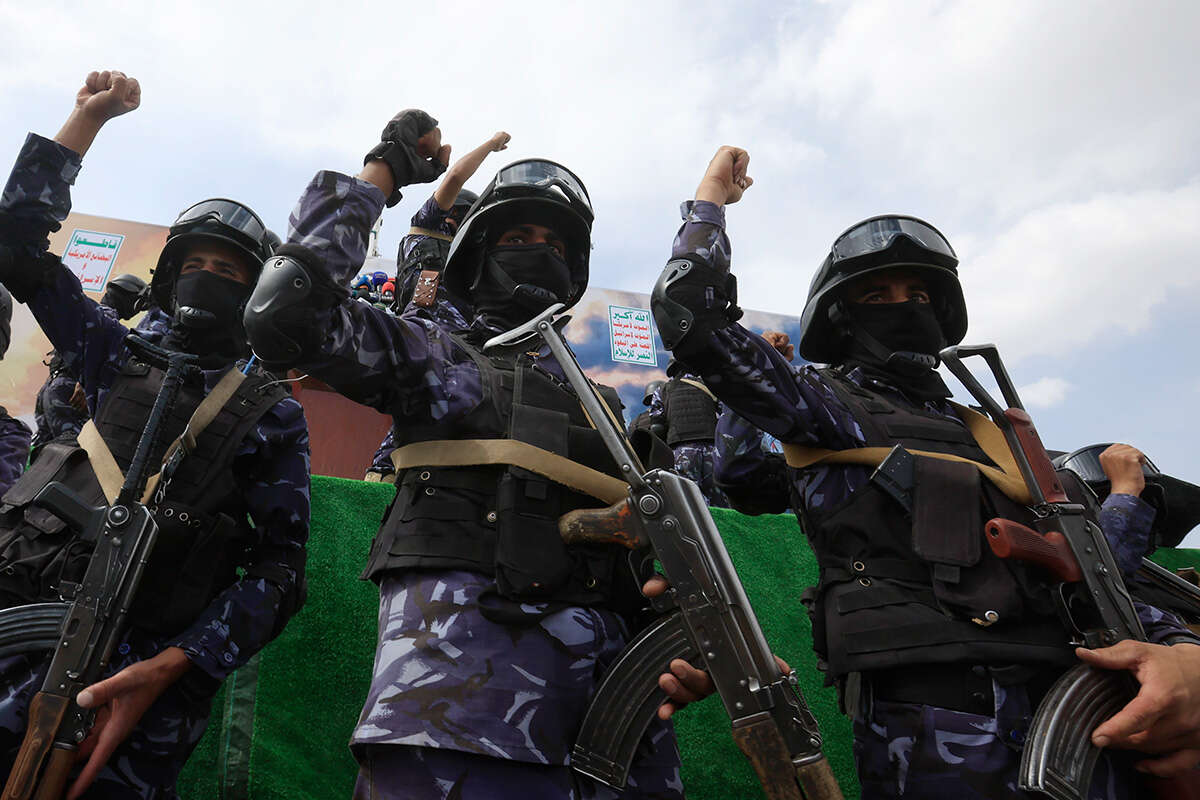
Until the Houthis seized power in Yemen just over a decade ago, few people had heard of, let alone taken an interest in, this largely forgotten country at the southern tip of the Arabian Peninsula. Yemen is an impoverished, underdeveloped country of warring tribes that have long fought among themselves, with the overwhelming majority of its 43 million inhabitants living in poverty and deprivation.
The Houthis take their name from their founder, Hussein Badreddin al-Houthi, and emerged from a tribal group of the same name. They belong to the Zaydi branch of Islam, which is closely associated with Shiite Islam and accounts for roughly half of Yemen's population. On the face of it, the Houthis are simply another tribal faction among the many that have fought for control of the country for centuries. But the alliance they forged with Iran after seizing power transformed the Houthis into a force unlike any other, turning Yemen into a strategic threat to its neighbors.
As with Hezbollah in Lebanon, Iran provided the Houthis with financial and military assistance that transformed them into a formidable fighting force. They now exercise an iron grip over much of Yemen, with ambitions to expand their control, while threatening and attacking neighboring countries, particularly Saudi Arabia.
Beyond that, the organization has disrupted maritime traffic through the Bab el-Mandeb Strait, a chokepoint along one of the world's most important shipping routes. The disruption has effectively paralyzed Israel's southern port of Eilat and dealt a severe blow to Egypt's economy, which depends heavily on revenues from ships passing through the Suez Canal.
The Saudis, together with the United Arab Emirates, were the first to recognize the danger. As soon as the Houthis seized power in Yemen, they launched Operation Decisive Storm in March 2015, conducting targeted airstrikes against the group. But the Saudis lacked the intelligence and operational capabilities needed to make the campaign effective. The strikes did little to deter the Houthis or halt their advance.
Instead, the Houthis launched effective missile and drone attacks against oil infrastructure in Saudi Arabia and the UAE, eventually forcing both countries to accept a ceasefire. That agreement gave the Houthis a considerable boost, allowing them to expand and improve their missile and drone arsenal, including through domestic production.
About two years ago, the United States also launched a military campaign against the Houthis, possibly as a prelude to an attack on Iran. But once US President Donald Trump discovered how much the missiles being fired at targets in Yemen were costing, and just how ineffective the strikes were proving, he too moved quickly to reach a ceasefire with the group.

After all, the Houthis are neither a conventional state nor a regular army, and wars cannot be won through airpower alone. Israel also carried out a series of strikes in Yemen before opting to lower its profile, hoping the Houthis would stop attacking the Jewish state.
Now the fighting has resumed, and the Houthis have renewed their war against Saudi Arabia. What is astonishing is that despite Yemen's poverty and underdevelopment, the Houthis have managed to inflict serious damage on the Saudi kingdom. They have even launched a military offensive against Yemen's internationally recognized government, based in the south of the country and supported by its predominantly Sunni population.
The Saudis are now seeking assistance from the United States, and perhaps from Israel as well. But Washington is in no hurry to respond.
Perhaps American officials remember Yemen's civil war in the 1960s, when Egyptian President Gamal Abdel Nasser intervened and sent troops into the country. In Yemen's rugged, mountainous terrain, those forces struggled to fight the local tribes, including the Zaydi royalist forces from which the Houthis would later emerge. At the time, those forces received support from Saudi Arabia and Israel.
The Houthis can be defeated by cutting off their Iranian lifeline while recruiting forces from within Yemen to fight them, just as the Americans enlisted Kurdish fighters in Syria and Iraq in the campaign against the Islamic State terrorist organization.
Nor should the possibility of the Americans effectively "buying off" the Houthis be ruled out. After all, the Houthis' relationship with Iran is based on shared interests rather than a natural ideological affinity. Yemen's Zaydi branch of Islam has historically been relatively moderate, with little in common with the radical Shiite ideology of Iran's rulers.
What is clear is that no one should expect a decisive victory in Yemen anytime soon. And anyone who values their own security would be wise to steer clear of the Yemeni quagmire.