When Israel struck Iranian targets, Erdogan positioned Turkey as a "new Iran", asserting military, political, and nuclear ambitions. For the first time since the Ottoman Empire's collapse, Turkey openly seeks regional dominance.
Like Iran, Turkey provides political and logistical support to terror organizations, notably Hamas, further destabilizing regional security and threatening Israel. This strategic posture closely mirrors Iran's longstanding pursuit of regional influence through military intimidation and nuclear brinkmanship.
Erdogan recently announced rapid advancement of Turkey's ballistic missile program, having successfully tested the 'Typhoon' missile capable of hitting targets at distances up to 560 km. He explicitly warned that if Greece does not remain "calm", Athens itself could become a target. Turkey has also initiated mass production of the domestically developed stealth fighter jet 'Kaan', expected to enter service by 2029. Erdogan emphasized that Turkey "cannot afford to lag behind" Iran and Israel.
Turkey is accelerating its nuclear project at Akkuyu on the Mediterranean Sea, which begins operations this year. Its insistence on independent uranium enrichment suggests a rapid shift to military nuclear capability. In 2019, Erdogan explicitly stated: "I cannot accept the ban on Turkey possessing nuclear weapons while Israel has them". Turkey risks following Iran's path, leveraging an international network: Pakistan, which previously assisted Iran and Libya; Niger, supplying nuclear raw materials; and Somalia, hosting clandestine Turkish military training bases far from Western scrutiny.
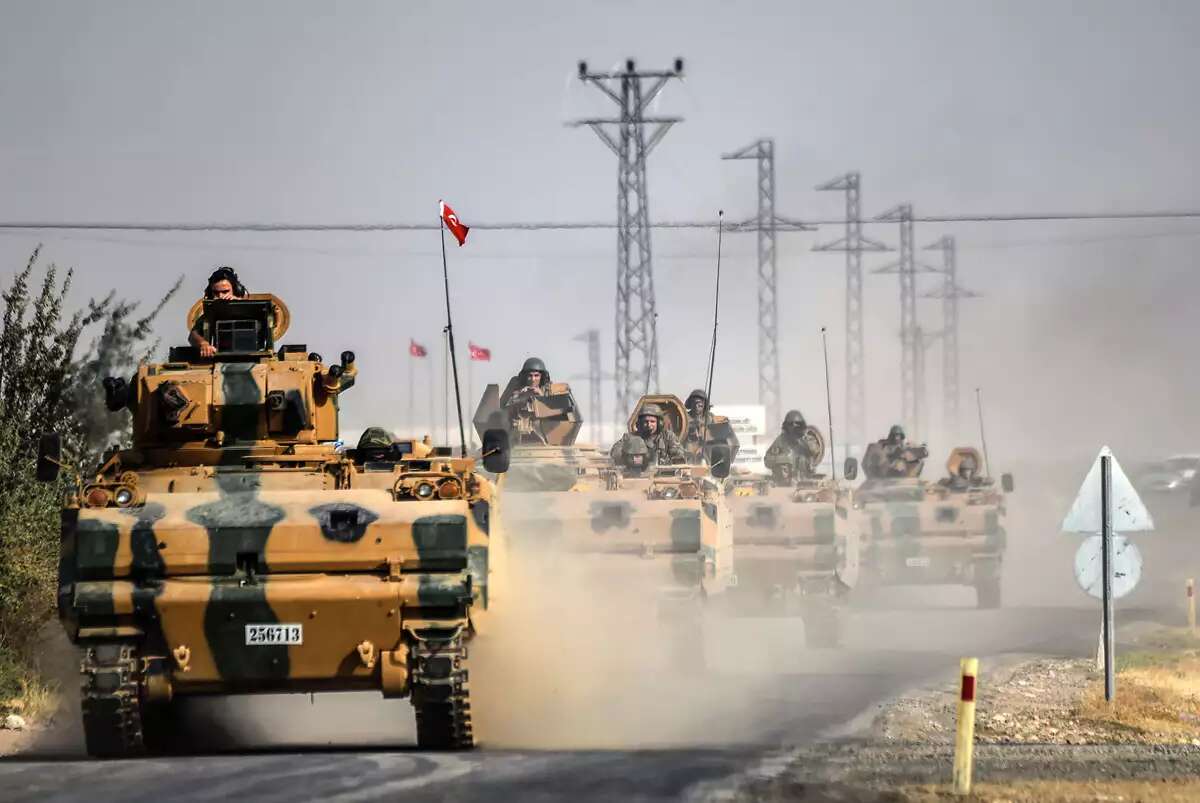
Turkey's threats against Greece and its ongoing 50-year occupation of northern Cyprus, an EU member's territory, are core elements of its revisionist 'Blue Homeland' doctrine aimed at Turkish naval and aerial dominance in the Eastern Mediterranean. An unchecked Turkish threat against Greece risks an unprecedented crisis between two NATO allies, further destabilizing the alliance. Similar to China's incremental strategy in the South China Sea and Iran's behavior, Erdogan employs a dangerous 'salami-slicing' tactic - small incremental violations of territorial waters and airspace - individually minor yet collectively amounting to strategic change and regional instability.
Turkey exploits its NATO membership for immunity, undermining the alliance from within and enjoying protection Iran has never received, despite Ankara's policies contradicting NATO interests. Despite Turkey's acquisition of Russia's S-400 system compromising NATO security, President Trump seeks Turkey's return to the F-35 program, further emboldening Erdogan. Moreover, NATO's Article 5 shields Erdogan's aggression from direct response by neighbors. NATO must reassess Turkey's abuse of Article 5, conditioning defense guarantees upon Ankara ending threats against alliance members and regional partners.
Yet EU policy toward Turkey remains dangerously contradictory. In May 2025, the EU approved the €150 billion SAFE program, granting Turkey security cooperation despite Ankara's ongoing human rights abuses against the Kurds, occupation of Cyprus, and explicit threats against Greece.
The inconsistent policies of the US and Europe necessitate an independent strategic Israeli response. Turkey's military buildup in northern Syria provides an additional platform for projecting threats against Israel. A recent Israeli government Nagel Committee's 2025 strategic assessment emphasizes Turkey's threat as potentially surpassing even the Iranian threat. Israel has strengthened strategic alliances with Greece and Cyprus, regularly conducting military exercises and naval cooperation to secure energy assets. Simultaneously, Israel is reinforcing security cooperation with Egypt and the UAE, both of whom are also concerned by Turkey's rising military ambitions.
While Israel certainly does not seek direct confrontation with Turkey nor intends to employ such capabilities imminently, it must nevertheless ensure that the operational capacity to strike Turkish military assets - similar to its demonstrated actions against Iranian threats - is fully developed, credibly signaled, and closely coordinated with regional allies. Israel must firmly oppose any deal reinstating Turkey into the F-35 program in exchange for concessions in Syria. In any future talks with Syria, Israel must clearly demand limits on Turkish military presence in northern Syria.
Amid soaring inflation, political arrests, and mass protests, Erdogan may escalate external threats as authoritarian leaders often do, to divert public attention from internal turmoil.
At regional and international levels, reactions to Turkey's actions remain dangerously ineffective and inconsistent. The US views Turkey as a necessary partner against Moscow and Europe oscillates between criticism and cooperation, further emboldening Turkey. This inconsistent Western policy underscores the urgent need for decisive action, before Ankara's ambitions become irreversible, potentially eclipsing even Iran's threat.
Shay Gal is an expert in international politics, crisis management, and strategic communication. He operates globally on issues of power relations, geopolitical strategy, and public diplomacy, and their impact on policy shaping.