

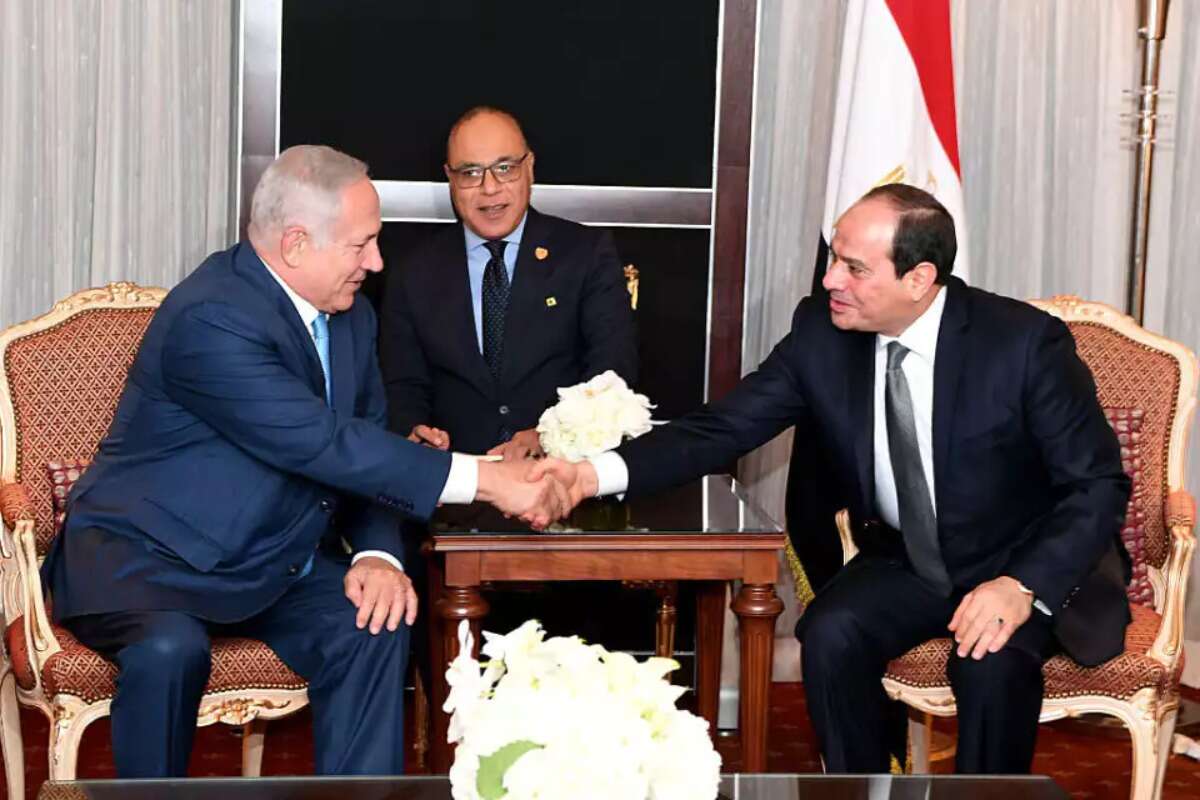
Prime Minister Benjamin Netanyahu recently singled out Israel-Egypt relations for harsh criticism. Yet his remarks, and even the announcement of a freeze on advancing a $35 billion gas deal under which Egypt was to purchase Israeli natural gas, appear to have bolstered President Abdel Fattah el-Sissi's standing rather than harmed it. In Cairo, the criticism was seen as proof that el-Sissi prioritizes Egyptian national interests above all else. As some Egyptians noted, if Netanyahu is criticizing Egypt, it must mean Cairo is putting its own interests first.
Both the Israeli and Egyptian defense establishments fully recognize the importance of maintaining relations, safeguarding the security status quo, and ensuring coordination and cooperation. Even though the peace between the two countries remains cold and devoid of genuine solidarity, its significance today is greater than ever.
Netanyahu's criticism of Egypt seems to be coordinated with el-Sissi's government and aimed primarily at the Israeli public, serving domestic political needs. It was meant as a response to reports claiming that Egypt was violating the peace treaty by strengthening and expanding its forces in Sinai and along the border with Israel. In reality, there has been no violation of the treaty. Egypt cannot violate it, and the military adjustments are mostly aimed at preventing Gazans from fleeing into Sinai.
The Egyptian military has indeed changed over the past decade, technologically and numerically. This can be seen in its purchase of advanced weapons, including German-made submarines. But the changes are limited and tightly supervised, since the primary supplier is the United States. Washington never transfers weapons without coordination with Israel. This is also reflected in the long-standing American refusal to sell advanced fighter jets to Gulf states, despite their close relations with Washington and massive investments there.
Israel and Egypt share strategic assets, and for 45 years since signing their peace treaty, they have managed to protect them: from securing the Red Sea and preventing the Houthis from threatening shipping routes, to intelligence operations in Africa, the fight against Islamic State terrorists in Sinai, and confronting their mutual enemy, Iran. Any violation of the treaty could disrupt this delicate balance of mutual interests, something neither country wants. This is why ties between Cairo and Jerusalem, often routed through Washington, certain European states, and the Gulf, are not likely to be harmed, especially in light of the profound shifts the Middle East has undergone over the past two years.
In fact, the current war has only reinforced cooperation. It is no coincidence that Egypt has long played, and continues to play, a crucial role in negotiations between Israel and Hamas, well before the war erupted on October 7.
Given the current reality, it is difficult to be optimistic about full normalization between the Israeli and Egyptian peoples. That process is likely to take far longer than many can imagine. Yet without question, military coordination and security normalization will remain in place. The two countries' strategic interests are shared and intertwined, regardless of who holds power in Jerusalem, Cairo, or in global capitals.
In practice, there is no violation of the peace treaty. The changes are narrowly tailored and primarily intended to prevent Gazans from crossing into Sinai.


