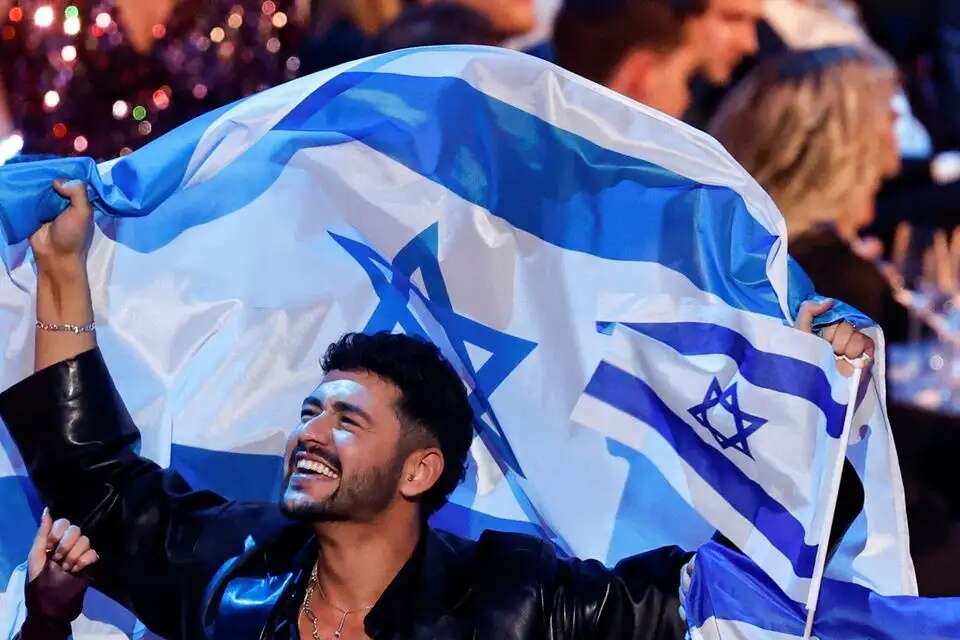
How symbolic it was that the 70th Eurovision Song Contest was held this year in Vienna, the city where Theodor Herzl worked, the city where the Zionist idea was shaped into a concrete political program.
In his book "The Jewish State," Herzl believed that once the Jews gained sovereignty and established a state of their own, Europe would accept them back into the family of nations.
The Jews, he believed, would become a "normal" people, with a state, borders, an army and a modern national identity. Yet since the establishment of the State of Israel, our relationship with Europe seems to have been far more complex. In many ways, Israel sought for years to be part of the European sphere culturally, athletically and sometimes even emotionally.
We built homes with red-tiled roofs despite the fact that we did not live among the Alps. We dreamed of Paris, London and Rome, and raised generations of students on English, French and Western culture. Although the State of Israel is rooted in the heart of the Middle East, its gaze has always also turned westward, toward the continent into which the Jewish people sought to reintegrate after generations of persecution. The more we wanted to draw closer, the more Europe itself seemed to recoil from that closeness.
In soccer, we sought to join the European framework. In basketball, we celebrated the moment when "we are on the map." And since 1973, Eurovision has become one of the symbols of Israel's aspiration to belong to the European cultural space. For most countries, it was a colorful song contest, one that at times even lost some of its cultural prestige.
For Israel, however, Eurovision was much more than a musical show. For many Israelis, it was a kind of annual vote on the question of our belonging to the West. Behind the anticipation of 12 points, there was sometimes a deeper desire for recognition. Every victory was seen as proof that we were part of Europe. Every failure was immediately explained by antisemitism, political rejection or an unwillingness to accept us as a natural part of the European sphere. The further we moved from the recognition we sought, the more tightly we seemed to cling to it.
Since Oct. 7, this tension has only intensified. Eurovision has turned from a cultural arena into a battleground of public consciousness. In recent weeks, it seemed as if the entire public discourse in Israel revolved around the question of how Europe sees us: how much contempt was heard, what statements were made and what the votes meant. Once again, we searched in a song contest for an answer to a much deeper question: Is the West still willing to accept us? Yet the real question may not be what Europe thinks of us, but why we still need its approval so badly.
As the years pass since the Holocaust, the continent is changing politically, culturally and demographically, and its relations with Israel are changing accordingly. Herzl believed that the establishment of "The Jewish State" would solve the "Jewish problem" in Europe. But perhaps reality teaches something else: A sovereign state is not supposed to measure its worth by the applause of others. And perhaps this is the deepest lesson from Eurovision in recent years: The question is not whether Europe sees us as part of it, but whether we still need a song contest to feel that we belong to a place that was never sure it wanted us.