When Israeli venture capitalist Jonathan Medved launched his OurCrowd funding platform five years ago, he billed it as a novel way to give individual investors a piece of the action in the country's vibrant startup scene, traditionally the playground of well-heeled venture funds.
Now his firm has burgeoned into a $650 million behemoth.
Medved has gathered more than 20,000 investors from over 100 countries, taken stakes in dozens of cutting-edge startups, and watched 18 of his portfolio companies enjoy "exits" through public offerings on global stock markets or acquisitions by tech giants. An estimated 10,000 investors and entrepreneurs from around the globe descended on Jerusalem on Thursday for OurCrowd's gala birthday bash and investor conference.
But as the firm marks its anniversary, questions remain about whether its creative approach is wise for small investors.
While traditional venture funds seek investors such as billionaires, university endowments and pension funds to put down millions of dollars at a time, OurCrowd allows individuals to invest in selected companies for a minimum of $10,000, or enter their funds with investments as low as $50,000. OurCrowd pools these investments and takes stakes in startups on behalf of its clients.
Realizing the risky nature of venture investing, OurCrowd's clients must meet local regulations. American clients, for example, must have $1 million in assets.
Still, these clients are a far cry from the traditional venture capital crowd.
"We can democratize to an extent," Medved said.
He said clients can either choose individual companies, in the hope they will be part of Israel's next big thing, or "you could actually get into a venture capital fund, but you don't have to be a billionaire to do so."
Medved, a seasoned businessman who founded and funded several Israeli startups and previously managed one of the country's largest venture capital firms, called OurCrowd a "hybrid" between crowdfunding and traditional venture capital.
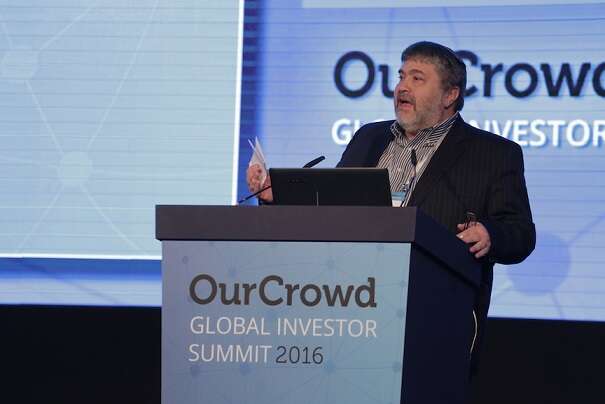
Unlike other many equity crowdfunding platforms, in which people invest directly into companies, OurCrowd vets the companies and provides clients with investment guidance.
In just five years, OurCrowd has made a splash in Israel's venture capital scene. It holds stakes in many of the country's most promising startups, such as Consumer Physics, developers of an optical spectrometer, alongside more established firms such as Freightos, a shipping logistics company, and defense contractor mPrest.
Since its launch in 2013, the company says it has raised $650 million in assets for 145 startups and 12 funds, ranging from health care technology to artificial intelligence. The bulk of the startups are Israeli.
"I think it's fair to say that OurCrowd has opened it [the venture capital world] up to retail investors in a way that it was never was open to retail before," said Michael Eisenberg, a partner at Tel Aviv-based venture capital fund Aleph.
"Otherwise, I would say it is close to impossible for a retail investor to get into almost any venture capital deal without something like an OurCrowd," he said.
Experts caution that venture capital remains very risky, with low success rates and slim payouts in many cases. Venture capitalists emphasize that most of the profits derive from a tiny percentage of investments.
Medved acknowledged that the Hebrew term for venture investing translates as "danger capital" and recommended that investors enter diversified funds, instead of individual startups.
"The reality is, if you don't take a basket, you're unlikely to get that one towering winner because usually [only] one out of 10 will really hit," he said.
Over the past two decades, Israel has developed into one of the world's most fertile grounds for venture capital firms. It is home to a bustling startup scene, fueled by an entrepreneurial spirit and the successes of graduates from secretive high-tech military units.
Israel has produced a series of high-profile successes over the years, including Check Point Software Technologies, a cybersecurity company that trades on the Nasdaq, mobile navigation app Waze, which was acquired by Google for about $1 billion, and Mobileye, which produces technology for self-driving cars and was gobbled up by Intel last year for $15 billion.
Of OurCrowd's 145 portfolio companies, 18 have made profitable exits. Yet according to OurCrowd, the return on investment on these exits has been a modest 30 percent. Six companies have flopped.
"If they can secure some of the top entrepreneurs and startups within the ecosystem in Tel Aviv and its surroundings, then that makes sense," said Christian Catalini, an economist at MIT who studies the venture capital world. "But otherwise you're taking a lot of risks because it's extremely early-stage, and at the end of the day they of course do a lot of due diligence, but you're relying on their process."
OurCrowd declined to provide a full breakdown of its investors but said it has drawn huge sums from North America, and, increasingly, Asia. It even counts investors from Muslim countries that do not have diplomatic ties with Israel, including Algeria, Bahrain, Indonesia, Kuwait, Morocco, Pakistan, Qatar, Saudi Arabia and the United Arab Emirates.
Marianna Shapira, a researcher at the Israel Venture Capital Research Center, said equity crowdfunding firms, foremost among them OurCrowd, are meeting a growing need in the Israeli tech market for early-stage investment.
As more Israeli companies reach maturity, venture capital firms are focusing their financing on growth, leaving "a void in earlier development stages," she said. Equity crowdfunding platforms have stepped up by "answering this financing demand, mostly because of their natural tendency to invest smaller amounts per round."
For the time being, investing in the next tech phenomenon through platforms such as OurCrowd remains out of reach for all but the very wealthy, though Medved envisions a future in which the less affluent can get in on the ground floor.
"Over time, we hope we can become much more democratic and allow ways to broaden this out so that schoolteachers and bus drivers and students can invest," Medved said.