Israel Hayom is a media organization founded on the belief that the Israeli public deserves better journalism—more balanced, more accurate, and more reliable. Journalism that speaks rather than shouts. Journalism that is trustworthy, objective, and matter-of-fact. A different kind of journalism, offered free of charge. The first print edition was published on July 30, 2007, and in 2010 Israel Hayom became the Israeli newspaper with the highest weekday readership. The newspaper’s publisher is Dr. Miriam Adelson. Its Editor-in-Chief is Omar Lachmanovitch, and its founding editor is Amos Regev. Israel Hayom’s Hebrew and English websites, as well as its Android and iOS applications, provide around-the-clock news coverage, exclusive content, breaking news and updates, analysis and commentary, video, podcasts, and live broadcasts. The digital platforms of Israel Hayom include news and opinion channels covering culture and entertainment, lifestyle, technology, sports, business and consumer affairs, health, military affairs, food, Judaism, tourism, and automobiles. In 2021, a new Hebrew-language website and mobile application were launched to provide users with a fast, up-to-date, secure, and convenient experience. The content of the newspaper’s print edition is also available online through a daily digital edition and can be received via newsletter. “The Israel Hayom Clique,” the publication’s exclusive benefits club, offers website users discounts and special promotions on products and services. Israel Hayom welcomes feedback, criticism, and suggestions for improvement from its readers. You can contact the organization by email at hayom@israelhayom.co.il

Monday Jul 20, 2026
NEWSLETTER
www.israelhayom.com
  • Home
  • News
    • Israel
    • Israel at War
    • Middle East
    • United States
  • Opinions
  • Jewish World
    • Archaeology
    • Antisemitism
  • Lifestyle
    • Food
    • Travel
    • Fashion
    • Culture
  • Magazine
    • Feature
    • Analysis
    • Explainer
  • In Memoriam
www.israelhayom.com
  • Home
  • News
    • Israel
    • Israel at War
    • Middle East
    • United States
  • Opinions
  • Jewish World
    • Archaeology
    • Antisemitism
  • Lifestyle
    • Food
    • Travel
    • Fashion
    • Culture
  • Magazine
    • Feature
    • Analysis
    • Explainer
  • In Memoriam
www.israelhayom.com
Home Economy Business & Finance

Intel bets on smart buildings in Israel to attract tech talent

Tech companies in Israel were unable to fill about 17,000 positions in 2018, according to Start-Up National Central, a nonprofit research organization, and that figure continues to climb.
by  Reuters and Israel Hayom Staff
Published on  02-06-2020 10:58
Last modified: 02-06-2020 10:58
Intel bets on smart buildings in Israel to attract tech talentReuters/Amir Cohen

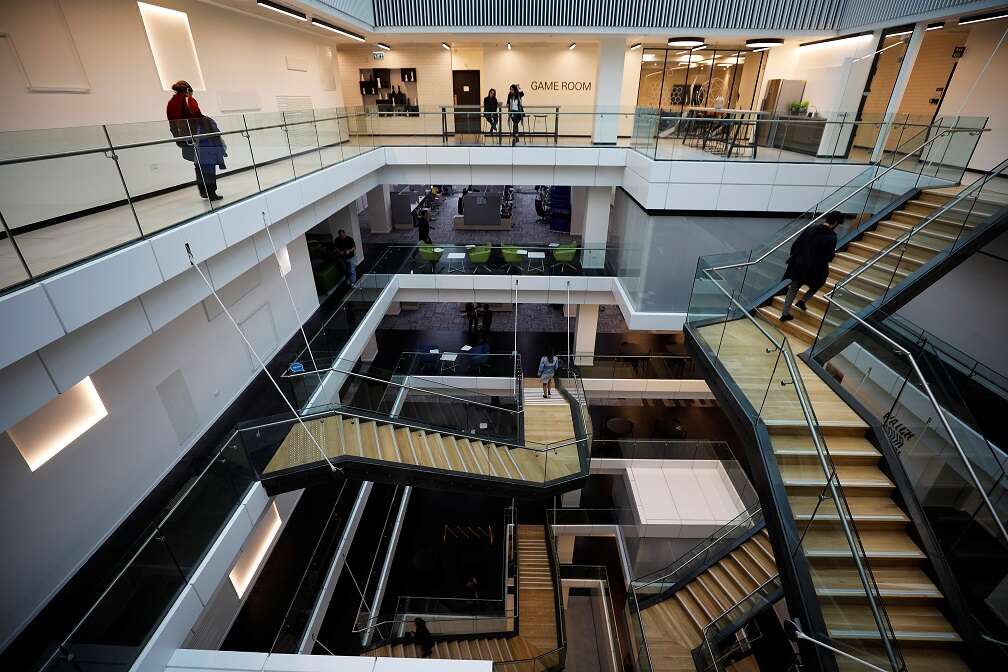
An indoors view of Intel's "smart building" in Petah Tikva (Reuters/Amir Cohen) | Photo: Reuters/Amir Cohen

Share on FacebookShare on Twitter

Intel Corporation is investing heavily in "smart buildings" in Israel that will be full of perks to keep employees happy, helping the US chipmaker compete for the country's top professionals.

Intel, one of the biggest employers and exporters in Israel, plans to invest $11 billion to build a manufacturing facility in the country, where some of its most advanced technologies have been hatched.

 Follow Israel Hayom on Facebook and Twitter

Home to more startups per capita than any other nation thanks to its advanced military and government support, Israel is suffering from a shortage of talent.

While multinationals like Intel, Apple and Google have snapped up local startups and set up research centers, competition is making it tough to find skilled workers.

Tech companies in Israel were unable to fill about 17,000 positions in 2018, according to Start-Up National Central, a nonprofit research organization, and that figure continues to climb.

An indoors view of Intel's "smart building" in Petah Tikva (Reuters/Amir Cohen)

To address this gap and lure talent, Intel has upped the ante at its new development center in the city of Petah Tikva in central Israel. Replete with environmentally friendly systems, a smart gym and massage parlor, the structure also has 14,000 sensors that monitor motion, light and air to make sure workers are comfortable.

If these efforts give Intel an edge in hiring, rival companies are expected to follow suit.

"Anything you offer as a perk, whether it's a gym membership or a paperless work environment or additional days for maternity leave or a go-green policy, all of these things are going to help you," said David Gantshar, chief executive of California-based Shepherd Search Group.

Intel's box-shaped, 10-story building is covered in glass and will accommodate up to 2,700 of its local 13,000 workforce.

The company declined to comment on how much it spent on the development center. Israeli media reported a cost of NIS 650 million ($188 million).

David Hareli, deputy CEO of Afcon Holdings, which constructed the building, said it was a challenge to finish the project within Intel's three-year timetable.

Originally designed to be seven stories high, Intel asked to add three floors. Once the contract was signed, Intel asked for LEED Platinum certification, the highest standard of green construction, rather than the lesser gold level.

This required a double-skin facade to improve ventilation and prevent the building from heating up under the strong Middle Eastern sun.

Architect Dagan Mochli, who designed the building, said he was working on a new development center for Intel in the northern city of Haifa that will also be smart and LEED Platinum.

He called Intel's building a "breakthrough," with demand growing among clients for similar structures. He is planning a smart 15,000-square-meter banking campus in Israel as well as a 240,000-square-meter smart biotech park in China.

Smart travel

The building has an open-space format. An atrium in the center is roofed by skylights, and caps the five top floors. Health-conscious employees often use the internal stairs in the atrium instead of the elevator.

For those seeking seclusion, there are small soundproof rooms and noise-insulated armchairs near the windows.

The 14,000 sensors – twice the number found in similar buildings, according to company officials

Intel Israel CEO Yaniv Garty (Reuters/Amir Cohen)

– detect when someone enters a room and adjust the lighting and air conditioning.

For example, when carbon dioxide levels rise, fresh air is introduced to keep people energetic.

The sensors and corresponding app can also help employees find the best way to travel to and from work and let them know which of the building's three restaurants has room during lunch. The app lets workers alert other staff as to their whereabouts.

Not everybody was excited about the new workspace. Some employees anonymously complained on an Israeli news website about a lack of privacy.

Intel Israel CEO Yaniv Garty said the tracking and collection of data is on an opt-in basis.

"We don't ask people to clock in or clock out. We believe in a relationship which is based on output," Garty said.

Ido Melamed, a hardware engineer who has worked at Intel for 16 years, moved to the new building from an office with cubicles. He said the benefits outweigh the disadvantages.

"We see each other, we can talk more openly and collaborate more effectively," Melamed said. "There is real trust between the company and employees that the data [collected] is used for the right purposes."

Tags: AppleGoogleIntelIsrael

Related Posts

Two tech giants announce Israel layoffs

Two tech giants announce Israel layoffs

by Shachar Shapiro and Nitzan Cohen

Website-building giant Wix announced painful cuts of 20% of its workforce in a dramatic Zoom call this morning. At the...

TASE crashes, bank stocks down 5%

Investors see Israel as less risky despite Iran War

by Nitzan Cohen

The index compiled by Henley & Partners, the world’s largest firm for investment migration, and AlphaGeo shows that risk is...

Why philanthropy should be managed like an exit

Why philanthropy should be managed like an exit

by Maya Natan Mozer

Modern philanthropy is not a question of generosity, but of management. Just as business capital is managed carefully, separating decision-making...

Menu

Analysis 

Archaeology

Blogpost

Business & Finance

Culture

Exclusive

Explainer

Environment


Features

Health

In Brief

Jewish World

Judea and Samaria

Lifestyle

Cyber & Internet

Sports


Diplomacy 

Iran & The Gulf

Gaza Strip

Politics

Shopping

Terms of use

Privacy Policy

Submissions

Contact Us

About Us

The first issue of Israel Hayom appeared on July 30, 2007. Israel Hayom was founded on the belief that the Israeli public deserves better, more balanced and more accurate journalism. Journalism that speaks, not shouts. Journalism of a different kind. And free of charge.

All rights reserved to Israel Hayom

Hosted by sPD.co.il

  • Home
  • News
    • Israel at War
    • Israel
    • United States
    • Middle East
    • Sports
  • Opinions
  • Jewish World
    • Archaeology
    • Antisemitism
  • Lifestyle
    • Food
    • Travel
    • Fashion
    • Culture
  • Magazine
    • Feature
    • Analysis
    • Explainer
    • Environment & Wildlife
    • Health & Wellness
  • In Memoriam
  • Subscribe to Newsletter
  • Submit your opinion
  • Terms and conditions

All rights reserved to Israel Hayom

Hosted by sPD.co.il

Newsletter

[contact-form-7 id=”508379″ html_id=”isrh_form_Newsletter_en” title=”newsletter_subscribe”]

  • Home
  • News
    • Israel at War
    • Israel
    • United States
    • Middle East
    • Sports
  • Opinions
  • Jewish World
    • Archaeology
    • Antisemitism
  • Lifestyle
    • Food
    • Travel
    • Fashion
    • Culture
  • Magazine
    • Feature
    • Analysis
    • Explainer
    • Environment & Wildlife
    • Health & Wellness
  • In Memoriam
  • Subscribe to Newsletter
  • Submit your opinion
  • Terms and conditions

All rights reserved to Israel Hayom

Hosted by sPD.co.il