Israel Hayom is a media organization founded on the belief that the Israeli public deserves better journalism—more balanced, more accurate, and more reliable. Journalism that speaks rather than shouts. Journalism that is trustworthy, objective, and matter-of-fact. A different kind of journalism, offered free of charge. The first print edition was published on July 30, 2007, and in 2010 Israel Hayom became the Israeli newspaper with the highest weekday readership. The newspaper’s publisher is Dr. Miriam Adelson. Its Editor-in-Chief is Omar Lachmanovitch, and its founding editor is Amos Regev. Israel Hayom’s Hebrew and English websites, as well as its Android and iOS applications, provide around-the-clock news coverage, exclusive content, breaking news and updates, analysis and commentary, video, podcasts, and live broadcasts. The digital platforms of Israel Hayom include news and opinion channels covering culture and entertainment, lifestyle, technology, sports, business and consumer affairs, health, military affairs, food, Judaism, tourism, and automobiles. In 2021, a new Hebrew-language website and mobile application were launched to provide users with a fast, up-to-date, secure, and convenient experience. The content of the newspaper’s print edition is also available online through a daily digital edition and can be received via newsletter. “The Israel Hayom Clique,” the publication’s exclusive benefits club, offers website users discounts and special promotions on products and services. Israel Hayom welcomes feedback, criticism, and suggestions for improvement from its readers. You can contact the organization by email at hayom@israelhayom.co.il

Tuesday Oct 20, 2026
NEWSLETTER
www.israelhayom.com
  • Home
  • News
    • Israel
    • Israel at War
    • Middle East
    • United States
  • Opinions
  • Jewish World
    • Archaeology
    • Antisemitism
  • Lifestyle
    • Food
    • Travel
    • Fashion
    • Culture
  • Magazine
    • Feature
    • Analysis
    • Explainer
  • In Memoriam
www.israelhayom.com
Home Analysis

In Israel and beyond, COVID vaccines spell political power

Forget about oil and arms. Coronavirus vaccines are emerging as the newest currency of choice in the Middle East.

by  AP and ILH Staff
Published on  02-22-2021 12:01
Last modified: 02-22-2021 10:47
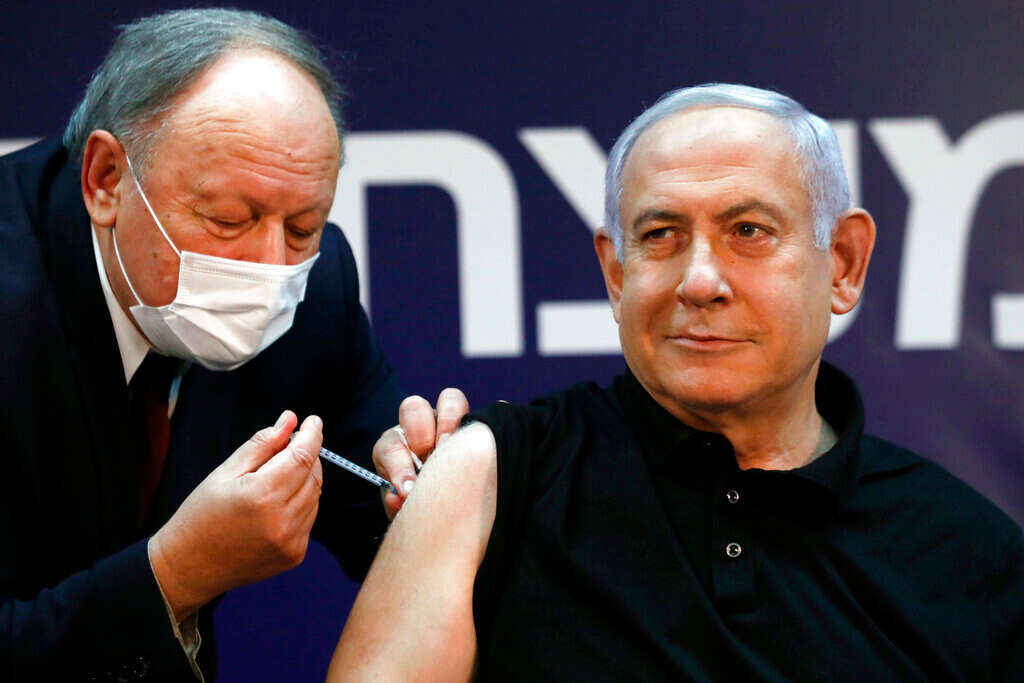
'A small jab for man, a huge step for health': Netanyahu receives COVID vaccine

PM Benjamin Netanyahu receives a coronavirus disease (COVID-19) vaccine at Sheba Medical Center in Ramat Gan, Dec. 20, 2020 (Amir Cohen/Pool via AP)

Share on FacebookShare on Twitter

Forget about oil and arms. Coronavirus vaccines are emerging as the newest currency of choice in the Middle East.

Follow Israel Hayom on Facebook and Twitter 

Israel's reopening of its economy, combined with a murky prisoner swap with Syria and the arrival of a batch of vaccines in the Gaza Strip, have all underscored how those with access to the vaccines have political power in the turbulent region.

Prime Minister Benjamin Netanyahu has been at the forefront of this trend, pinning his re-election hopes on the success of his campaign to vaccinate Israel's adult population. At the same time, he has offered rewards to those who vaccinate and punishments to those who don't.

Israel has jumped out to the world's fastest vaccination campaign, administering at least one dose to more than half its 9.3 million people and the required two doses to about a third in less than two months. In contrast to the long waits seen in Europe and the US, vaccines are plentiful and available almost on demand to anyone who wants one. Clinics have even offered free food and cappuccinos to help lure reluctant holdouts to come in and get the jab.

Netanyahu's efforts finally seem to be bearing fruit, and the number of new coronavirus infections and serious cases is dropping. That enabled the government on Sunday to lift a number of restrictions, reopening stores, shopping malls, and many schools after a two-month lockdown. In the coming weeks, all schools and restaurants are expected to reopen, just in time for the March 23 election.

"The timing is good for him," said Gideon Rahat, a political scientist at Israel's Hebrew University.

Much will depend on Netanyahu's "agenda setting," Rahat said. "He will talk about the vaccines all the time," he said, while others will focus on his missteps over the past year.

Hundreds of thousands of people have lost their jobs and businesses during a series of lockdowns, and there is widespread public anger over the flouting of lockdown restrictions by the ultra-Orthodox religious community, one of Netanyahu's key political allies. Many say Netanyahu waited too long to close the country's main airport, allowing fast-spreading variants of the virus to infect the unvaccinated.

Netanyahu on Saturday unveiled his "green pass" program, which will allow the fully vaccinated to attend cultural events, fly abroad and patronize restaurants and health clubs. These services and amenities will remain off-limits for those who do not get immunized.

"I ask everyone who has not been vaccinated – go be vaccinated. You will have the Green Pass and you will also be able to benefit from it," Netanyahu said.

Israel has faced international criticism for largely excluding Palestinians in the West Bank and Gaza Strip from the vaccination campaign. Yet Netanyahu reportedly showed little hesitation in agreeing to pay Russia some $1.2 million to buy coronavirus vaccines for archenemy Syria as part of a deal last week to release an Israeli woman held captive in Damascus.

Netanyahu boasted last week that his warm ties with Russian President Vladimir Putin helped clinch the deal. His office made no mention of any vaccines and reportedly pushed the country's military censor to block the vaccine purchases.

Asked about the reported deal, Netanyahu said "not one Israeli vaccine" was delivered to Syria – a country that harbors hostile Iranian forces. But he would not say whether Israel had paid Russia for the vaccines.

"It is legitimate for the Israeli government to decide to deviate from past norms and to pay with another form of currency," Yoav Limor, an Israel military affairs correspondent, wrote in Israel Hayom. "However, the decision to hide that is baffling and worrisome. Obviously, someone was very uncomfortable with having that matter come to light."

Yet Netanyahu does not appear to be deterred. An Israeli official said Sunday that Israel is considering sharing surplus vaccines with friendly nations.

The disparities between Israel's successful vaccination push with its own population and the Palestinians have drawn criticism from UN officials and rights groups, which contend that Israel is responsible for vaccinating the Palestinians, while Israel has argued that under interim peace agreements it is not responsible for vaccinating them.

Israel's vaccination campaign has included its own Arab population.

Palestinian Authority President Mahmoud Abbas has struggled to secure vaccines for his people. So far, he has received 2,000 doses from Israel to treat medical workers in the West Bank, and 10,000 doses from Russia.

One of Abbas' main rivals on Sunday orchestrated the delivery of 20,000 doses of the Russian Sputnik V vaccine from the United Arab Emirates. The move by Mohammed Dahlan, a former Abbas aide forced into exile after a falling out with the Palestinian leader, appeared to be aimed in part at making Abbas appear weak ahead of parliamentary elections scheduled in May.

Dahlan, who is backing a list of supporters in the election, "boosted his position and political presence" with the delivery, said Mustafa Ibrahim, a Gaza-based writer. "It's part of the campaigning and empowers the group that delivers the aid."

Subscribe to Israel Hayom's daily newsletter and never miss our top stories!
Related Posts

Behind the Yellow Line, Hamas is already preparing for the next phase

Behind the Yellow Line, Hamas is already preparing for the next phase

by Shachar Kleiman

Three years after the October 7 attack, Hamas is fighting to survive the war to face the day after. As...

Aryeh Amidror, the man who failed to sound the alarm

Aryeh Amidror, the man who failed to sound the alarm

by Itay Ilnai

When the Nukhba terrorists' SIM cards came online in the middle of the night, he was unfazed. When NCO V....

Not by air or sea: The new way Israel could take on the Houthis

Not by air or sea: The new way Israel could take on the Houthis

by Dr. Yossi Mansharof and Noa Lazimi

The terrorist organization's growing strength and the weakening regional response demand new ways of confronting the threat from Yemen. Alongside...

Menu

Analysis 

Archaeology

Blogpost

Business & Finance

Culture

Exclusive

Explainer

Environment


Features

Health

In Brief

Jewish World

Judea and Samaria

Lifestyle

Cyber & Internet

Sports


Diplomacy 

Iran & The Gulf

Gaza Strip

Politics

Shopping

Terms of use

Privacy Policy

Submissions

Contact Us

About Us

The first issue of Israel Hayom appeared on July 30, 2007. Israel Hayom was founded on the belief that the Israeli public deserves better, more balanced and more accurate journalism. Journalism that speaks, not shouts. Journalism of a different kind. And free of charge.

All rights reserved to Israel Hayom

Hosted by sPD.co.il

  • Home
  • News
    • Israel at War
    • Israel
    • United States
    • Middle East
    • Sports
  • Opinions
  • Jewish World
    • Archaeology
    • Antisemitism
  • Lifestyle
    • Food
    • Travel
    • Fashion
    • Culture
  • Magazine
    • Feature
    • Analysis
    • Explainer
    • Environment & Wildlife
    • Health & Wellness
  • In Memoriam
  • Subscribe to Newsletter
  • Submit your opinion
  • Terms and conditions

All rights reserved to Israel Hayom

Hosted by sPD.co.il

Newsletter

[contact-form-7 id=”508379″ html_id=”isrh_form_Newsletter_en” title=”newsletter_subscribe”]

  • Home
  • News
    • Israel at War
    • Israel
    • United States
    • Middle East
    • Sports
  • Opinions
  • Jewish World
    • Archaeology
    • Antisemitism
  • Lifestyle
    • Food
    • Travel
    • Fashion
    • Culture
  • Magazine
    • Feature
    • Analysis
    • Explainer
    • Environment & Wildlife
    • Health & Wellness
  • In Memoriam
  • Subscribe to Newsletter
  • Submit your opinion
  • Terms and conditions

All rights reserved to Israel Hayom

Hosted by sPD.co.il