Recent reports suggest that the United States is disturbed by aspects of the Israeli-Iranian shadow war raging across the region – in this case, at sea. It seems reasonable to conclude that Washington is trying to lower tensions it fears can spoil attempts to negotiate a new nuclear agreement with Tehran.
Follow Israel Hayom on Facebook and Twitter
American sources told The Wall Street Journal in recent days that since 2019, Israel allegedly attacked 12 ships illegally carrying Iranian oil to Syria, using weapons such as limpet mines to damage the vessels.
The report came amid signs of a possible escalation between Israel and Iran on the seas, suggesting that the information was designed to send a signal to Israel to cool down the alleged maritime operations.
It also surfaced at about the time Iran accused Israel of attacking an Iranian container ship in the eastern Mediterranean Sea last week named the Shahr e Kord, causing a fire.
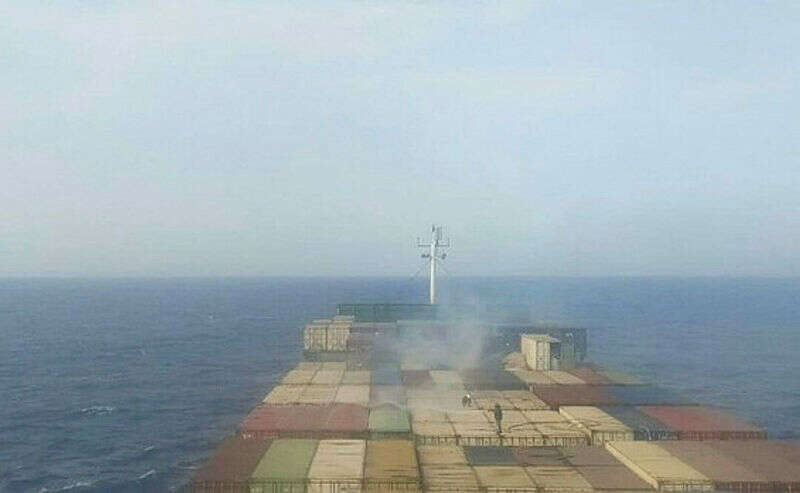
That attack came days after Israel said Iran was behind an attack on an Israeli-owned cargo ship, the MV Helios Ray, in the Gulf of Oman.
Israel's alleged covert campaign at sea is part of a much larger campaign, dubbed by the defense establishment as the "campaign between the wars," designed to prevent the radical Iranian axis from building up its military and terrorist power in the region but to do so without crossing the threshold of regional war.
It is a delicate balancing act that has enabled Israel to curb alarmingly ambitious Iranian schemes, pioneered by the former Islamic Revolutionary Guard Corps' Quds Force commander Qassem Soleimani, to use the air, land and sea to flood Syria, Lebanon, Iraq and other areas with precision-guided missiles, weapons factories, well-armed militias and the creation of new "rings of fire" around Israel.
Jerusalem has created a powerful intelligence-gathering machine that is able to detect many of these activities in real-time and disrupt them, using an array of precision airstrikes, special operations, cyber technology and other means. Most of these activities remain hidden from public view.
Cash payments from Damascus to Beirut
So why have oil tankers that are moving Iranian oil to Syria become an alleged target?
According to a recent analysis by Yediot Aronoth's veteran military analyst Ron Ben-Yishai, Iranian oil-smuggling to Syria began even before the Trump administration placed sanctions on Iranian oil exports in May 2018 (when Trump withdrew from the former nuclear agreement), and before the United States slapped sanctions on Syrian President Bashar Assad and his regime for its countless war crimes.
However, since May 2018, when the Iranians faced restrictions on transferring funds through the international financial network, they faced a new obstacle: How to get paid for smuggled oil to countries such as Syria?
They found a work-around: The Assad regime began paying its oil debts directly to Iran's proxy Hezbollah, enabling Iran to launder its terror financing in new, convenient ways, and to continue its backing of Hezbollah's force build-up programs, according to Ben-Yishai.
To get around America's Caesar Act, which bans international transactions with Syrian banks, as well as with Lebanese banks that work with their Syrian counterparts, the Assad regime was able to smuggle cash payments from Damascus to Beirut with ease.
As part of this scheme, oil tankers are loaded up at Iranian ports in the Persian Gulf or at Qeshm island in the Strait of Hormuz and then proceeded to sail via various routes toward the Syrian coastline, where, while still at sea, they rendezvous with Syrian ships and transfer their oil cargo, or alternatively, directly dock at Syria's Latakia or Tartus ports and unload their oil cargo.
With these journeys forming a key part of Iran's radical axis financing, Israel may have decided that as part of its campaign between the wars, it was time to disrupt this Hezbollah financing channel.
The Iranians, likely fed up with such operations, retaliated at the end of February by targeting the Israeli-owned cargo ship, and Israel may have decided to boost its own deterrence by targeting the Shahr e Kord in response.
'Part of Iranian pirate activities to circumvent sanctions'
This apparent escalation seems to have set off alarm bells in the Biden administration, likely resulting in the leaked information to the Wall Street Journal about this previously unknown aspect of the campaign between the wars.
A question that remains unanswered is how the ecological disaster caused by an oil spill off the Israeli coastline in late February – which has been linked by Israel's Environmental Protection Ministry to a ship illegally smuggling oil from Iran to Syria – fits into this picture.

Environmental Protection Minister Gila Gamliel said Iran was behind the spill, accusing it of "ecological terrorism," though Israel's defense establishment has not confirmed this is indeed the case.
Meanwhile, dispelling rumors that Israel itself was accidentally responsible for the spill as part of its campaign against Iranian oil tankers, Defense Minister Benny Gantz firmly dismissed this theory.
Presumably relying on an array of intelligence reports, Gantz said on Sunday, "I can tell you emphatically that Israel is not responsible for the oil spill that caused the considerable damage along the coast."
The cause of the spill, therefore, remains a mystery.
"We are moving into the water arena. This is one of the arenas of conflict between Iran and Israel," Professor Uzi Rabi, director of the Moshe Dayan Center for Middle Eastern and African Studies at Tel Aviv University, observed on Sunday.
Subscribe to Israel Hayom's daily newsletter and never miss our top stories!
"This is part of Iran's pirate activities at sea to circumvent sanctions and sell oil," he said, adding that Hezbollah and Iranian militias in Syria gain the return benefit.
The wider context, he said, is that Iran is gathering negotiating "bargaining chips" ahead of talks with Washington. Describing the "Iranian paradox," Rabi said that "the worse things are inside Iran, the more they 'purchase' bargaining chips on the outside."
As the region waits to see how Washington and Tehran engage, Israel's defensive shadow war can be expected to continue, even though it might be adjusted to avoid angering America at this sensitive time.
Reprinted with permission from JNS.org.