Israel Hayom is a media organization founded on the belief that the Israeli public deserves better journalism—more balanced, more accurate, and more reliable. Journalism that speaks rather than shouts. Journalism that is trustworthy, objective, and matter-of-fact. A different kind of journalism, offered free of charge. The first print edition was published on July 30, 2007, and in 2010 Israel Hayom became the Israeli newspaper with the highest weekday readership. The newspaper’s publisher is Dr. Miriam Adelson. Its Editor-in-Chief is Omar Lachmanovitch, and its founding editor is Amos Regev. Israel Hayom’s Hebrew and English websites, as well as its Android and iOS applications, provide around-the-clock news coverage, exclusive content, breaking news and updates, analysis and commentary, video, podcasts, and live broadcasts. The digital platforms of Israel Hayom include news and opinion channels covering culture and entertainment, lifestyle, technology, sports, business and consumer affairs, health, military affairs, food, Judaism, tourism, and automobiles. In 2021, a new Hebrew-language website and mobile application were launched to provide users with a fast, up-to-date, secure, and convenient experience. The content of the newspaper’s print edition is also available online through a daily digital edition and can be received via newsletter. “The Israel Hayom Clique,” the publication’s exclusive benefits club, offers website users discounts and special promotions on products and services. Israel Hayom welcomes feedback, criticism, and suggestions for improvement from its readers. You can contact the organization by email at hayom@israelhayom.co.il

Wednesday Sep 23, 2026
NEWSLETTER
www.israelhayom.com
  • Home
  • News
    • Israel
    • Israel at War
    • Middle East
    • United States
  • Opinions
  • Jewish World
    • Archaeology
    • Antisemitism
  • Lifestyle
    • Food
    • Travel
    • Fashion
    • Culture
  • Magazine
    • Feature
    • Analysis
    • Explainer
  • In Memoriam
www.israelhayom.com
  • Home
  • News
    • Israel
    • Israel at War
    • Middle East
    • United States
  • Opinions
  • Jewish World
    • Archaeology
    • Antisemitism
  • Lifestyle
    • Food
    • Travel
    • Fashion
    • Culture
  • Magazine
    • Feature
    • Analysis
    • Explainer
  • In Memoriam
www.israelhayom.com
Home Analysis

Can Hezbollah's loyalty to Iran be shaken?

In the event of an Israeli strike on Iran, Hezbollah leader Hassan Nasrallah is expected to follow any orders by his patrons on Tehran as it wields both religious and financial power over his organization.

by  Yaakov Lappin , JNS and ILH Staff
Published on  12-29-2021 08:10
Last modified: 12-29-2021 08:10
Report: Hezbollah leader wants to torpedo probe of Beirut blastAFP via Al-Manar

Hezbollah leader Sheikh Hassan Nasrallah | File photo: AFP via Al-Manar

Share on FacebookShare on Twitter

While Israel has refrained from publicly setting clear red lines to act as precise markers for a threshold that, if surpassed by Iran's nuclear program, would trigger an Israeli attack, it is clear that Jerusalem has been sending warning signals about Iran's approach towards the danger zone.

Follow Israel Hayom on Facebook and Twitter 

These warnings appear, in part, to be growing louder in the vacuum left behind of a lack of a credible American military threat in the event of an Iranian decision to break out to a nuclear weapon, and Washington's priority of pivoting towards superpower competition with China and Russia.

As Israel's warning grows louder, and Iran's nuclear program continues to make progress – particularly in the area of uranium enrichment, and the centrifuges that enable it – it is natural to wonder about the multiple scenarios that a theoretical Israeli future strike could lead to.

History has demonstrated that the course of wars is not deterministic, and the question of what would follow an Israeli strike on Iranian nuclear sites is no different.

However, some contingencies appear to be more likely than others. The Israel Defense Forces, in its stepped-up planning for contingencies, must build up its readiness for them all, and particularly for the most severe one.

The key question is whether Hezbollah leader Hassan Nasrallah will launch a full-scale assault on Israel from Lebanon if he receives the order from Iranian Supreme Leader Ayatollah Khamenei to do so.

In light of the fact that Hezbollah poses the number one conventional military threat to Israel today, and that any multi-front conflict would be dominated by the Lebanese arena due to Hezbollah's enormous arsenal of projectiles, this question is a top priority issue for the Israeli defense establishment's planners.
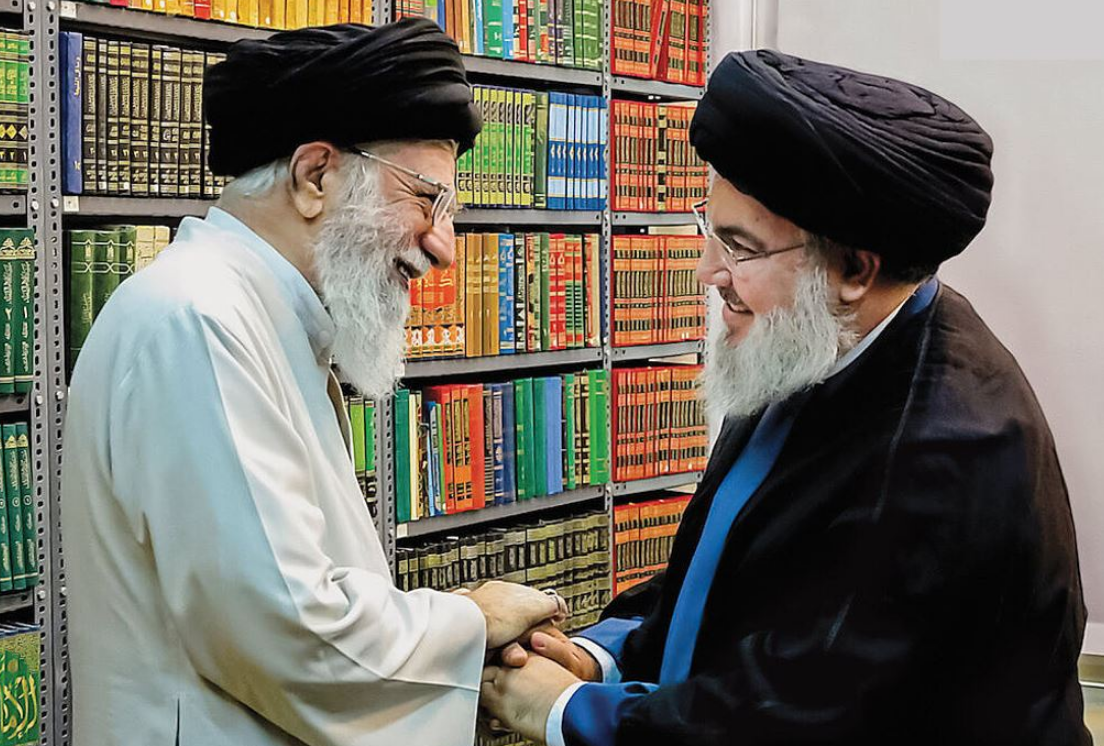
Irianian leader Ayatollah Ali Khamenei with Hezbollah leader Hassan Nasrallah in Tehran (Screenshot/File) Khamenei.ir

It is impossible to imagine a scenario in which Nasrallah would reject an Iranian directive to act in retaliation. The next question centers around the scope of that retaliation. Should Iran instruct Hezbollah to enter into a full-scale conflict with Israel, it would be difficult to imagine Nasrallah turning this down as well.

A highly religious man, Nasrallah should be expected to follow through on the orders of the Iranian "mothership," which is not only the source of Hezbollah's radical Shi'ite Islamist ideology, but also its funding and force build-up.

After all, it was Iran that sent Hezbollah into the bloody battlefields of Syria for years. Any hopes that Nasrallah would limit Hezbollah's response to an Israeli attack on Iran should therefore not guide Israeli policy, planning or resource allocation.

It is difficult to gage how seriously Khamenei is taking current Israeli threats about the consequence of further nuclear progress – but as Israel continues to enhance its long-range military capabilities, and its readiness for full-scale conflict with Iran and all of its proxies simultaneously, Jerusalem's posture in Iranian eyes will be more difficult to dismiss.

The IDF has received billions of shekels to improve its Iran strike capabilities, and the Israeli Air Force has placed this capability at the top of its entire agenda for the year 2022.

What the IAF is also doing is planning how it will be able to engage Iran and its proxies across Lebanon, Syria, western Iraq and elsewhere. The IDF's ground forces, meanwhile, are focusing their war training on the Lebanese arena, which would suffer unprecedented levels of Israeli firepower in the event of general conflict, taking Lebanon decades back in time.

Despite the high-pressure messaging, the decision junction is not yet imminent. Although Iran has made great progress on amassing fissile material, it is still more than a year away from completing other aspects needed for nuclear weapons, such as having a proven nuclear explosive mechanism, and being able to place it on a missile warhead.

Still, the fissile material stockpiling is the most challenging aspect of building the bomb, and Iran's progress, in addition to its build-up of technological knowledge, is alarming.

Since the Iranian nuclear program is the only threat that could prove existential if left unchecked, it is the number one priority for the Israeli defense establishment, overtaking the threat posed by Iran's regional entrenchment program, which is the target of an extensive Israeli grey zone "lawnmowing" campaign, particularly in Syria.

Subscribe to Israel Hayom's daily newsletter and never miss our top stories!

Building an updated long-range Iran strike option is not something the IAF will do overnight, but the project has certainly begun in earnest.

The mammoth planning has to take into consideration highly complex aspects, including intelligence, the right choice of ammunition, the right combination of jets and refueling configurations, as well as pilot training. There can be no comparison with closer missions that the IAF is used to undertaking.

Former IAF Commander Maj. Gen. (res.) Eitan Ben Eliyahu provided a glimpse into this planning, telling Army Radio last Tuesday, "We're talking about something practical. This isn't about just one specific target – the IAF must be used to operating at distances of 2,000 kilometers. This is a whole ensemble of flight technique and operational planning. One must know emergency airfields for landing on the way, and how to manage fuel differently."

Reprinted with permission from JNS.org.

 

Related Posts

For first time since Ukraine invasion, Russia admits: We are at war

Europe braces for war as Russia tests NATO's red lines

by Dudi Kogan

A CIA warning in Moscow and a wave of cyberattacks and sabotage have put Europe on heightened alert, with fuel...

Iranian axis fractured but not defeated

Iranian axis fractured but not defeated

by Shachar Kleiman

Hezbollah has been weakened, the Houthis grow in confidence, the militias in Iraq are under pressure and pro-Iranian cells are...

Turkey's blood libel against Israel – and the record Ankara hopes you won't checkPresidential Press Service via AP; RONEN ZVULUN / POOL / AFP; Reuters/Umit Bektas

Syria strike was a warning shot to Turkey, and Erdoğan finally got it

by Meir Ben Shabbat

Turkey's quiet push to entrench itself near Aleppo forced Israel's hand. The strike worked, and now is not the time...

Menu

Analysis 

Archaeology

Blogpost

Business & Finance

Culture

Exclusive

Explainer

Environment


Features

Health

In Brief

Jewish World

Judea and Samaria

Lifestyle

Cyber & Internet

Sports


Diplomacy 

Iran & The Gulf

Gaza Strip

Politics

Shopping

Terms of use

Privacy Policy

Submissions

Contact Us

About Us

The first issue of Israel Hayom appeared on July 30, 2007. Israel Hayom was founded on the belief that the Israeli public deserves better, more balanced and more accurate journalism. Journalism that speaks, not shouts. Journalism of a different kind. And free of charge.

All rights reserved to Israel Hayom

Hosted by sPD.co.il

  • Home
  • News
    • Israel at War
    • Israel
    • United States
    • Middle East
    • Sports
  • Opinions
  • Jewish World
    • Archaeology
    • Antisemitism
  • Lifestyle
    • Food
    • Travel
    • Fashion
    • Culture
  • Magazine
    • Feature
    • Analysis
    • Explainer
    • Environment & Wildlife
    • Health & Wellness
  • In Memoriam
  • Subscribe to Newsletter
  • Submit your opinion
  • Terms and conditions

All rights reserved to Israel Hayom

Hosted by sPD.co.il

Newsletter

[contact-form-7 id=”508379″ html_id=”isrh_form_Newsletter_en” title=”newsletter_subscribe”]

  • Home
  • News
    • Israel at War
    • Israel
    • United States
    • Middle East
    • Sports
  • Opinions
  • Jewish World
    • Archaeology
    • Antisemitism
  • Lifestyle
    • Food
    • Travel
    • Fashion
    • Culture
  • Magazine
    • Feature
    • Analysis
    • Explainer
    • Environment & Wildlife
    • Health & Wellness
  • In Memoriam
  • Subscribe to Newsletter
  • Submit your opinion
  • Terms and conditions

All rights reserved to Israel Hayom

Hosted by sPD.co.il