Israel Hayom is a media organization founded on the belief that the Israeli public deserves better journalism—more balanced, more accurate, and more reliable. Journalism that speaks rather than shouts. Journalism that is trustworthy, objective, and matter-of-fact. A different kind of journalism, offered free of charge. The first print edition was published on July 30, 2007, and in 2010 Israel Hayom became the Israeli newspaper with the highest weekday readership. The newspaper’s publisher is Dr. Miriam Adelson. Its Editor-in-Chief is Omar Lachmanovitch, and its founding editor is Amos Regev. Israel Hayom’s Hebrew and English websites, as well as its Android and iOS applications, provide around-the-clock news coverage, exclusive content, breaking news and updates, analysis and commentary, video, podcasts, and live broadcasts. The digital platforms of Israel Hayom include news and opinion channels covering culture and entertainment, lifestyle, technology, sports, business and consumer affairs, health, military affairs, food, Judaism, tourism, and automobiles. In 2021, a new Hebrew-language website and mobile application were launched to provide users with a fast, up-to-date, secure, and convenient experience. The content of the newspaper’s print edition is also available online through a daily digital edition and can be received via newsletter. “The Israel Hayom Clique,” the publication’s exclusive benefits club, offers website users discounts and special promotions on products and services. Israel Hayom welcomes feedback, criticism, and suggestions for improvement from its readers. You can contact the organization by email at hayom@israelhayom.co.il

Saturday Oct 10, 2026
NEWSLETTER
www.israelhayom.com
  • Home
  • News
    • Israel
    • Israel at War
    • Middle East
    • United States
  • Opinions
  • Jewish World
    • Archaeology
    • Antisemitism
  • Lifestyle
    • Food
    • Travel
    • Fashion
    • Culture
  • Magazine
    • Feature
    • Analysis
    • Explainer
  • In Memoriam
www.israelhayom.com
  • Home
  • News
    • Israel
    • Israel at War
    • Middle East
    • United States
  • Opinions
  • Jewish World
    • Archaeology
    • Antisemitism
  • Lifestyle
    • Food
    • Travel
    • Fashion
    • Culture
  • Magazine
    • Feature
    • Analysis
    • Explainer
  • In Memoriam
www.israelhayom.com
Home Commentary

Saudi Arabia has no business lecturing on human rights

Before this war, Saudi-Israel normalization seemed within reach. Today, it appears Saudi Arabia has chosen to align with the "axis of evil".

by  Zina Rakhamilova
Published on  11-13-2024 08:00
Last modified: 11-13-2024 12:07
Saudi Arabia has no business lecturing on human rightsAhmed Nureldine/Saudi Press Agency/AFP

Saudi Crown Prince Mohammed bin Salman (L) and Iran's president Ebrahim Raisi (R) attending an emergency meeting of the Arab League and the Organisation of Islamic Cooperation (OIC), in Riyadh, on Nov. 11, 2023 | Photo: Ahmed Nureldine/Saudi Press Agency/AFP

Share on FacebookShare on Twitter

The Abraham Accords brought a hopeful vision for the Middle East's future. This series of normalization agreements, established in 2020, initiated formal diplomatic ties between Israel and several Arab nations, aiming to foster peace and economic cooperation in ways many thought unimaginable in our lifetime. When discussions about potential normalization between Saudi Arabia and Israel began, it seemed as though the region was on the brink of a new era – one that could unite against shared threats (especially from Iran), align with US interests, open doors for economic opportunity, and pave the way for peace between the Jewish and Arab worlds. Unfortunately, that vision now seems far from reality.

Recently, Saudi Arabia hosted The Extraordinary Arab and Islamic Summit in Riyadh, where Arab leaders gathered to address the ongoing conflicts involving Israel, Gaza, and Lebanon.

The Summit's statements were deeply problematic, to say the least. It presented a one-sided narrative, ignoring Israel's pressing security concerns and making no mention of Hamas or Hezbollah – two Iranian proxies that have been targeting Israeli civilians for over a year. Instead, the Kingdom chose to ignore Iran's provocations entirely, with Crown Prince Mohammed bin Salman calling on Israel to "respect the sovereignty of the sisterly Islamic Republic of Iran and not to violate its lands," effectively warning Israel against retaliating.

The Summit also called for the establishment of a Palestinian state along the "lines of June 4, 1967, with east Al-Quds as its capital." This would mean Jews would once again be barred from the Jewish Quarter of Jerusalem, home to the Western Wall and other sites of profound historical and religious importance to the Jewish people.
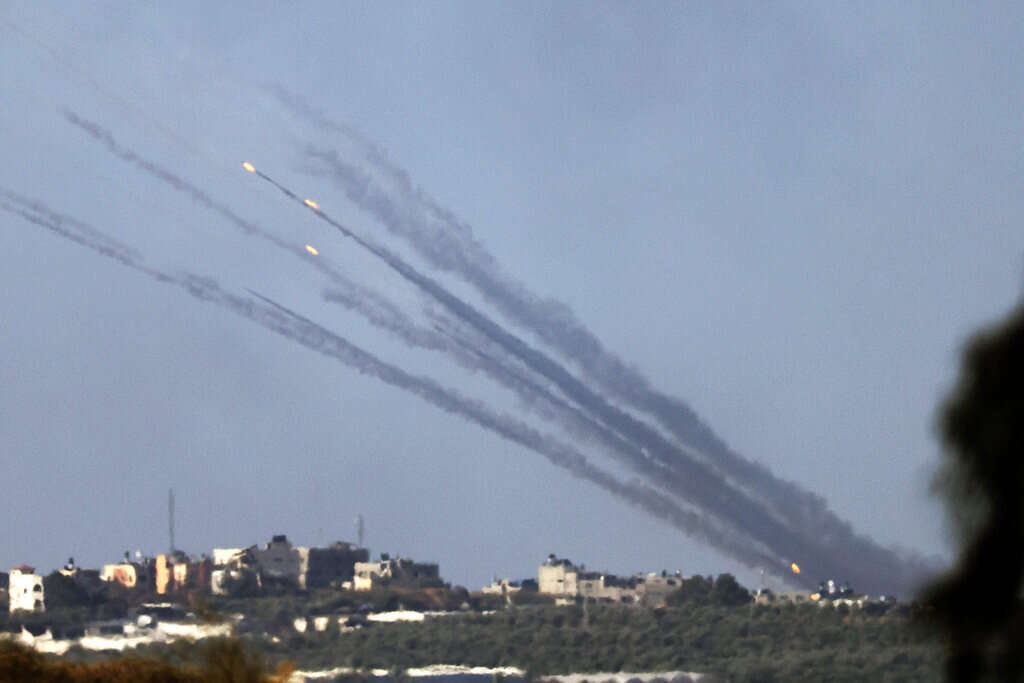
A picture taken from Israel's southern city of Sderot shows rockets fired from northern Gaza towards Israel on October 30, 2023. Photo credit: Jack Guez / AFP AFP

Further, the Summit accused Israel of "genocide," repeating the same propaganda used by Hamas when bin Salman claimed that they condemn and reject "the genocide committed by Israel against the brotherly Palestinian people, which has claimed the lives of 150,000 martyrs, wounded, and missing, most of whom are women and children."

Such statements are, in essence, demanding that Israel reward terrorism by granting Palestinians statehood even after Hamas brutally murdered 1,200 Israeli civilians. They ignore Iran's relentless support for terror against civilians since Oct. 7, 2023. The Summit failed to call on Hezbollah to cease its rocket fire on Israel since the conflict began on Oct. 8, 2023, nor did it urge Hamas to agree to a hostage deal or hold the Palestinian Authority accountable for inciting terror. It called for reparations for Palestinian refugees but failed to mention the nearly 900,000 Jewish refugees expelled from Arab and Islamic lands following Israel's establishment in 1948, who were forced to leave their homes, possessions, and livelihoods. Fair discussion of reparations should include these Jewish communities from the Middle East and North Africa.

While the Summit urged adherence to UN Resolution 1701, it conveniently ignored that Hezbollah has violated this resolution by stationing weapons and digging tunnels near UNIFIL positions. It also condemned Israel for targeting UN peacekeepers, failing to mention that Hezbollah has long exploited the proximity of UNIFIL sites. Though the Summit addressed Gaza's humanitarian crisis, it overlooked Hamas's well-documented diversion of aid, along with their partners at UNRWA, reselling it for profit, reportedly amounting to half a billion dollars.

The issues are many. Before this war, Saudi-Israel normalization seemed within reach. Today, it appears Saudi Arabia has chosen to align with the "axis of evil" by renewing ties with Iran in a China-brokered deal in March 2023.

Nothing about the Summit reflected a balanced view, nor did bin Salman's words chart a realistic path toward peace in the region. Any viable resolution must be balanced, realistic, and address the rights of all parties involved.

Israel remains committed to peace and open dialogue with its regional partners. But it does not need lectures on human rights from oil-rich Arab states, especially when such countries only permitted women to drive as of 2018 and still impose male-guardian restrictions on marriage and travel.
Tags: Gaza WarIsraelSaudi Arabia

Related Posts

Nobel Prize for hypocrisy – the judge redefining genocide to target IsraelAP

Nobel Prize for hypocrisy – the judge redefining genocide to target Israel

by Yuval Elbashan

Navi Pillay once called Israel an echo of apartheid South Africa, and now she is reshaping international law’s definition of...

Israel's standing in America belongs on the election agendaHARLY TRIBALLEAU / AFP

Israel's standing in America belongs on the election agenda

by David Makovsky and Dennis Ross

It is a strategic imperative for the next Israeli government to stop the hemorrhaging of Israel’s position in America. Difficult,...

Flydubai co-pilot allegedly plotted to crash jet into Tel Aviv skyscrapers

Why does terrorism keep catching Israel by surprise?

by Prof. Zaki Shalom and Prof. Kobi Michael

No security system can prevent every act of terrorism, but security depends on asking what we have failed to imagine....

Menu

Analysis 

Archaeology

Blogpost

Business & Finance

Culture

Exclusive

Explainer

Environment


Features

Health

In Brief

Jewish World

Judea and Samaria

Lifestyle

Cyber & Internet

Sports


Diplomacy 

Iran & The Gulf

Gaza Strip

Politics

Shopping

Terms of use

Privacy Policy

Submissions

Contact Us

About Us

The first issue of Israel Hayom appeared on July 30, 2007. Israel Hayom was founded on the belief that the Israeli public deserves better, more balanced and more accurate journalism. Journalism that speaks, not shouts. Journalism of a different kind. And free of charge.

All rights reserved to Israel Hayom

Hosted by sPD.co.il

  • Home
  • News
    • Israel at War
    • Israel
    • United States
    • Middle East
    • Sports
  • Opinions
  • Jewish World
    • Archaeology
    • Antisemitism
  • Lifestyle
    • Food
    • Travel
    • Fashion
    • Culture
  • Magazine
    • Feature
    • Analysis
    • Explainer
    • Environment & Wildlife
    • Health & Wellness
  • In Memoriam
  • Subscribe to Newsletter
  • Submit your opinion
  • Terms and conditions

All rights reserved to Israel Hayom

Hosted by sPD.co.il

Newsletter

[contact-form-7 id=”508379″ html_id=”isrh_form_Newsletter_en” title=”newsletter_subscribe”]

  • Home
  • News
    • Israel at War
    • Israel
    • United States
    • Middle East
    • Sports
  • Opinions
  • Jewish World
    • Archaeology
    • Antisemitism
  • Lifestyle
    • Food
    • Travel
    • Fashion
    • Culture
  • Magazine
    • Feature
    • Analysis
    • Explainer
    • Environment & Wildlife
    • Health & Wellness
  • In Memoriam
  • Subscribe to Newsletter
  • Submit your opinion
  • Terms and conditions

All rights reserved to Israel Hayom

Hosted by sPD.co.il