Israel Hayom is a media organization founded on the belief that the Israeli public deserves better journalism—more balanced, more accurate, and more reliable. Journalism that speaks rather than shouts. Journalism that is trustworthy, objective, and matter-of-fact. A different kind of journalism, offered free of charge. The first print edition was published on July 30, 2007, and in 2010 Israel Hayom became the Israeli newspaper with the highest weekday readership. The newspaper’s publisher is Dr. Miriam Adelson. Its Editor-in-Chief is Omar Lachmanovitch, and its founding editor is Amos Regev. Israel Hayom’s Hebrew and English websites, as well as its Android and iOS applications, provide around-the-clock news coverage, exclusive content, breaking news and updates, analysis and commentary, video, podcasts, and live broadcasts. The digital platforms of Israel Hayom include news and opinion channels covering culture and entertainment, lifestyle, technology, sports, business and consumer affairs, health, military affairs, food, Judaism, tourism, and automobiles. In 2021, a new Hebrew-language website and mobile application were launched to provide users with a fast, up-to-date, secure, and convenient experience. The content of the newspaper’s print edition is also available online through a daily digital edition and can be received via newsletter. “The Israel Hayom Clique,” the publication’s exclusive benefits club, offers website users discounts and special promotions on products and services. Israel Hayom welcomes feedback, criticism, and suggestions for improvement from its readers. You can contact the organization by email at hayom@israelhayom.co.il

Tuesday Jul 7, 2026
NEWSLETTER
www.israelhayom.com
  • Home
  • News
    • Israel
    • Israel at War
    • Middle East
    • United States
  • Opinions
  • Jewish World
    • Archaeology
    • Antisemitism
  • Lifestyle
    • Food
    • Travel
    • Fashion
    • Culture
  • Magazine
    • Feature
    • Analysis
    • Explainer
  • In Memoriam
www.israelhayom.com
  • Home
  • News
    • Israel
    • Israel at War
    • Middle East
    • United States
  • Opinions
  • Jewish World
    • Archaeology
    • Antisemitism
  • Lifestyle
    • Food
    • Travel
    • Fashion
    • Culture
  • Magazine
    • Feature
    • Analysis
    • Explainer
  • In Memoriam
www.israelhayom.com
Home News Israel Israel at War

Trump says Israel agrees to 2-month ceasefire

Breakthrough has paved the way for Prime Minister Benjamin Netanyahu's upcoming Washington visit next week, although Hamas has yet to agree. The trip primarily aims to celebrate the outcome of the war with Iran and align on further actions.

by  ILH Staff
Published on  07-01-2025 01:38
Last modified: 07-02-2025 13:19
Trump says Israel agrees to 2-month ceasefireAP

President Donald Trump and Prime Minister Benjamin Netanyahu | Photo: AP

Share on FacebookShare on Twitter

Negotiations for a hostage deal are intensifying, with a diplomatic official noting "substantial strides in shaping the American proposal meant to underpin an agreement." Recent hours have seen active discussions on these developments and the question of sending an Israeli delegation to Cairo.

The core obstacle is Hamas' demand for assurances that the ceasefire will persist beyond the initial 60 days. During talks in Washington, Minister of Strategic Affairs Ron Dermer and envoy Steve Witkoff proposed at least two solutions to resolve this issue, with Israel demonstrating significant openness.

On Tuesday, President Donald Trump shared on TRUTH: "My Representatives had a long and productive meeting with the Israelis today on Gaza. Israel has agreed to the necessary conditions to finalize the 60 Day CEASEFIRE, during which time we will work with all parties to end the War. The Qataris and Egyptians, who have worked very hard to help bring Peace, will deliver this final proposal. I hope, for the good of the Middle East, that Hamas takes this Deal, because it will not get better — IT WILL ONLY GET WORSE."

Hamas, in turn, has softened its stance on key issues it once rejected. The terror group agreed to share details on the hostages' status, permit international monitoring of food distribution in its controlled areas, and show flexibility regarding its future role. Yet, talks with senior IDF officials and security experts highlighted fears that the intense pressure on Hamas and its heavy losses could endanger the hostages, driven by anarchy and conflicts with other armed groups and organized clans.

This breakthrough has paved the way for Prime Minister Benjamin Netanyahu's upcoming Washington visit next week. The trip primarily aims to celebrate the outcome of the war with Iran and align on further actions. Should a ceasefire be declared during the visit, it would bolster Trump's global image as a peacemaker and advance Netanyahu's goals of ending the Gaza conflict and expanding the Abraham Accords.

Still, Gaza's challenges persist. Hamas' push for guarantees that the ceasefire will last until the war's end conflicts with Israel's refusal to accept Hamas' terms – disarmament and exile of its leaders. The current proposal postpones these contentious issues to the 60-day ceasefire negotiation period.

Under the ceasefire, 10 living hostages and about 15 bodies will be freed. Eight living hostages will be released early in the ceasefire, with the rest mid-term. In return, Israel will release terrorists from its prisons based on ratios from past deals. Hamas must provide updates on the remaining hostages' health and ensure their well-being. Israel insists on Red Cross visits and medical care, which Hamas has yet to approve.
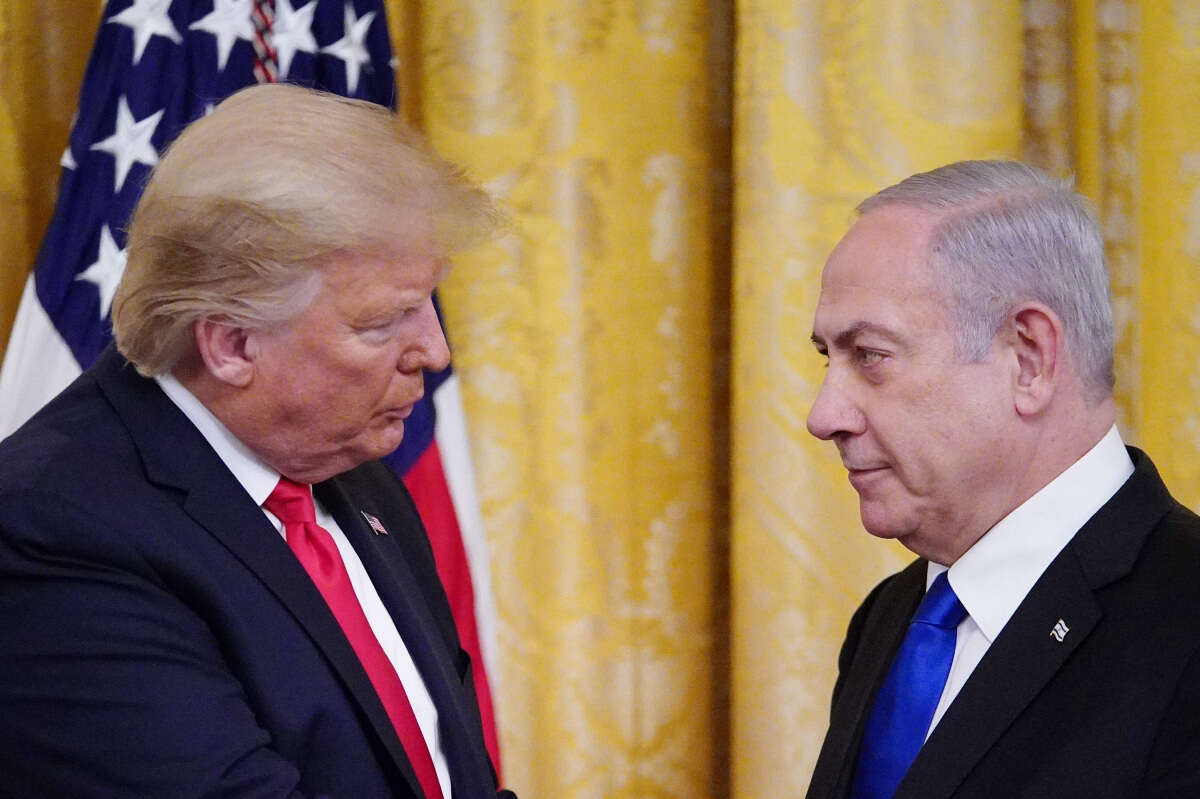
US President Donald Trump and Israel's Prime Minister Benjamin Netanyahu take part in an announcement of Trump's Middle East peace plan in the East Room of the White House in Washington, DC on January 28, 2020 (AFP / Mandel Ngan)

The plan allows for continued and increased aid deliveries to Hamas-controlled areas. Israel demands international supervision to prevent theft by Hamas, a condition Hamas resists, claiming UN personnel should oversee distribution. Hamas accuses Israel of inciting armed clans to steal supplies.

Israel's withdrawal will be phased and limited, tied to progress in final agreement talks. During the 60-day ceasefire, only a minimal pullback will occur, per IDF guidelines. Israel will maintain control over the main borders and routes inside the Gaza Strip, namely, the Philadelphi Corridor, the Morag Axis, the perimeter, and the northern boundary near Sderot.

The second phase envisions a multinational force – including Arab, American, and other troops – taking over security and policing in Gaza. A key hurdle is the refusal of all parties to deploy while Hamas retains its weapons. No consensus exists on the tunnel issue, as Hamas refuses to share maps or surrender heavy arms like rockets, mortars, and explosives.

While progress is notable, caution is warranted. Past ceasefires have emboldened Hamas to stiffen its demands. An Arab official close to Palestinian internal talks notes Hamas' insistence on a role in Gaza's future governance. Meanwhile, Gulf states, particularly Saudi Arabia, are pushing a broader regional deal for enhanced security and stability. With Iran weakened and Qatar treading carefully, opposition to this deal has been weakened.

Tags: 7/2IranIsraelOperation Rising LionTrumpUS

Related Posts

This is what Hamas' disarmament would look like

Hamas rakes in millions, prepares for war

by Lilach Shoval

Direct taxation, control of markets and smuggling are helping Hamas swell its coffers. Funds from abroad are funneled into the...

Hasbara in crisis: How the October 7 massacre is being forgotten Arab Networks

1,000 days of war: Gaza border residents warn Hamas will return

by Shirit Avitan Cohen

The plan to establish humanitarian shelters near Rafah is stirring anger and concern in Gaza border communities. Officials warn: "Any...

'A blow to IDF readiness': Deputy chief of staff issues unusual warningIDF Spokesperson's Unit

'A blow to IDF readiness': Deputy chief of staff issues unusual warning

by Lilach Shoval

Leaked document outlines a 40 billion shekel ($11.1 billion) deficit that military leaders say compromises long-term security, halts defense infrastructure...

Menu

Analysis 

Archaeology

Blogpost

Business & Finance

Culture

Exclusive

Explainer

Environment


Features

Health

In Brief

Jewish World

Judea and Samaria

Lifestyle

Cyber & Internet

Sports


Diplomacy 

Iran & The Gulf

Gaza Strip

Politics

Shopping

Terms of use

Privacy Policy

Submissions

Contact Us

About Us

The first issue of Israel Hayom appeared on July 30, 2007. Israel Hayom was founded on the belief that the Israeli public deserves better, more balanced and more accurate journalism. Journalism that speaks, not shouts. Journalism of a different kind. And free of charge.

All rights reserved to Israel Hayom

Hosted by sPD.co.il

  • Home
  • News
    • Israel at War
    • Israel
    • United States
    • Middle East
    • Sports
  • Opinions
  • Jewish World
    • Archaeology
    • Antisemitism
  • Lifestyle
    • Food
    • Travel
    • Fashion
    • Culture
  • Magazine
    • Feature
    • Analysis
    • Explainer
    • Environment & Wildlife
    • Health & Wellness
  • In Memoriam
  • Subscribe to Newsletter
  • Submit your opinion
  • Terms and conditions

All rights reserved to Israel Hayom

Hosted by sPD.co.il

Newsletter

[contact-form-7 id=”508379″ html_id=”isrh_form_Newsletter_en” title=”newsletter_subscribe”]

  • Home
  • News
    • Israel at War
    • Israel
    • United States
    • Middle East
    • Sports
  • Opinions
  • Jewish World
    • Archaeology
    • Antisemitism
  • Lifestyle
    • Food
    • Travel
    • Fashion
    • Culture
  • Magazine
    • Feature
    • Analysis
    • Explainer
    • Environment & Wildlife
    • Health & Wellness
  • In Memoriam
  • Subscribe to Newsletter
  • Submit your opinion
  • Terms and conditions

All rights reserved to Israel Hayom

Hosted by sPD.co.il