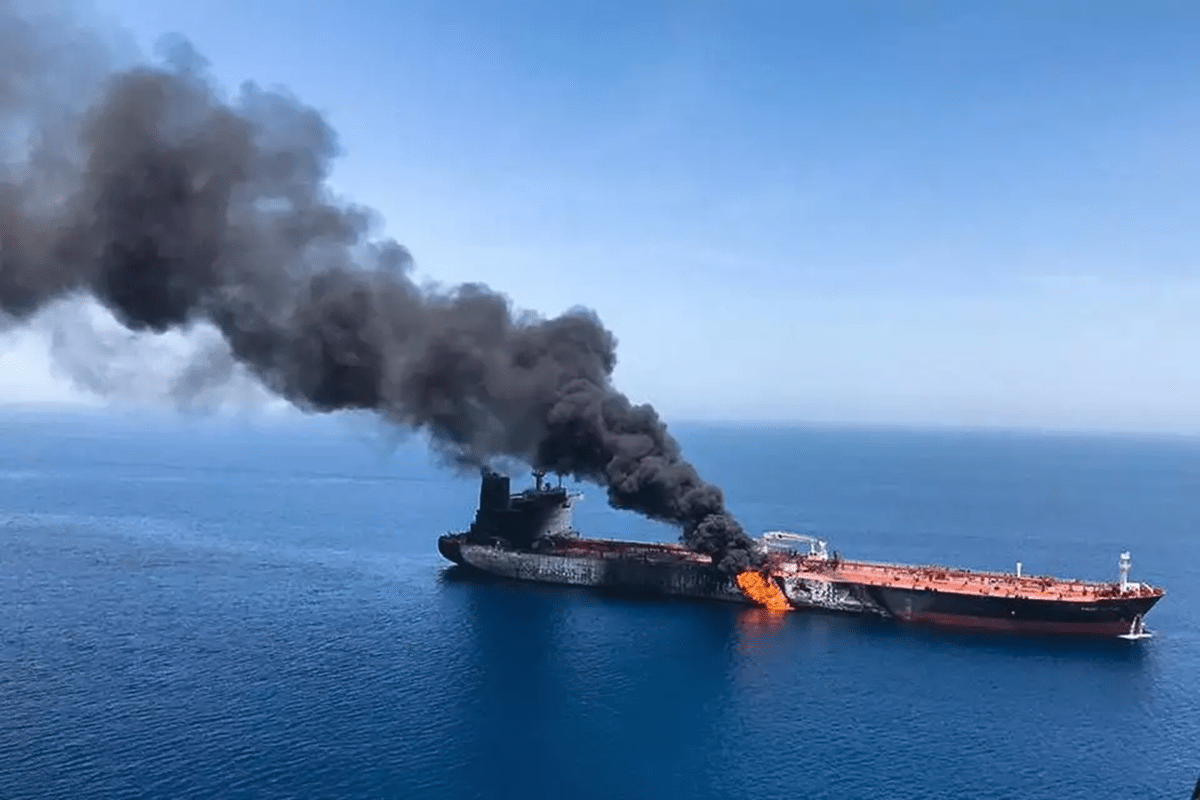
While Israel contends with incoming missiles from Hezbollah and Iran, the central – and perhaps defining – challenge facing the United States in its campaign against Iran plays out on an entirely different stage: the Strait of Hormuz.
The problem is not only the oil and gas trapped in the Persian Gulf by Iranian threats, but also the potential disruption of a critical shipping route for global trade. A forcible closure of the strait could choke the flow of goods from Asia to the Middle East and destabilize energy markets worldwide. A rise in energy prices is already being felt, and a continued trajectory could trigger broader inflation – since a large share of global industry depends on fuel and gas.
Alongside the economic dimension lies a political one. In the United States, voices are being raised – including by President Donald Trump – that the campaign cannot be concluded as long as Iran threatens freedom of navigation through the strait. US Central Command (CENTCOM) commander Vice Adm. Brad Cooper said Monday that "we are focused on dismantling the decades-old threat of closing the Strait of Hormuz."

The most direct way to eliminate that threat would have been a naval confrontation between the United States and Iran – a scenario in which American naval supremacy is unquestioned. But Washington is well aware that even a limited strike on an American vessel could hand Iran a significant psychological victory and damage public morale back home.
For that reason, the US Navy's aircraft carriers and large warships are keeping their distance from the theater, well beyond Iranian strike range. On the eve of the war, Tehran published videos simulating the sinking of American aircraft carriers – but in practice, Western officials emphasize, it is Iran that has absorbed the brunt of Israeli and American airstrikes.
And yet the central question remains unanswered: how can the threat to the Strait of Hormuz be removed without escalating to direct confrontation? Chinese Foreign Ministry spokesman Lin Jian said Monday that Beijing "is in contact with all parties and is committed to promoting calm and de-escalation."
The Chinese position is not new, but overnight, Trump introduced another card – the planned summit between himself and Chinese President Xi Jinping in Beijing, scheduled to open on March 31. In China, that meeting is seen as a major diplomatic event for 2026, and Beijing hopes that agreements with Trump will help address its economic challenges.
Nevertheless, Trump hinted that the summit could be postponed if Beijing does not help resolve the Hormuz crisis. He argued that China and many other countries need the Strait open far more than the United States does – and even suggested that American energy companies could benefit from higher oil prices.

Assessments of China's dependence on Iranian oil vary, but there is no question that freedom of navigation through the strait is of particular importance to its economy. "China has an opportunity here," said Karis Whittie, head of the Signal Institute. Beijing, she said, may try to lead a diplomatic initiative that resolves the crisis without the use of force – a move that would also allow it to claim a major global diplomatic achievement.
"If China manages to mediate between the parties and open the strait, it will earn significant international credit," Whittie said. "For Beijing, being seen as a global mediator capable of resolving crises peacefully is an important strategic goal."
Even so, even if China intervenes, success is not guaranteed. For Iran, the threat to close the Strait of Hormuz is its primary lever of pressure against the United States, and it is therefore unlikely to relinquish it easily. Tehran also claims that the strait is open to countries that maintain relations with it – and that China, therefore, is not directly harmed by the situation.
Despite this, the current impression is that a large share of maritime traffic in the Gulf has been disrupted. One thing is clear: as long as the threat to the Strait of Hormuz is not removed, it is hard to see how the campaign against Iran reaches its conclusion.