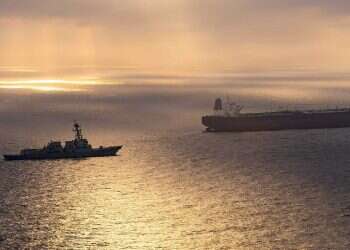
US Central Command (CENTCOM) began enforcing a naval blockade Monday at 5:00 p.m. (Israel time) over all vessels entering and leaving Iranian ports in the Persian Gulf and the Gulf of Oman, covering ships from every nation. US President Donald Trump announced the move following the collapse of peace talks in Islamabad, with the aim of choking off Iranian oil exports and intensifying pressure on Tehran to yield to US demands on its nuclear weapons program and the opening of the Strait of Hormuz.
In an almost absurd twist, the war had, in fact, been good for Iranian oil revenues, which surged 37% compared with the same period the previous year. While Iran benefited from uninterrupted exports and a war-driven spike in global oil prices, its Gulf neighbors saw their revenues collapse.
According to Bloomberg, Tehran earned approximately $139 million a day from oil exports in March, up from $115 million in February. The Islamic Revolutionary Guard Corps had established a "protection corridor" allowing vessels from select countries – including India, Pakistan, and China – to transit the strait in exchange for fees of up to $2 million per ship.

Washington had itself played a role in enabling that revenue stream. In an effort to address shortages in the global energy market and rising fuel prices, the Trump administration lifted sanctions on a portion of Iranian oil held aboard tankers at sea, making it more accessible to international buyers. As part of ongoing negotiations with the US, Iran has been demanding formal recognition of this mechanism's legitimacy. According to an analysis by Miad Malki, a senior fellow at the Foundation for Defense of Democracies (FDD) and a former senior official in the US Treasury Department's sanctions unit, the blockade could inflict economic damage of approximately $435 million a day on Iran – roughly $13 billion a month. Of that total, around $276 million represents losses from blocked exports, including oil, petrochemicals, and other goods. Malki estimates an additional $159 million in economic damage from blocked imports and the disruptions they would cause.
Malki outlined further consequences. A halt to imports would worsen the food crisis, drive up prices, and accelerate the already-collapsing value of the Iranian rial. With limited storage capacity, Iranian oil tankers would fill up in roughly 13 days, potentially forcing the country to shut down oil wells and risking long-term reservoir damage. Malki concluded, "The blockade makes continued resistance economically impossible."

The US has recent experience enforcing a blockade, drawn from its confrontation with Venezuela. There, the Navy deployed camouflaged forces, special operations units, and Coast Guard teams to board oil tankers, seize cargo, and escort vessels to American ports. Ships that refused to stop were pursued until captured. "We are guarding the oil. We are guarding the ships too," Trump said at the time. He added that the Iran blockade would be similar, "but at a higher level." The blockade could allow Trump to try to strangle Iran's economy and force concessions without a ground operation that could drag on and cost many lives. At the same time, it is expected to push oil and energy prices higher in the short term, given the already-reduced global supply. What may emerge is a "war of pain" decided by whichever side can absorb more: the American president enduring soaring energy prices ahead of the midterm elections, or the Iranian regime absorbing the blow to its economy.
The additional danger is a collapse of the ceasefire, which Trump, at least for now, appears to want to preserve.
Tehran quickly responded with threats, calling the move an act of "maritime piracy in violation of international law." The IRGC warned that any military vessel attempting to approach the strait "will be dealt with firmly and decisively." The joint command of the IRGC and the Iranian army threatened that "security in the ports of the Persian Gulf is either for everyone or for no one."
The blockade poses a particularly acute dilemma for Trump regarding China. Approximately 45% of China's oil imports from Gulf states pass through the Strait of Hormuz, and before the war, China purchased roughly 90% of Iran's oil – accounting for an estimated 13% of China's total oil imports. Despite China's large reserves and its ability to use coal and alternative technologies, the energy shortage has already prompted Beijing to order refineries on its territory to limit fuel exports. Trump is set to meet Chinese President Xi Jinping in Beijing in roughly a month, and the Financial Times asked Monday, "What will the US do – seize a Chinese tanker? And what will the Chinese do?"