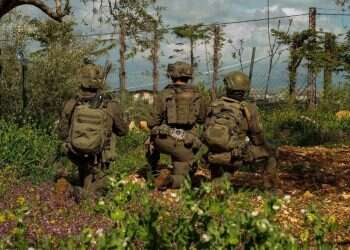
In the absence of a technological and operational response to Hezbollah's drone threat, IDF troops in southern Lebanon are improvising various solutions in an effort to face the danger. Among other measures, soldiers are deploying nets designed to "trap" the drones before they explode on troops and vehicles. But some of these nets are improvised and do not necessarily get the job done, instead of the IDF having prepared for this in advance and equipped the forces with the proper means to confront a threat that was known for years.
A senior officer who spoke with Israel Hayom acknowledged that "they woke up too late. They fell asleep at the wheel. There needs to be a process of developing techniques and drills, while learning from the war between Russia and Ukraine. This should have been done long ago, by formulating a comprehensive concept for protecting the forces and attacking the threat."

The senior officer also noted that the IDF should have arranged in advance for nets to protect the soldiers, along with other measures in which the Israeli security establishment has not invested enough in recent months, despite the threat being well known. "They should have made sure ahead of time that there were nets to protect the soldiers. The army today uses a lot of empty slogans. IDF army needs to be asked what techniques and capabilities it is introducing."
According to the officer, the IDF has set up teams trying to deal with the problem, but these are slow-moving think tanks that do not know how to deliver results within the required time frame. "There needs to be a senior officer, someone serious, working at a fast pace. The army is a heavy organization. It takes time to respond to these things. This should have been dealt with long ago. For example, intelligence collection should have been increased, with checks into where the equipment for the drones is coming from and action taken to strike it. This is not something that should only start being handled when it is already exploding on soldiers. The writing was on the wall."
The officer further said, "Our luck is that Hezbollah is still only learning. If they were professionals, we would be in serious trouble. And they will become professionals. The IDF did not expect the drone threat at this level of intensity, and that is a mistake, because the writing was on the wall. Unlike Gaza, which is a small area where it is relatively possible to control what enters, Lebanon is a large area. It is impossible to control what reaches Hezbollah. The organization can arm itself and obtain outside knowledge relatively easily."
The IDF says some of the solutions for contending with the drone threat are already mature and are being integrated, while additional options are being examined continuously. The solution to the problem is multilayered and includes proper conduct by the forces, vigilance, defensive measures, batteries and trenches, alongside offensive capabilities aimed at destroying the operators and reaching deeper into the supply chain.
Over the past three weeks, a plan has been drawn up in which the problem was defined, along with the mission and the various subteams. Before that, the issue had been addressed in the context of border defense. Experiments have already been conducted on technologies with the potential to provide an operational solution, including cooperation with companies overseas. At the same time, efforts are being made to reduce the gap in warning the forces, in order to give them several seconds to activate drills that have already been written and are now being validated and implemented in the field.

The IDF assessment is that a force that operates properly in the field, defines skyward sectors of observation and is equipped with suitable means, such as a shotgun or similar weapon, together with an optical sight that locks onto the target, will be able to improve its ability to confront the threat significantly. Some forces already have this sight, and dispersing ammunition that would allow for easier hits is also being examined.
When operational conduct is proper, the assessment adds, it can be seen that the enemy fails to attack and the layers of protection and other measures have a very significant effect.