Reuters reported Monday that European Union foreign ministers had clinched a political accord on fresh sanctions against violent Israeli settlers in Judea and Samaria, citing four diplomatic sources.
The foreign ministers of all 27 European Union member states convened on Monday to discuss sanctions on violent settlers and restrictions on exports from Judea and Samaria to EU countries. For the first time in years, Israel entered such a meeting without Hungary's automatic veto, following Viktor Orbán's ouster and Péter Magyar's rise to power.
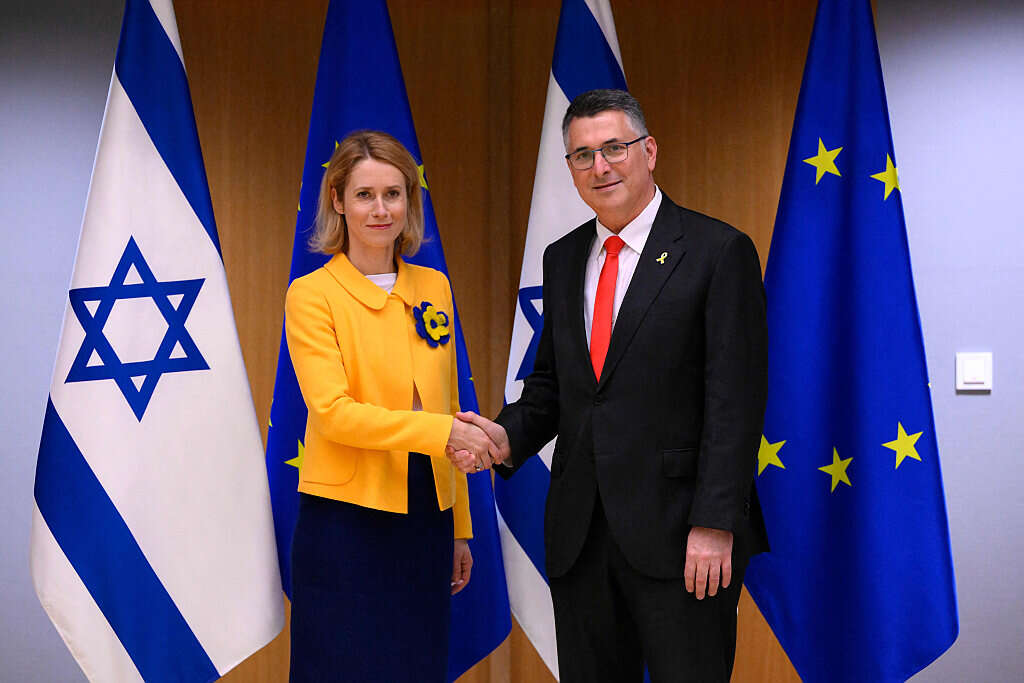
EU High Representative Kaja Kallas took to X to address the decision. "EU Foreign Ministers just gave the go-ahead to sanction Israeli settlers over violence against Palestinians. They also agreed on new sanctions on leading Hamas figures. It was high time we move from deadlock to delivery," Kallas said, in a reference to the former Hungarian veto that had blocked such measures. "Extremism and violence carry consequences."
Israeli Foreign Minister Gideon Sa'ar sharply denounced the move, saying: "The European Union has chosen, in an arbitrary and political manner, to impose sanctions on Israeli citizens and entities because of their political views and without any basis. Equally outrageous is the unacceptable comparison the European Union has chosen to make between Israeli citizens and Hamas terrorists. This is a completely distorted moral equivalence. Israel has stood, stands, and will continue to stand for the right of Jews to settle in the heart of our homeland."
Israel firmly rejects the decision to impose sanctions on Israeli citizens and organizations.
The European Union has chosen, in an arbitrary and political manner, to impose sanctions on Israeli citizens and entities because of their political views and without any basis.…
— Gideon Sa'ar | גדעון סער (@gidonsaar) May 11, 2026
Several EU member states began to advance last month a partial suspension of the Association Agreement (the decades-old trade and political framework governing Israel–EU relations), an initiative that could deal a significant blow to the Israeli economy, including the agriculture, academia, and technology sectors, potentially costing Israel billions of euros. Approximately one-third of Israeli trade is conducted with EU member states.
Not all the decisions to be made during the meeting require the same threshold of support. Sanctions against settlers require the unanimous agreement of all 27 EU member states – and it was precisely here that Hungary's veto repeatedly shielded Israel. By contrast, a partial suspension of the Association Agreement requires only a qualified majority, making Hungary's veto irrelevant to that measure from the outset.