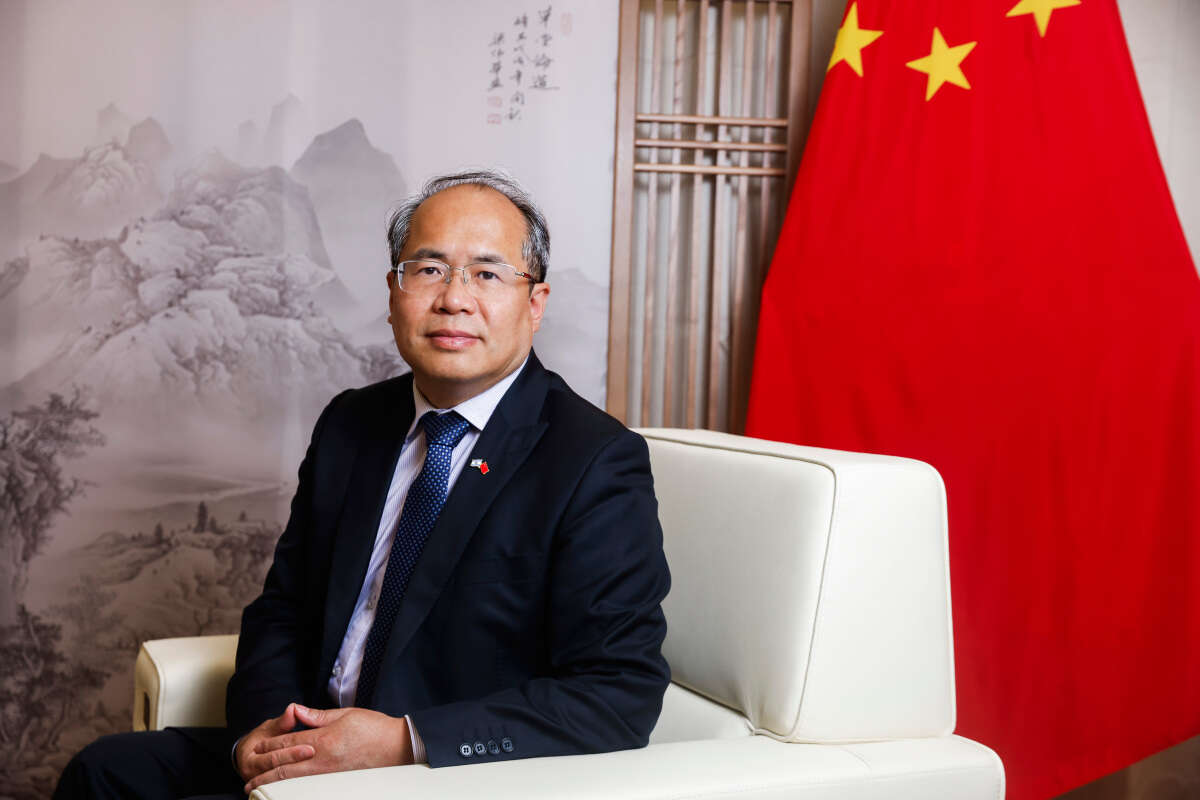
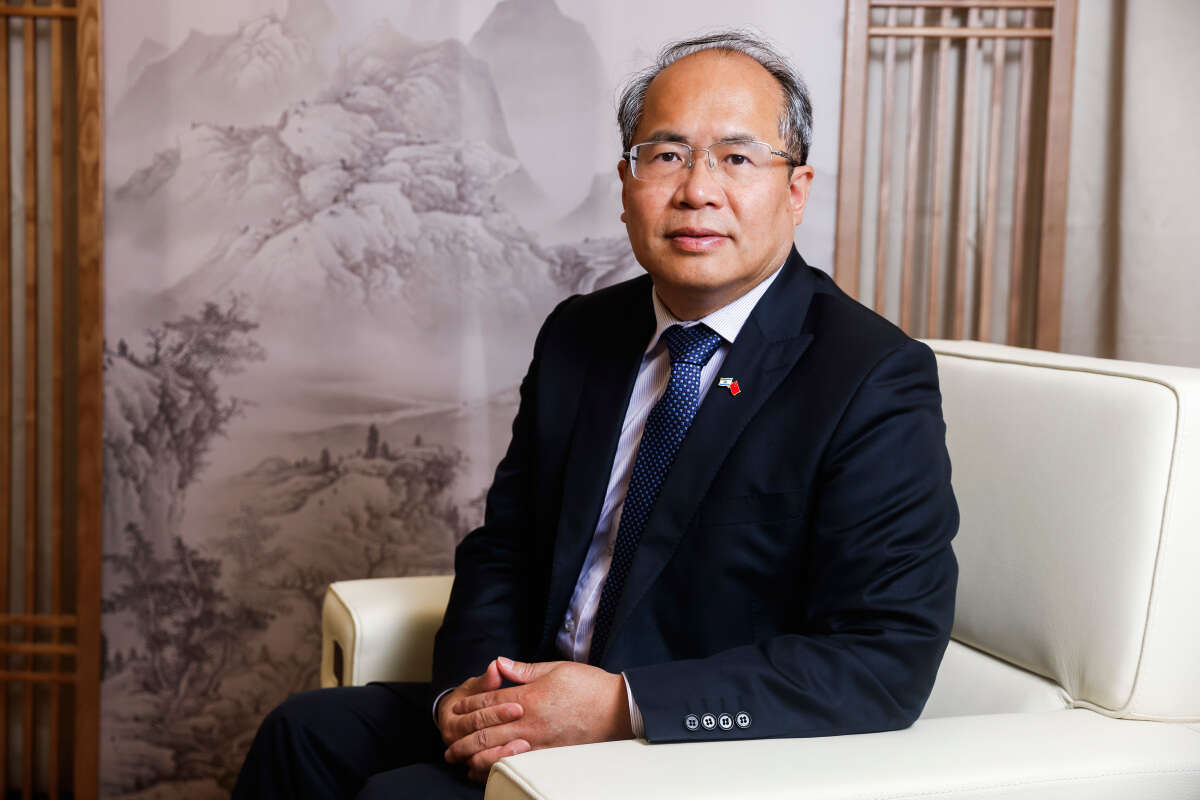
The conversation begins, improbably, with cheesecake. Ambassador Xiao Junzheng, China's envoy to Israel, has been told that Shavuot – Israel's wheat-harvest holiday, falling the day after our meeting – is celebrated, somewhat inexplicably, with mountains of dairy. He wants to know what the holiday means. Where does it sit in the Jewish calendar?
Shavuot, we explain, falls roughly fifty days after Passover and marks the moment the Israelites received the Torah at Mount Sinai – the Ten Commandments, the founding covenant. The ambassador listens carefully, the way a diplomat trained in a culture older than most listens to someone else's origin story. "Ten Commandments," he says with keen interest and nods. The dairy tradition is murkier, we admit.
"It's a commercial success of the milk companies," one of us adds, lightening the moment. The ambassador smiles politely. He may not yet realize the Chinese connection to this holiday. Tnuva, Israel's largest dairy producer and the engine of the country's Shavuot cheesecake economy, has for more than a decade been owned by the Shanghai-based food conglomerate Bright Food. Every Israeli reaching for a tub of sweet white cheese this weekend will, without knowing it, be participating in a small commercial ritual that quietly braids the two countries together – a Chinese company helping Israelis celebrate a Jewish holiday.
It is a fitting overture. We are sitting in the embassy's newly inaugurated building in the Tel Aviv hi-tech hub of Ramat Hachayal – a real fortress compared to the small building where the People's Republic of China embassy was on Hayarkon Street. The building's dimensions and overall aura befits a country that sees itself on an equal footing with the United States.
"In the past year and a half as a foreigner here, I really experienced three wars or conflicts, which shows how complex the regional situation is," he says, when asked whether he has a message for Israelis. "The most impressive one for me is that Jewish people and the Israeli nation really have a resilience towards the conflicts or wars. We can hear different voices on the same questions, but the whole society expressed its solidarity in front of the challenge."
We are the first journalists, the ambassador notes, to interview him here. Outside, Tel Aviv is moving through the closing week of what Israelis now matter-of-factly call the second Iran war. Xiao has been in the country since November 2024 – "almost a year and a half," he corrects us – and has watched three Israeli conflicts – the Gaza war and two historic Israel-Iran clashes – unfold from the windows of his ambassadorial offices. A quarter-century ago, he was posted to Tehran as a key diplomat in the embassy there, effectively managing the delicate ties with the ayatollahs. Few foreign envoys in Israel, perhaps none, are as personally embedded in the geometry of the present Middle East dynamics, having worked on both sides of the Persian Gulf.
"In the past year and a half as a foreigner here, I really experienced three wars or conflicts, which shows how complex the regional situation is," he says, when asked whether he has a message for Israelis. "The most impressive one for me is that Jewish people and the Israeli nation really have a resilience towards the conflicts or wars. We can hear different voices on the same questions, but the whole society expressed its solidarity in front of the challenge."
It is a graceful opening – and a fitting one for someone who truly seems to enjoy his job and his host country.
The Xi-Trump world order
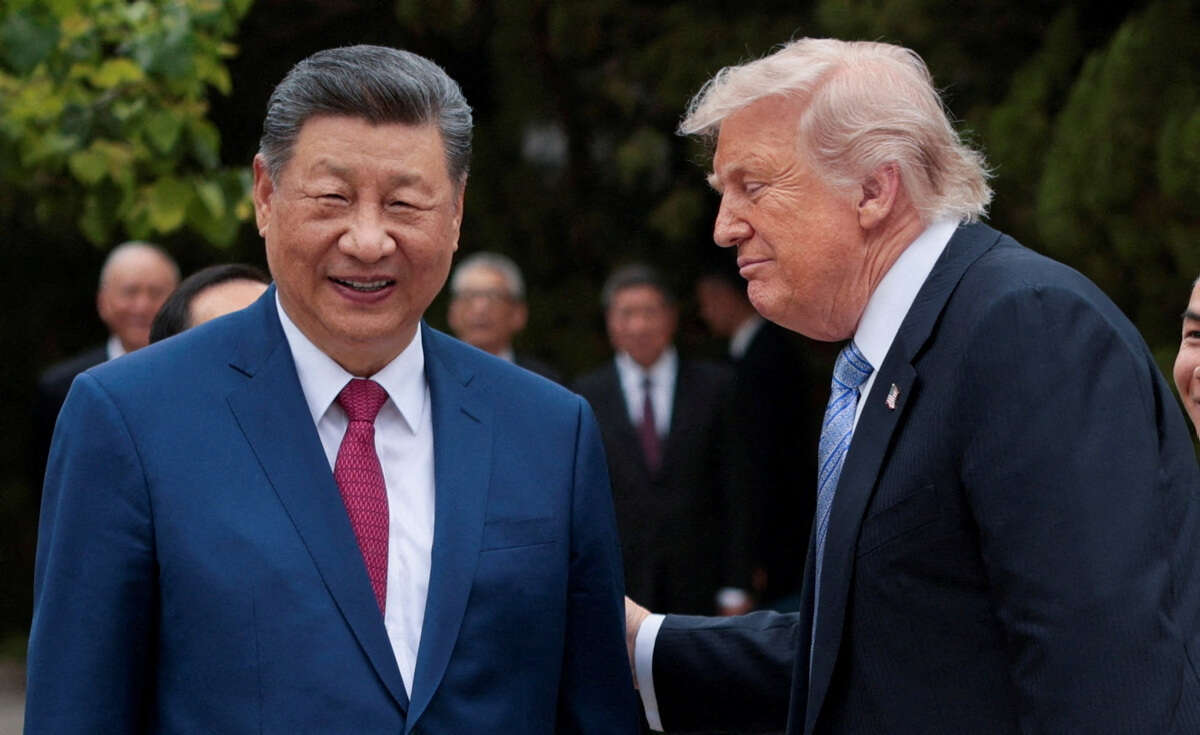
The interview takes place days after President Xi Jinping's summit with Donald Trump, which produced warm communiqués and little visible movement on either of the issues that most preoccupy Beijing's interlocutors in the region: Iran's nuclear file and Taiwan. We ask the ambassador whether China – which brokered the 2023 Saudi-Iranian rapprochement and coordinated with Pakistan on a ceasefire during the latest war – will lean on Tehran to dilute or surrender its enriched uranium stockpiles.
"The history of the Middle East tells the world time and again that force provides no solution, and armed conflicts will only increase hatred and breed new crises," he answers without providing details beyond the regular stance Beijing offers on this delicate issue. "China has maintained an objective and impartial position and actively promoted peace talks. We acted with integrity and sought no selfish interests."
The summit had been billed as a reset – tariffs, semiconductor export controls, Iran's nuclear file, and the question of Taiwan, all on the same table. The communiqué afterward mentioned none of them by name. Xiao, it appears, wanted to reassure us that no news was good news. It showed stability.
Even after the interview was concluded he made sure to reiterate the optimism that one should feel after the summit. "President Xi noted that President Trump's visit has been a historic and landmark one; both President Xi and President Trump are leaders of two great nations," he told us.
"China has consistently opposed hegemony and power politics. We advocate equality among all countries regardless of size, strength, or wealth. Put simply, building a community with a shared future means encouraging all countries to move beyond differences in nationality, ethnicity, culture, and ideology and work together to address global challenges. To build a community with a shared future, it is first necessary to foster a new type of major country relationship committed to no conflict, no confrontation, mutual respect, and win-win cooperation. So in the recent meeting between the Chinese and US presidents, they agreed to build a constructive China-US relationship of strategic stability. It reflects a strong sense of responsibility and strategic vision needed to move beyond the Thucydides Trap and open a new chapter in major country relationships. This proves that achieving the great rejuvenation of the Chinese nation and making America great again can go hand in hand. The two countries can help each other succeed and advance the well-being of the whole world. We can expect that this meeting will have a significant and far-reaching impact on the world, including the Middle East."
Even after the interview was concluded he made sure to stress this point and reiterate the optimism that one should feel after the summit. "President Xi noted that President Trump's visit has been a historic and landmark one; both President Xi and President Trump are leaders of two great nations," he told us.
Perhaps this attests to how important the summit is to China not just on substance but on image: Having the world accept it as a partner to the U.S. – albeit a sparring partner at times – in running the world.
Asked about Western reporting that Chinese state-linked firms are actively working on transferring shoulder-fired missiles and sodium perchlorate – a key precursor for solid rocket fuel – to Iran via third countries, the ambassador's message is clear.
"These reports are entirely speculative," he says. "China firmly rejects the circulation of speculative, misleading disinformation and ill-intentioned association targeting China." We remind him that at our last sit-down, he had dismissed parallel claims about Chinese jets to Iran with a sentence that became his headline: A lie repeated a thousand times is still a lie. Does he stand by the denial with the same force today?
"Of course. Of course," he replies. "We never sell weapons or provide ammunition to countries at war or to conflict zones."
Did Iran ask?
"I don't know."
The answer leaves a lot to the imagination – and only sharpens the question: Will we ever truly know what the military relationship between the two countries is?
China wants dialogue
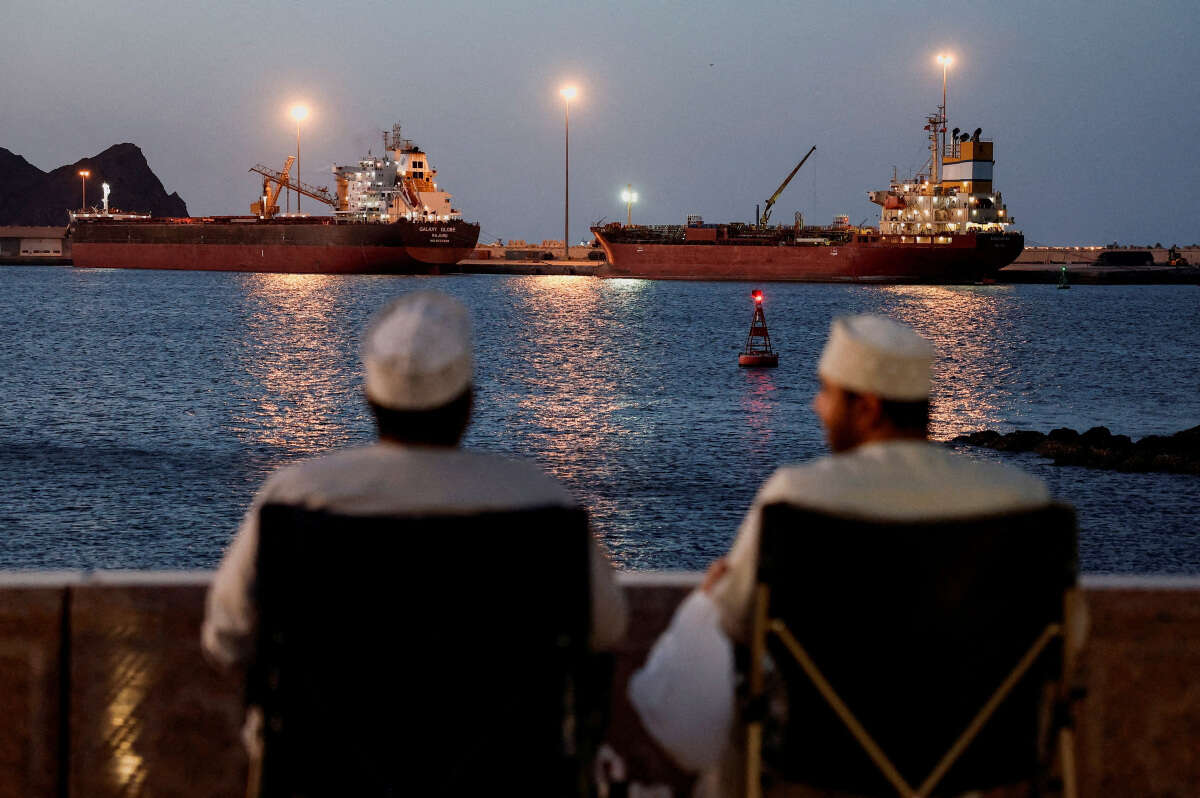
Tehran's maximalist demand — that any post-war settlement recognize its sovereign rights over the Strait of Hormuz, up to and including the right to levy tolls on the international shipping that passes through it — was the diplomatic backdrop to our next question.
We ask the ambassador whether Beijing objects to this "Iranian tax" on using the strait. He noted that "China calls for reopening the Strait of Hormuz as soon as possible on the basis of continued ceasefire, and believes that the fundamental solution to the stalemate in the strait lies in achieving a permanent and comprehensive ceasefire." According to Xiao, "China has been working to promote peace talks, and will continue to play its role for an early end to the conflict and restoration of peace in the Middle East."
Thus, it appears that China, which buys nearly all of Iran's sanctioned crude and is by far Tehran's largest commercial lifeline, has effectively joined Riyadh, Abu Dhabi, Doha, Manama and Kuwait City in rejecting Tehran's efforts to extend the war to the economic front. On the question Iran most wants resolved in its favor, the world's second-largest economy has quietly stepped into line with the Gulf Arab states – and against its partner in Tehran.
Xiao noted that "President Xi set forth China's consistent position. He emphasized that the use of force cannot solve problems, and dialogue is the only right choice. Negotiations may not produce immediate results, but now that the door of dialogue has been opened, it should not be closed again. China encourages the U.S. and Iran to continue settling their differences and disputes through negotiation, including on the nuclear issue."
Like invading Florida
When the conversation turns to Taiwan, the ambassador becomes more pointed. Prior to the Trump-Xi summit, reports had circulated of an implicit understanding between Washington and Beijing: Iran for Taiwan. Xiao dismantles the premise.
"The Taiwan question is purely China's internal affair," he says. "There is simply no such thing as China invading Taiwan, just as there is no such thing as the United States invading Florida."
He cites Trump's own post-summit remarks – that the United States has no interest in encouraging Taiwanese independence, and that the distance from American shores makes the prospect of fighting a war over the island unappealing. "We don't want to travel 13,000 kilometers to fight," Xiao quotes the president saying. "I think after his meeting with the Chinese president, he had a more comprehensive and historical understanding of the importance and sensitivities of the Taiwan question."
Then comes a sharper passage, directed at Israeli politicians. A handful of Knesset members and a deputy minister have visited Taipei in recent months. "This kind of event definitely caused damage to the China-Israel relations," the ambassador says. He uses the word "infiltration" to describe Taiwanese outreach to Knesset members. Asked what he means, he answers plainly: "They arrange and pay all the hotels and flight tickets, something like that."
He has specific incidents in mind. Last summer, a group of Knesset members co-signed a letter supporting Taiwan's bid to join international organizations from which it has long been excluded – bodies, the ambassador notes, that under international rules are open only to sovereign states. Just days before our interview, the World Health Assembly in Geneva had refused even to bring to the floor a proposal to invite Taiwan as a participant. The motion died at the procedural stage.
"There is simply no such thing as China invading Taiwan, just as there is no such thing as the United States invading Florida."
"They [Taipei authorities] just mislead and misguide the Israeli Knesset members," he noted, regarding the letter in support of the island, which China regards as a renegade province. "Some Knesset members jointly signed a letter to support Taiwan's participation in some international organizations, but according to the international rules and regulations, Taiwan is not allowed to join the international organizations which are only open to independent sovereign states or members of the international communities."
He then goes on to launch a very targeted attack on the Taiwanese officials: "The Taiwan authorities, especially the DPP," he says – referring to Taiwan's ruling Democratic Progressive Party – "and the Taipei Economic and Cultural Office here [in Tel Aviv], are trying to deceive the Israeli public and the Israeli Knesset members."
His message is unambiguous. "Knesset members, they are not ordinary civilians or people; they are elected by their constituents. They represent what the Israeli people think. So I think they should be very careful when they face the Taiwan questions." It is among the sharpest words the Chinese embassy has issued on Israeli lawmakers in the thirty-three years of bilateral ties.
"Why did we lose our Chinese friend?"
Asked whether two years of war have damaged Israeli-Chinese affections (including China's initial harsh tone toward Israel over the Gaza conflict) he tells a story.
"On many different occasions, I was asked the question by my Israeli friends: Why is China [moving] away from Israel?" he says. "And one day, one of my good Israeli friends told me that actually, as Israelis here, we should ask ourselves: Why have we lost our Chinese friend? Maybe we should look at this question from another perspective."
He invokes the deeper backdrop with practiced ease: the more than 30,000 Jewish refugees who found shelter in Shanghai, Harbin, Tianjin and Hong Kong during World War II – a population, he notes, "larger than those sheltered in South Africa, Australia and New Zealand combined." Chinese universities, he adds, now spend months preparing delegations to Israel only to cancel when the next war erupts. "It is really frustrating for them. The same for our Israeli friends. I am quite sure when stability and peace come again, the people-to-people exchanges could resume immediately."
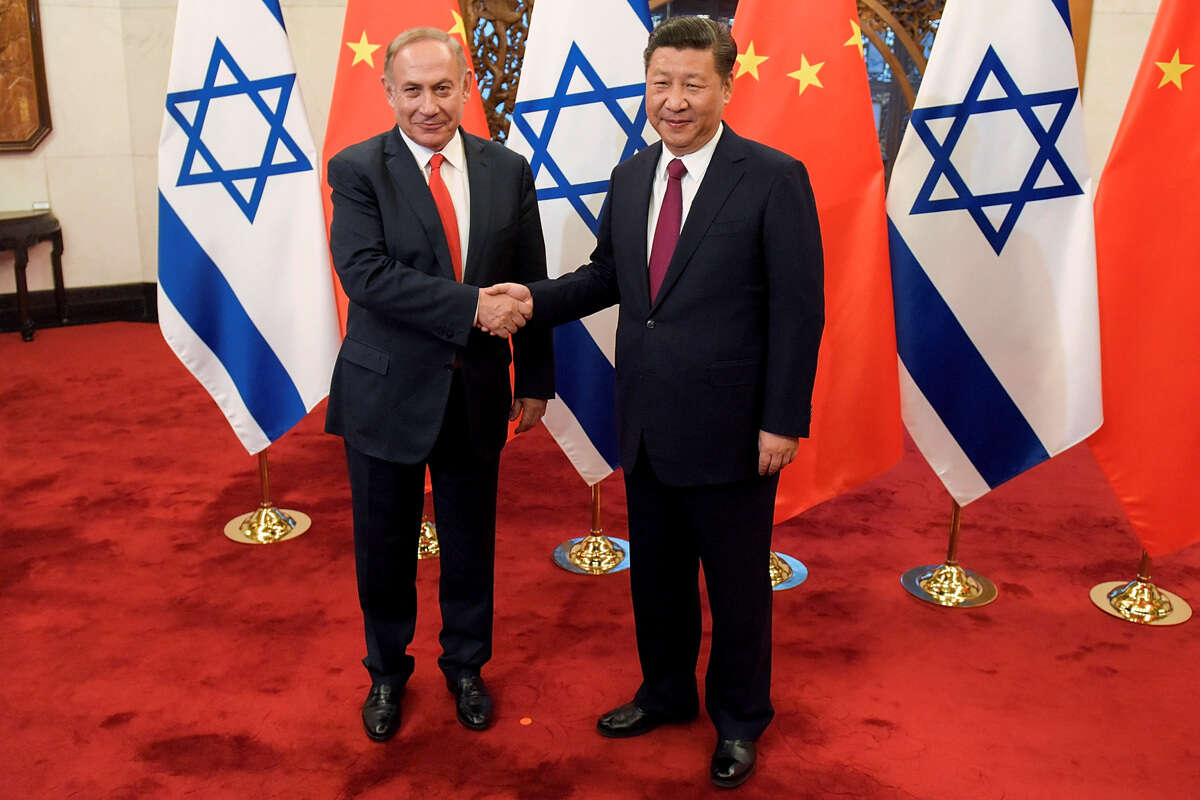
We remind him that just days before October 7, 2023, Prime Minister Benjamin Netanyahu had been preparing to board a plane to Beijing and that the war intervened before he could depart. While no visit has been publicly rescheduled for the past three years (as far as we are aware) judging from the tone of the ambassador and warm embrace of his war-torn host country, it's clear China views Beijing-Jerusalem ties as something that over the long run should not be affected by any disagreement on Iran or regional tension.
In fact, over the past three years, Chinese airlines have continued to fly to Israel even when all other foreign airlines would not, and Chinese workers have continued to work in Israeli projects despite the threat. This speaks for itself, as is the fact that China is Israel's second-largest trading partner and its largest source for imported goods.
Choosing Israel over Iran?
Toward the end of the interview, we put the question many Israelis have been quietly asking for two years. What is China's endgame in the Middle East? We put it bluntly to the ambassador.
Is Israel really an ally or is it just for interests for China in the Middle East? And if it had to choose between Israel and Iran, who's it going to choose?
The ambassador does not pick. "The Chinese government attaches great importance to its relations with the state of Israel," he says. The two countries are "partners for comprehensive innovation cooperation," a designation, he adds, that "you cannot find any other country" has signed with China. "We fully respect Israel's right to exist and its legitimate security concerns. At the same time, we hope Israel will uphold the concept of common security and properly handle the security concerns of relevant parties through political and diplomatic means."
We try again, more directly. Are Iran and Israel the same, as far as China is concerned? You're not preferring one over the other?
He doesn't bite. "China maintains good relations with Israel, Arab countries, and Iran in this region," he says, returning to the formula he has used twice already this evening: "China does not seek a sphere of influence, support proxy wars, or seek to fill any so-called power vacuum."
Trillions, and the threat beneath them
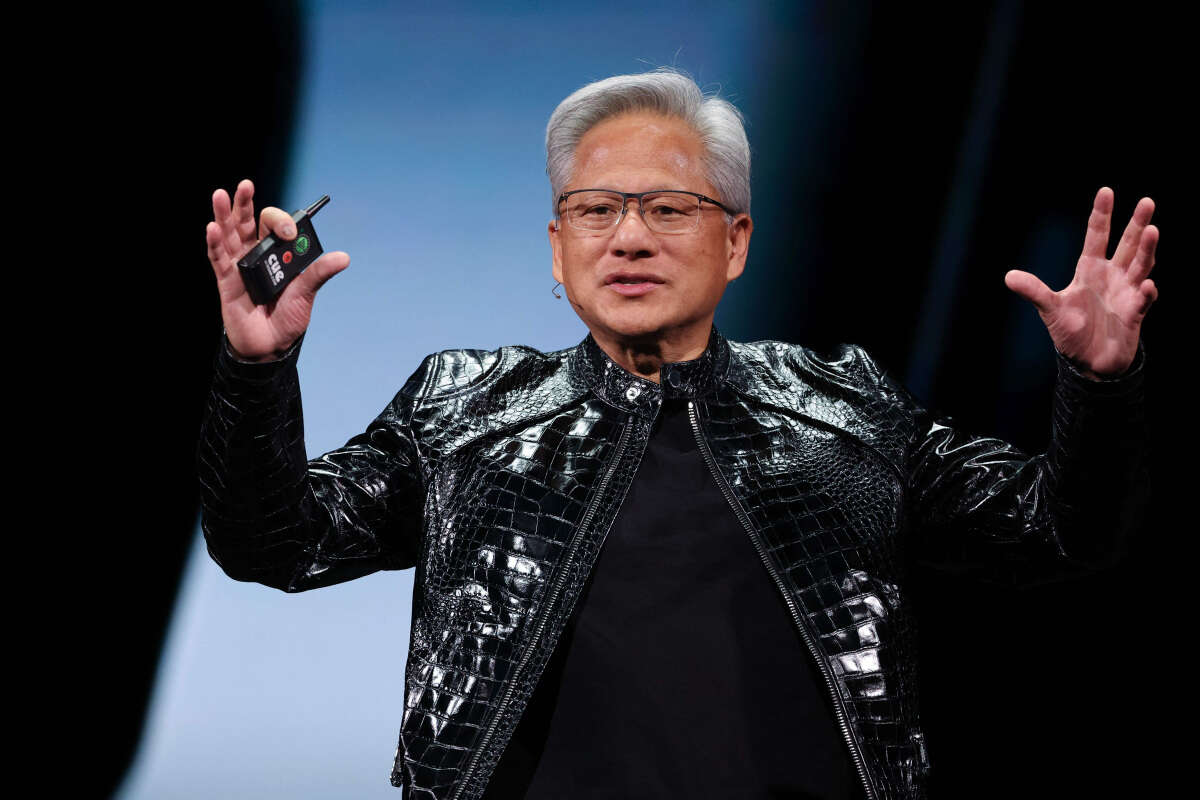
The interview is held just hours before the world's largest company, Nvidia, was to report its quarterly earnings. The company, which has been the engine of the AI revolution, is heavily dependent on Taiwan for its signature GPUs – the chips that are already transforming the world. Taiwan is the only place where such chips can be made at scale because of the unique technology at Taiwan Semiconductor Manufacturing Company (TSMC).
Taiwan produces most of the world's advanced semiconductors. If Beijing ever moved on the island – or if Washington imposed sweeping sanctions over US arms sales to it – the consequences would ripple through every chip in every device on earth. We ask whether China is prepared to absorb the hit, with the global economic earthquake that would follow.
"We fully respect Israel's right to exist and its legitimate security concerns. At the same time, we hope Israel will uphold the concept of common security and properly handle the security concerns of relevant parties through political and diplomatic means."
He answers with a warning aimed at Washington rather than reassurance aimed at Tel Aviv. "US arms sales to Taiwan seriously violate the One China principle," he says. China has already, he notes, sanctioned twenty US military-industrial companies and ten senior executives involved in arming the island, "and will continue to take resolute and forceful measures in the future."
Would China truly accept a multi-trillion-dollar economic hit over Taiwan? "As the world's two largest economies, China and the United States are deeply intertwined," he says. "Each has interests in the other, and neither can do without the other. So if the United States were to impose large-scale sanctions on China over the Taiwan question, it would, in fact, be imposing large-scale sanctions on itself as well. That means punish itself."
It is mutually assured economic destruction, restated in a diplomat's register. The pitch to Israelis is gentler. We raise the long-standing US and Israeli concern that Chinese investment in Israel – the Haifa Port, the Tel Aviv light rail, telecoms – has been a Trojan horse for Belt and Road influence or for Beijing's intelligence services. How does he reassure Israeli businesses that working with China will not draw American sanctions on their heads?
"To work with China is to work with opportunities," he says. "To believe in China is to believe in the future. To invest in China is to invest in the future too." He invites Israeli companies to "seize the opportunities of China's high-quality development" and "greatly benefit from China's multi-trillion yuan market." China, he adds, has built a legal architecture – the unreliable-entity list, anti-foreign-sanctions law, rules against "unjustified extraterritorial application of foreign legislation" – designed to shield Chinese partners from precisely the US pressure Israeli companies have been quietly worrying about for years. "We will take all necessary measures to resolutely safeguard the legitimate rights and interests of Chinese companies and individuals."

And then – after seventy-plus minutes of Iran, Taiwan, satellite resolutions and ancient civilizations – the ambassador does something a more guarded envoy would never do. He agrees to the photographs. Not a courtesy snap or two, but a full session: sofas rearranged, lamps repositioned, the ambassador shifting from couch to standing portrait to seated tableau as the photographer circles for nearly ten minutes. He had apologized at the start of the evening for a hoarse voice – he was not feeling well, he warned, and asked us in advance to forgive him – though in the event his answers were as sharp, layered and citation-heavy as any career diplomat could deliver in his second language.
A thousand years of contact, he told us earlier in the evening, lie between China and the Jewish people. Outside, Tel Aviv is going dark ahead of Shavuot, and the supermarkets are stacked high with Tnuva cheesecake – Bright Food's, in the longest sense – bound for tables across a country that has just emerged from its second Iran war and is choosing, as it always does, to celebrate anyway.
The Israeli friend's question, posed earlier in the evening, no longer feels quite so heavy. Why did we lose our Chinese friend? The answer writes itself. We didn't.