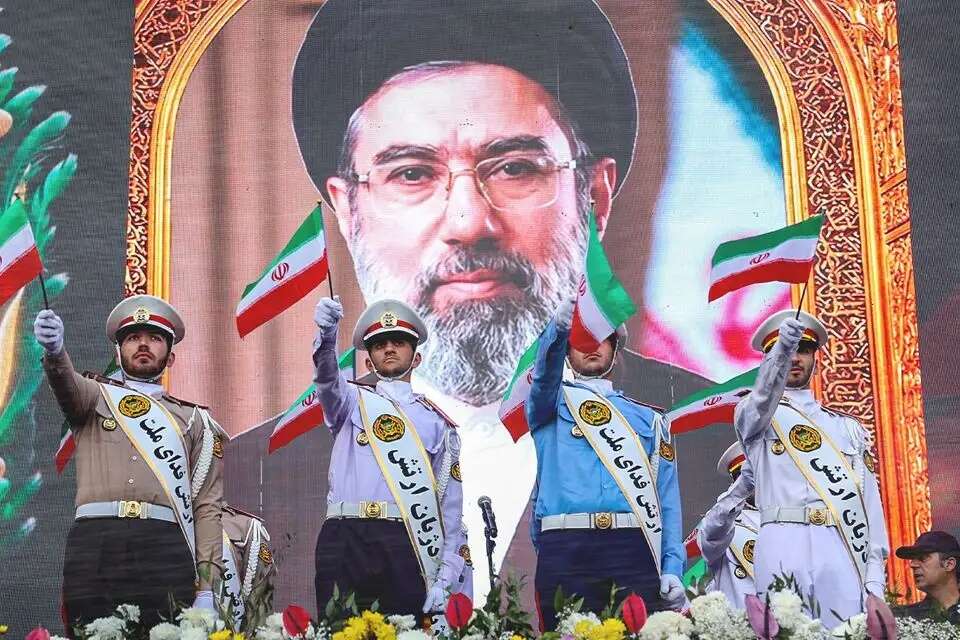
Mojtaba Khamenei's latest Hajj declaration reaffirms the "2040 doctrine" and illustrates that generational change in Tehran will not bring moderation. In the face of the US push for a delaying agreement that will funnel billions to Tehran, Israel must shift its paradigm and seek the active collapse of the Iranian octopus' head.
While the Trump administration seeks to formulate a deal with the Iranian regime, its leader, Mojtaba Khamenei, is openly declaring his intention to advance and cultivate the vision of Israel's destruction.
In a message he published last Tuesday for the Hajj, Mojtaba validated his father's 2015 declaration that Israel, the "cancerous tumor," would not survive until 2040.
Mojtaba's statement therefore serves as evidence of his commitment to the contract of annihilation decreed against Israel by the founder of the Islamic regime, Ruhollah Khomeini, in his famous speech of Aug. 15, 1979.
Accordingly, Palestine Square in Tehran was adorned with a banner showing an hourglass counting down to Israel's end, stating that 5,218 days remain until its demise and that it will not survive the next 15 years.
Granted, "The Voice of Iran," an online publication issued by the office of Iran's leader, stated in an article published the next day that Israel would be destroyed on its own as a result of an accelerated process of internal collapse. However, Iran's pattern of action shows that Tehran is pursuing the active destruction of Israel.
Operational plan went awry
In September 2015, as will be recalled, then-Iranian leader Ali Khamenei for the first time put an expiry date on Israel, declaring that it would be destroyed by 2040. Despite statements in Iran that Israel would be destroyed on its own as a result of a socioeconomic process and an internal political-security crisis, a rare remark by a senior Iranian official exposed Iranian preparations for Israel's destruction.
It was at a conference in Tehran in February 2018, which dealt with the destruction of Israel, that Hossein Amir-Abdollahian, later foreign minister in President Ebrahim Raisi's government, declared that Iran had a plan for how to implement Khamenei's statement, but that he could not detail it in the media. In 2019, statements by then-Islamic Revolutionary Guard Corps commander Hossein Salami and the head of the IRGC Operations Division, Abbas Nilforoushan, revealed the progress of the Iranian plan to destroy Israel.
Salami explained that eliminating Israel had turned from a vision into an attainable goal. Nilforoushan declared that Iran had succeeded in encircling Israel from all sides and, hinting at the convergence of arenas, added that any Israeli aggression against one component of the axis of resistance would ignite a regional war against it.
As can be learned from documents captured by the IDF during Operation Swords of Iron in Gaza, the Quds Force drew on Khamenei's vision of Israel's destruction as the justification for allocating increased financial and military aid to Hamas' military wing. This was done with the knowledge that the assistance would be directed toward carrying out especially large offensive initiatives against Israel.
At the same time, Hamas initiated increased coordination with Hezbollah and the Quds Force to advance a crushing multi-front attack aimed at eliminating Israel. But Sinwar was in a hurry. He launched the massacre without waiting for final coordination with Hezbollah and Iran, assuming that they would join him once they saw the attack begin.

A warning sign for Israel
Even after the Oct. 7 attack, senior officials in Iran's security establishment called for advancing a multi-front attack, based on the lessons of Oct. 7, in order to eliminate Israel. Many of them were eliminated in Operations Rising and Roaring Lion.
In early May, Mehdi Mohammadi, a senior security analyst who also serves as an adviser to Mohammad Bagher Ghalibaf, the speaker of the Majlis and a member of the Supreme National Security Council, repeated his call from November 2025 and urged the regime to advance a "large collective operation against Israel" by the axis of resistance under Iran's leadership, aimed at destroying Israel.
Mohammadi explained that the war had weakened Israel and that Iran had succeeded in pushing it into a corner. Against the backdrop of these remarks, which are still being heard in regime and media discourse about advancing the vision of Israel's destruction through a multi-front axis attack, Mojtaba's words appear to serve as a compass and a signal of direction.
Mojtaba's Hajj message was translated into Arabic and also distributed to the broader public in the region. It therefore appears that he seeks to present himself as driven by religious fervor and highly motivated to double the regime's efforts to export the revolution, thanks to the gains Iran accumulated in the war and despite the difficulties it suffered during it.

From his perspective, it seems, Iran is at the starting line for realizing the final victory over Israel that his father envisioned and promised for years. Therefore, the timeline Mojtaba set for Israel's destruction, 2040, as a continuation of the vision of Israel's destruction cultivated by his father, could give the Revolutionary Guards and the various players in the axis of resistance a timeframe for implementing an operational plan to achieve this goal.
Mojtaba also detailed his vision regarding the future of the US presence in the region. He expressed his commitment to the vision his father outlined for removing the US military presence from the region, and called on the countries of the region to cooperate with Iran's efforts to lead a new regional order. Nevertheless, according to indications, Trump supports a deal that would focus on removing or postponing the nuclear threat posed by Iran, and does not intend to act to topple the regime or implement his promise to assist the Iranian opposition.
That contrasts with the Israeli approach, which supports toppling the regime, as reflected in the war objective, which was intended to weaken the regime and enable the Iranian people to overthrow it. The continuation of contacts between Tehran and Washington toward reaching an agreement despite Mojtaba's declaration lends further validity to the difference between the Israeli and American strategies toward the Iranian regime.
The billions of dollars the Iranian regime would pocket as a result of any agreement reached would allow it, first, to ensure its continued existence and later to advance its vision of Israel's destruction. Unlike the US, Israel cannot adopt a policy of delay in the face of the Iranian threat.

It was in mid-December 2022, at a ceremony in Gaza marking the 35th anniversary of Hamas' founding, that Sinwar declared publicly, "We will come to you in a sweeping flood, and with countless rockets. We will come to you in a flood of soldiers without limit. We will come to you with millions from among the members of our nation, wave after wave."
Israel cannot ignore the existential threat posed by the Iranian regime under Mojtaba. The expansion of the ground maneuver in Lebanon and the elimination of the heads of Hamas' military wing, Izz al-Din Haddad and Mohammed Odeh, therefore also constitute important achievements in the broader picture vis-à-vis the Iranian plan to destroy Israel.
If Israel does not act to topple the Iranian regime through the Iranian people, it will resemble a boxer who, in a boxing match against his opponent, tries only to weaken him, while the opponent strikes him in order to knock him down.