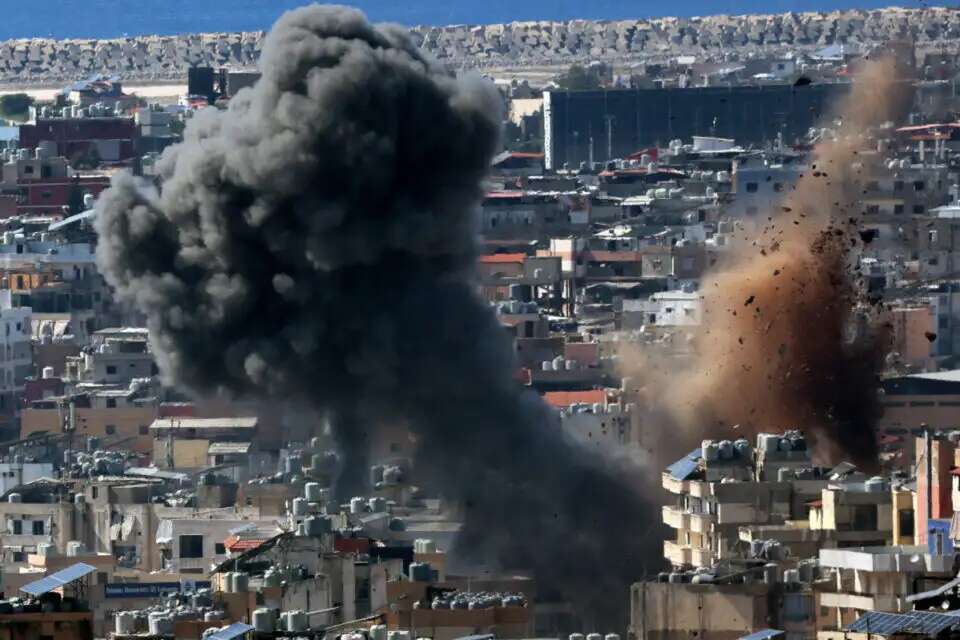
Two missiles fired by the Houthis Monday outlined a dangerous equation set by the Iranian axis. From now on, not only will a strike in Beirut's Dahiyeh draw a response from Tehran, but its additional proxies will also join the campaign immediately.
During Operation Roaring Lion, it took the Yemeni terrorist organization a full month to intervene. That card was saved for a more advanced stage of the war, during which the Houthis mostly sat on the fence. This time, they also declared a naval blockade against Israeli vessels in the Red Sea. As of this writing, they have not announced the lifting of the restrictions following the emerging ceasefire.
One Houthi spokesman said the Iranian axis had decided to change the regional equation and present a show of "unity of the fronts." That was also what stood behind the missile barrage fired at northern Israel in response to the strike in Dahiyeh on Hezbollah's headquarters. The same Houthi spokesman also included Hamas in the axis, even though the Gaza front was long ago separated from Hezbollah's equations. This appears to be the Iranian axis' wish: to rebuild the ring of terrorist organizations that surrounded Israel on the eve of Oct. 7.

It can be said that the Iranian regime went all in. Had US President Donald Trump decided to definitively blow up the talks through Pakistan and return to a broad war, quite a few senior figures in Tehran's current leadership would have been killed. However, it appears that those Islamic Revolutionary Guard Corps generals, who turned Mojtaba Khamenei into the supreme leader, are deeply troubled by the possibility that Israel will achieve another victory on the Lebanese front. Several developments stand before them that must be blocked as quickly as possible.
First, the Lebanese leadership is close to another agreement with Israel, which would include a new plan for disarming Hezbollah. Second, Israel has proven over the past two years that it knows how to surprise the terrorist organization and knock it off balance. Third, Hezbollah's situation is not as bright as it is trying to suggest through its propaganda. Hundreds of its terrorists have been killed in recent weeks, its senior officials are being hunted, and it is losing more and more infrastructure every day. That is why Tehran is willing to take a major risk to save it by the skin of its teeth.
A ceasefire on the Lebanese front, or at least a restriction on strikes, would serve several of the Iranian axis' goals. First, Hezbollah would give Tehran credit for restoring calm and present the talks between Israel and Lebanon in Washington as a failure. Beyond that, the pause would allow it to continue working to torpedo the negotiations. Threats in Lebanon against President Joseph Aoun and Nawaf Salam, who are pushing for understandings, are growing by the day. Finally, under the cover of calm, Hezbollah would be able to resume rebuilding its capabilities.

To foil the Iranian plan, Israel will need to continue dismantling the ring of terrorist organizations. Alongside advancing an agreement with Beirut that includes an effective disarmament plan and US assistance for the Lebanese Army, even if this is the lesser evil because its capabilities will still be limited, Israel must strike Hezbollah's "political" leadership, including Secretary-General Naim Qassem and his partners in parliament. There is no reason to be dragged into the discourse of equations and carry out further symbolic strikes in Dahiyeh.
As in 2024, Israel must break the equation and push to create a new reality in northern Israel.