The Air Force remains Israel's spear: fast, precise, deep, decisive. Nothing replaces it. But Israel's next depth is not in the sky. It is at sea.
Israel's vital border is no longer only a fence, a river, a ridge, or desert. It is the Mediterranean - airspace, surface, and seabed – through which run its lifelines: trade, gas, communications, Europe, and the world. The Red Sea is the second gate. Together, they are Israel's maritime perimeter.
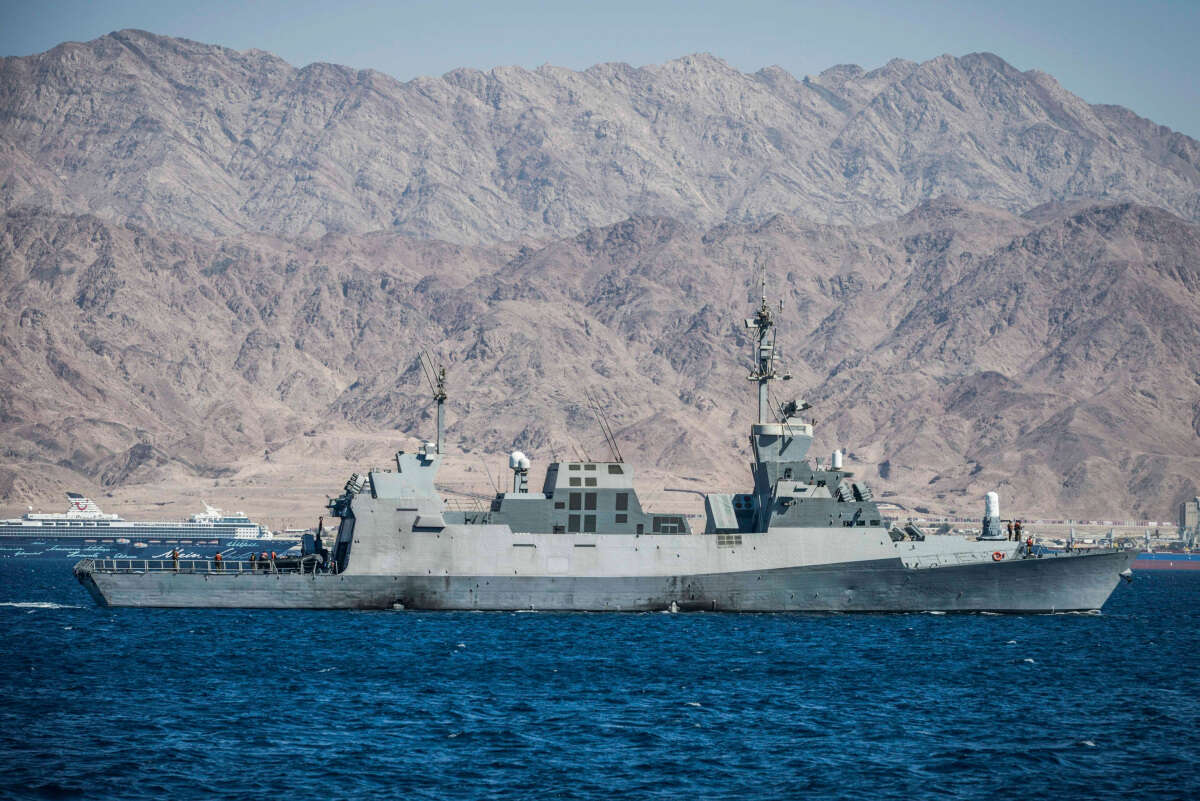
The Navy did not wait for doctrine. It guarded the coast, ports, and approaches; blocked Gaza infiltration; secured offshore gas; sustained the submarine arm; supported operations ashore; and extended south when the threat moved. Sa'ar 6 turned a small fleet into a layered combat grid: Naval Iron Dome, Barak systems, advanced sensors, EW (Electronic Warfare), helicopter capability, and Israeli integration. The old mission did not fail. It ended.
Maritime superiority means secure sea lanes, gas assets, undersea cables, beyond-horizon operations, and Greece and Cyprus as part of Israel's theatre. The Navy becomes comparable to the Air Force in scale, priority, training, prestige, industry, and reputation. Not its copy. It's equal.
The Hellenic Navy teaches Israel one hard lesson: how to read Turkish pressure through islands, straits, air-sea seams, and escalation thresholds. Israeli-Greek-Cypriot cooperation already follows that logic. Not all of it is public. It should not be.
Turkey removes the luxury of delay.
Ankara is manufacturing the Turkish perimeter at sea. Blue Homeland – Mavi Vatan – gives the map. Shipyards give the mass. Drone carriers, submarines, frigates, planned destroyers, and missiles give the hard power. Ports, exercises, and forward partnerships give the reach. The arc runs from the Aegean and Cyprus through Libya and the Red Sea, from the Bosporus to the Horn of Africa. Not procurement. Encirclement by access.
Turkey pressures before it fires: maps, drilling escorts, contested islands, cultivated ports, drone exports, and militarized ambiguity. Others are left to live inside the fiction.
The Turkey-Libya maritime memorandum was the ink method: a fictitious line across the eastern Mediterranean, erasing Greek islands, Cypriot rights, energy routes, and Israel's access to the sea on paper. Europe rejected it. Greece and Egypt answered. Ankara kept the friction. For Israel, this is not a legal footnote. It touches sea lanes, cables, gas, and the Mediterranean gate. Illegal maps need not become law to become pressure. If left unanswered, they become patrols, premiums, drilling calculations, and hesitation. Israel has gone to war before when others tried to close its sea gates.
The Constantinople Protocol - Israel's exit doctrine from Turkish-controlled gates - begins at sea. Its rule is simple: no Turkish gate remains singular. Ports, airspace, energy, trade, cables, insurance, diplomacy, and logistics must all have alternatives before Ankara can turn access into a veto. A country exists a coercive system not by declaring independence, but by replacing every gate before it closes. The Navy is the enforcer of that exit.
After Iran, the Turkish file is open. Turkey is not next because Israel seeks war. It is next because Ankara adds what Iran lacked: NATO access, shipyards, sea gates, industry, forward nodes, and pressure on the Greek-Cypriot space. Iran taught Israel how missiles, proxies, and endurance shape a long confrontation. Turkey adds the map, the fleet, and the gates.
Poseidon's Wrath is the contingency inside the doctrine. Once the Turkish occupation of northern Cyprus becomes an operational threat, it becomes an Israeli problem. The contingency is clear: neutralize the threat and help restore Cypriot sovereignty over territory taken by force. Israel can act today: air power, ISR (Intelligence, Surveillance and Reconnaissance), long-range precision, cyber, and EW; Greece, the Republic of Cyprus; and partners such as France provide the force. The issue is not the strike. It is the day after: holding the theatre, watching the seabed, blocking reinforcement, protecting cables, escorting ships, and preventing the next crisis.
An Israeli MYP (Multi-Year Plan) for this shift could be called Zebulun; in its Mediterranean register, Poseidon. Zebulun is the biblical tribe of the shore – "Zebulun shall dwell by the seashore" – Hebrew shorthand for ports, trade, distance, and the sea. Poseidon gives it its Mediterranean name: maritime power, Hellenic depth, and the answer to coercion at sea. The name defines the mission: Israel's return to the sea as sovereignty, industry, deterrence, and reach.
The first phase is Nachshon: the man remembered in Jewish tradition as the first to enter the sea before it split. Nachshon is the break - Israel's entry into the maritime domain as a central arena. The Sa'ar 6 layer, Naval Iron Dome, gas-rig defence, Red Sea posture, and maritime air defence are Nachshon. The missing step is hierarchy.
The second phase is Tannin: the biblical sea monster, the force of the depths. Tannin means submarines, sensors, UUVs (Uncrewed Underwater Vehicles), acoustic intelligence, mine detection, ASW (Anti-Submarine Warfare), cable protection, and covert endurance. INS Drakon, the Dakar-class submarines, and Israel's autonomous undersea layer already mark Tannin: not platforms, but Israeli undersea architecture operating with partners, especially Greece, and turning the seabed into a detection and denial layer.
The third phase is Tarshish: the biblical horizon of distant ships, trade, wealth, and long-range maritime reach. Tarshish turns capability into power beyond the horizon: range, logistics, naval aviation, drone motherships, maintenance depth, permanent Red Sea and eastern Mediterranean posture, larger surface platforms, undersea networks, exportable Israeli naval systems, and an officer corps whose prestige matches the mission. Israel does not need a supercarrier. It needs an Israeli projection platform: smaller, smarter, uncrewed-heavy, modular, linked to satellites, aircraft, submarines, missiles, and sensors, and harder to neutralize.
The budget is the doctrine in numbers. A ten-year MYP requires NIS 80-120 billion for platforms, submarines, USVs (Uncrewed Surface Vessels), UUVs, munitions, shipyard capacity, simulators, training, maintenance, undersea infrastructure, southern posture, and Mediterranean endurance. Measured against air superiority and maritime vulnerability, this is not excess. It is overdue.
The procurement logic is sovereignty, not shopping. Israel can buy steel, tonnage, logistics, hulls, shipyard capacity, and undersea engineering from trusted partners. It cannot outsource the brain: C4I (Command, Control, Communications, Computers and Intelligence), radars, missiles, air defence, EW, cyber, sensors, uncrewed systems, data links, and combat integration.
The United States remains essential, but it is not the gatekeeper of this file. The Air Force runs on American platforms and supply chains; the Navy does not. In the eastern Mediterranean, Washington balances contradictions Israel cannot ignore: Turkey, NATO cohesion, Black Sea access, Gulf interests, and de-escalation. Israel's maritime future cannot become collateral in that balance.
External partners should provide mass, shipyards, undersea expertise, Mediterranean depth, Red Sea reach, and access to the wider Indian Ocean frame. But the combat system, the doctrine, and the veto must remain Israeli.
On this file, Israel belongs with Europe's waterline states, not America's alliance-management instinct.
The Navy's offensive mission is sea-denial, strike, and A2/AD (Anti-Access/Area Denial): denying hostile fleets freedom, threatening coastal launch networks, disrupting smuggling and military logistics, protecting maritime corridors, and holding pressure where aircraft can hit but not stay. It no longer merely guards Israel from the sea. It denies the enemy the sea against Israel.
Israel is no longer only an air power with an excellent Navy. It is becoming an air-and-sea power: the Air Force strikes beyond Israel's borders; sea power holds beyond its shores. For a state whose most important gate to the world is the sea, this is not ambition. It is doctrine in motion.
Shay Gal works with governments and international institutions on strategic risk, security architecture, and high-stakes decision-making.