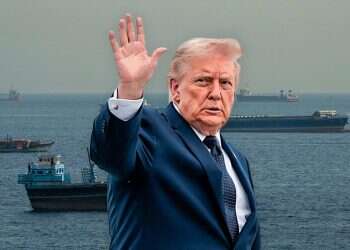
US President Donald Trump announced that a secret American operation has been underway for about a month to move oil tankers and merchant ships through the Strait of Hormuz. "Last month, I directed our Great US Military to execute a secret mission to support Oil Tankers and other Commercial Ships through the Strait of Hormuz," Trump wrote on Truth Social.
"This effort resulted in more than 100 million barrels of oil making its way through the Strait and into the free market. More than 200 Commercial Ships have safely traveled through the Strait. This hugely successful effort was made possible because the US controls the Strait of Hormuz, not Iran."
Earlier, speaking to reporters in the Oval Office, Trump was asked about inflation figures that showed the highest level since April 2023. "I love it," he replied. "You know what I really love? I love inflation. You know why? I can say it now, something you didn't know. Did you know we're taking out millions of barrels of oil? Nobody knows about it. Iran didn't know about it until now. We took, one night, 22 ships. Late at night, with no lights, because they don't have radar, because we smashed it."

The announcement came about a month after a declared American operation was halted shortly after it began. On May 4, Trump launched "Project Freedom," a US Navy maritime escort mission for tankers and merchant ships in the Strait of Hormuz. According to Secretary of State Marco Rubio, it was intended to rescue 23,000 civilians from 87 countries who were trapped on vessels in the Persian Gulf. A day later, Trump announced that the operation would be suspended "for a short period," amid talks with Iran on a broader agreement.
Since then, the public escort mission has not resumed. Instead, according to Trump's announcement, the US appears to have replaced the overt approach with a covert operation.
Turning off signal transponders
Hours earlier, Bloomberg reported that a growing number of tankers were turning off their signal transponders to increase the flow of oil through the Strait of Hormuz. According to the report, satellite images showed 16 tankers gathered over the weekend off the coast of Oman to transfer millions of barrels of oil that had been stuck in the Persian Gulf. About a month earlier, by contrast, the area had been completely empty.
According to Bloomberg, citing conversations with senior figures in the international shipping industry, traders in Asia and sources familiar with the details of the crossings, as well as satellite images, the strait is now "less blocked" than official ship-tracking data would suggest.
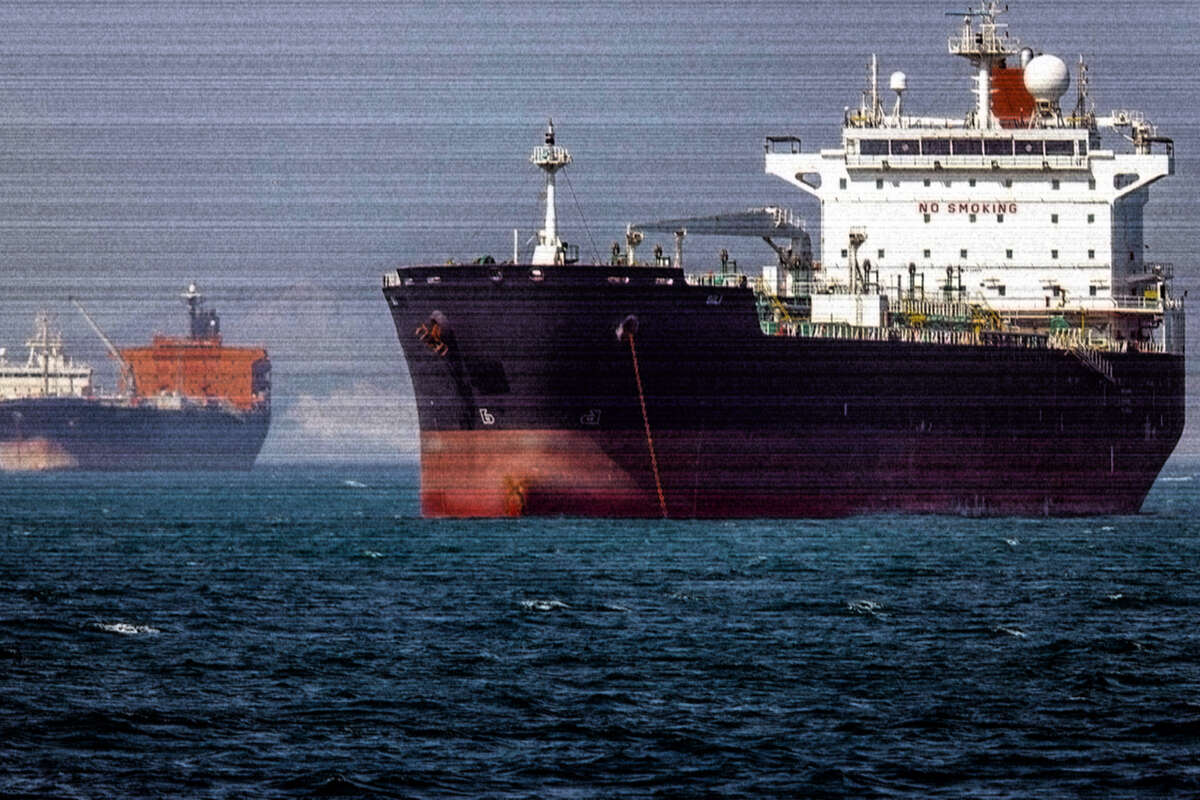
According to Bloomberg, the mechanism works as follows: Gulf oil producers use tankers under their control to move the barrels through the strait into the Gulf of Oman. There, at sea, they transfer the cargo to other tankers that are unwilling to risk entering the Persian Gulf, and those vessels carry it to customers in Asia and the rest of the world. The method, known as ship-to-ship transfer, allows cargo to be unloaded without docking at a port and without appearing in the usual trade records.
Iran itself has used the method for years to evade US sanctions on its oil exports, and now Gulf states are using it to bypass the Iranian blockade of the strait.
According to Bloomberg, these ships, including tankers belonging to state-owned companies from Kuwait and the United Arab Emirates, cross the strait under cover of darkness, with lights and transponders turned off, and crews are ordered to maintain radio silence. "It's mostly, if not exclusively, state-owned vessels that are passing through, and they appear to have communication channels and means to ensure safe passage," said Larry Johnson, head of freight at trading firm Mercuria.
According to estimates cited by Bloomberg, about 2 million barrels of oil a day are now flowing out of the Gulf. That volume remains far below the prewar average of about 20 million barrels a day, but is significantly higher than in the first weeks of the fighting.
TankerTrackers, which monitors tanker movements using satellite imagery, clarified that contrary to the interpretation given to Trump's comments on social media, this is not Iranian oil. "Iranian oil is still trapped," the company wrote on X, saying 46 tankers loaded with Iranian crude were stuck in Iran. "This is oil coming from Iran's Arab neighbors. Another reason oil prices aren't currently at $200 a barrel."