Israeli intelligence believes Iran moved thousands of uranium-enrichment centrifuges into tunnels deep inside a mountain as early as last fall, Israeli and US officials told The Wall Street Journal, a development that has heightened concerns that Tehran could rebuild its nuclear program.
Israel shared the intelligence findings with the US, saying the centrifuges had been transferred to the Pickaxe Mountain site last fall, after Operation Rising Lion in June 2025, when Israeli and US strikes hit Iran's three main nuclear facilities.
As Israel's war aims increasingly diverged from those of the US, Prime Minister Benjamin Netanyahu sought to persuade US President Donald Trump to resume large-scale attacks on Iran to further damage Tehran's weapons programs and reconstruction efforts. The US has intensified its strikes over the past 10 days, and Trump said Washington was prepared to attack Pickaxe Mountain.
"Pickaxe is a possible target for a nice big fat shot right near the front door," Trump told conservative broadcaster Hugh Hewitt on July 13. It was the first time Trump had explicitly identified the site as a possible target, although he had previously referred to an underground Iranian facility buried in granite.

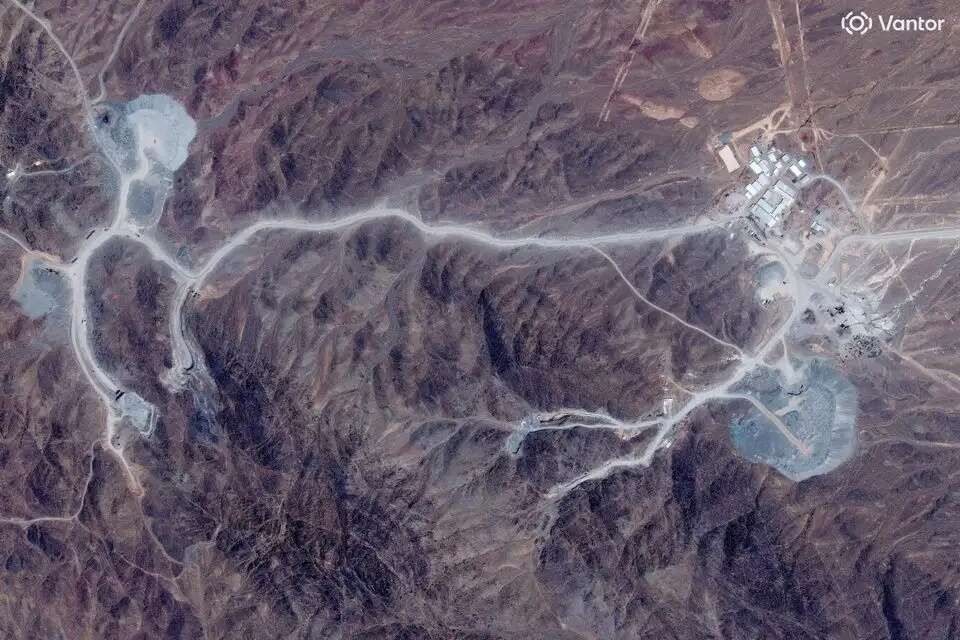
Known in Iran as Mount Kolang, the site has been under US and Israeli surveillance for years. The limited information available about Iranian activity there suggests that it would pose significant challenges to any airstrike. The facility is located near one of Iran's main nuclear installations and was built as an underground replacement for an Iranian centrifuge assembly plant that was badly damaged in a 2020 explosion, possibly caused by sabotage.
Activity at the site has continued steadily over the past 15 months, including truck traffic, tunnel reinforcement and the construction of a security perimeter, according to the Institute for Science and International Security, a research organization specializing in nuclear and nonproliferation issues. Work has also been carried out near an older tunnel network dating to 2007, which Iran has since sealed.
Not considered a major bombing target
Experts estimate that the underground complex lies approximately 90 to 140 meters (300 to 460 feet) beneath solid rock and contains enough space to accommodate several nuclear-related facilities.
Pickaxe Mountain was not considered a major bombing target during the war between Israel and Iran last year. It was also not attacked during the wave of fighting involving the US that began on Feb. 28. Officials have nevertheless long feared that Iran could use the tunnels to store or manufacture nuclear equipment and establish a small uranium-enrichment facility capable of producing fissile material.
An Israel Defense Forces official familiar with efforts to select targets for attack expressed concern that airstrikes during the latest war had not sufficiently damaged work related to nuclear weapons. The official said more remained to be done, including at Pickaxe Mountain.
Centrifuges are machines used to spin uranium gas and separate its isotopes, enriching the material for civilian nuclear energy or potentially for the production of nuclear weapons. Iran denies that it has ever sought to build a nuclear weapon, but it has produced approximately 1,000 pounds (454 kilograms) of uranium enriched to 60%, a level close to that required for nuclear weapons.
The presence of centrifuges at Pickaxe Mountain does not necessarily mean that Iran is establishing an enrichment facility there. Following the June 2025 bombings, Tehran may have moved surviving centrifuges to the site to reduce the risk that they would be destroyed.