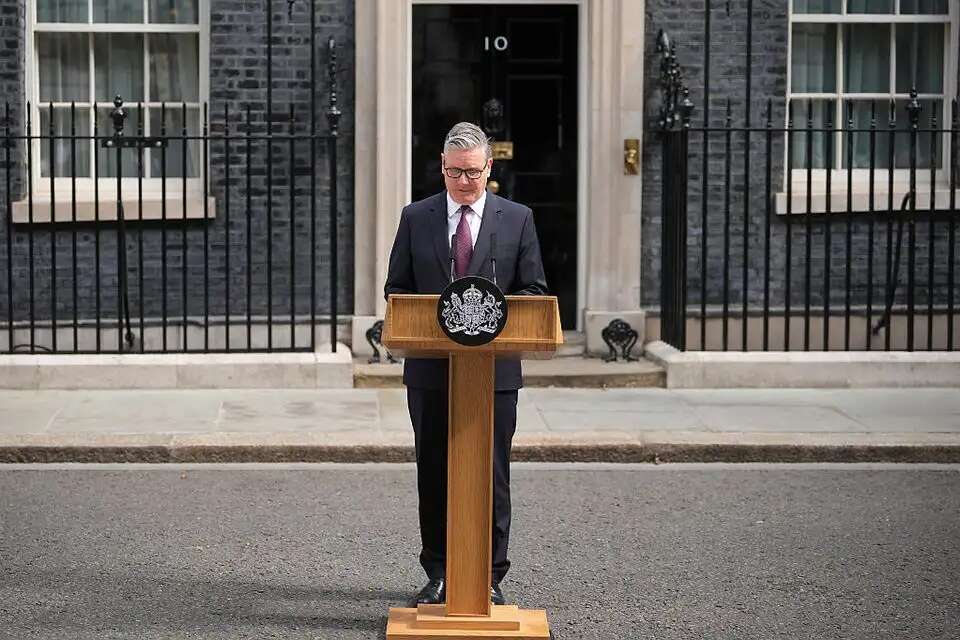
After a month spent trying to fend off a rebellion in the Labour Party, British Prime Minister Keir Starmer announced Monday that he had decided to step down as party leader, and then as prime minister once his successor is chosen. In his speech, Starmer said he was proud to have led Labour back to power, but acknowledged that he had now lost the party's confidence to lead it into the next general election, expected in about three years.
"The question my party is now asking is whether I am the best person to lead us into the next general election. I have heard the answer from my parliamentary party, and I accept it in good spirit," Starmer said in his speech. According to the timetable he presented, the process of choosing a new party leader will begin on July 9 and end in the summer, meaning a new leader will be announced before Parliament returns from its summer recess in September. Until then, he added, he would remain prime minister and "do everything in my power to ensure an orderly transfer of power."
In his resignation speech, Starmer listed what he described as the achievements of his two years in power. "An economy growing faster than those of our allies, wages rising faster than inflation every month since we came to power, an end to austerity," he said. "The fastest fall in National Health Service waiting lists in 17 years, the largest increase in defense spending since the Cold War, a decline in the number of small-boat crossings, and half a million children lifted out of poverty because of the decisions I made."

Starmer added that Britain had restored its international standing through new trade deals, support for Ukraine and a renewed alliance with Europe. "Change promised by a Labour government, change Labour fought for, change delivered by a Labour government," he said, paraphrasing his 2024 election slogan.
In the personal section of the speech, Starmer returned to the moment he inherited the Labour leadership six years ago. "I inherited a party that was politically, financially and morally bankrupt," he said. "I was told again and again that my party was finished, that it was destined to be consigned to history, and that a parliamentary majority, let alone a large one, was impossible. But we proved them wrong, because we changed our party. We rooted out the poison of antisemitism, restored trust on the economy, security and national defense, and once again became a party that proudly stands with the national flag, not against it."
At the end of the speech, his voice breaking, Starmer thanked his wife, Victoria, whom he described as "the rock beside me in good times and bad," and his children, "my pride and joy." "When I leave the greatest office in the land, I will spend more time in the most important role," he said, hinting that he may no longer remain in political life.

The likely successor
The emerging successor is outgoing Greater Manchester Mayor Andy Burnham. He would be the seventh person to hold the post in just over a decade, a rate of turnover not seen since the 1830s.
The immediate trigger for the resignation was Greater Manchester Mayor Andy Burnham's victory in Thursday's by-election in the Makerfield constituency in northwest England. It was a crushing victory in which he comfortably defeated the candidate from Nigel Farage's Reform UK party and secured a seat in Parliament from which he could challenge Starmer for the party leadership. In Labour, where many had despaired of Starmer's ability to halt Reform's rise in the polls and the collapse of his party, the victory is seen as proof that Burnham may be the person who can do so.

Burnham, 56, grew up in northwest England, studied at Cambridge and joined Labour as a teenager. He first entered Westminster in 2001, rose quickly through the party ranks under Prime Minister Tony Blair, and in 2007 joined Prime Minister Gordon Brown's cabinet, where he served until Labour's defeat in the 2010 election. That year, and again in 2015, he ran for the Labour leadership, but was defeated both times, first by Ed Miliband and then by Jeremy Corbyn.
In 2017, he left Parliament to run for mayor of Greater Manchester and won three consecutive terms. While he was initially identified with Blair's camp, he shifted leftward over the years and is now considered a "soft left" candidate, to Starmer's left but far from the "hard left" of Jeremy Corbyn, who was expelled from the party by Starmer. The nickname that stuck to him, the "King of the North," was born during the coronavirus pandemic, when he attacked Conservative Prime Minister Boris Johnson over his handling of a crisis that he said ignored the periphery and focused only on London.
In 2015, when he first ran for the Labour leadership, Burnham joined Labour Friends of Israel and described the BDS movement as "toxic," but that same year he also called Netanyahu's election victory "depressing." After Oct. 7, he broke with Starmer's line and, together with London Mayor Sadiq Khan and Scottish Labour leader Anas Sarwar, was among the first senior party figures to call for a ceasefire in Gaza. In June 2025, he signed a letter demanding that the British government recognize a Palestinian state, a move Starmer led in September of that year.
Burnham is considered one of Labour's best communicators and presents a more left-wing vision than Starmer's. While the prime minister tried to curb the rise of Farage's Reform by toughening immigration policy, Burnham built his own political brand, "Manchesterism," which he seeks to replicate on a national scale, an approach that puts "people and place before party" and appeals to regions that London has neglected. "What we have built in Greater Manchester should become national," he said in his victory speech in Makerfield. "The name Makerfield will forever be synonymous with bringing about the change this country needs."