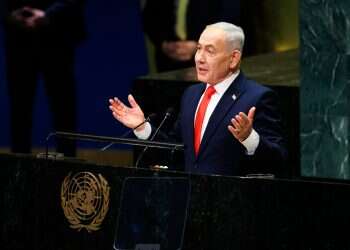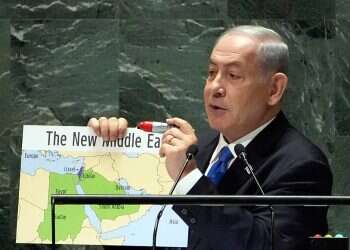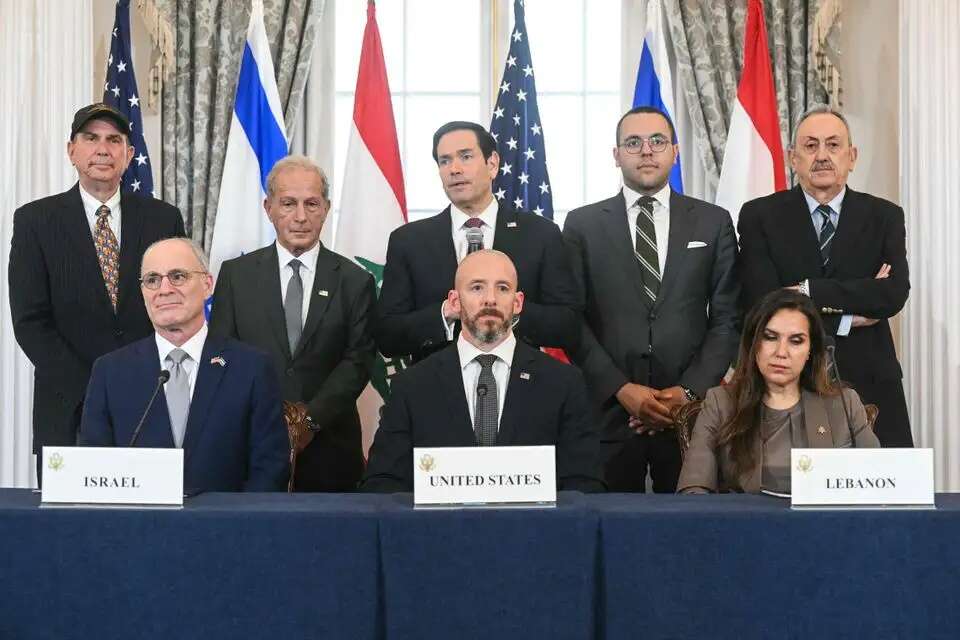
A historic moment: Israel and Lebanon held a signing ceremony for the agreement Friday at the State Department in Washington. US Secretary of State Marco Rubio said during the announcement that "There is a lot of work ahead." Prime Minister Benjamin Netanyahu welcomed the agreement, calling it "a major achievement for Israel and a major blow to Iran."
Rubio, who led the contacts between the sides, announced the agreement alongside the countries' ambassadors in Washington, Nada Hamadeh Mouawad and Yechiel Leiter. Immediately after the announcement, Rubio said that "there is still a great deal of work ahead of us."
"What the people of Lebanon deserve is a prosperous and peaceful state, a diverse country where people from different backgrounds can live together in coexistence," Rubio said. "It will take a great deal of work and time to get back to that point, but we believe today is the first step on that journey."
Secretary of State Marco Rubio on the Israel-Lebanon peace framework: "It's the beginning of the beginning. There is a lot of work ahead." pic.twitter.com/djoFtFMeaQ
— Open Source Intel (@Osint613) June 26, 2026
Details of the agreement
The agreement will be closely accompanied by the US military, which will also train and strengthen the Lebanese army. For that reason, Israeli officials say the agreement has a better chance of success than the previous one. It should be noted that following the 2024 agreement, an oversight command was also established in cooperation with American, French, Lebanese and Israeli officials.
According to Israeli officials, the IDF will remain for now on the yellow line, will not withdraw from Beaufort Castle, and Lebanese residents will not return to their homes. As in the past, the Lebanese army is again committed to dismantling terrorist infrastructure in those pilot areas. If implementation there succeeds to Israel's satisfaction, additional areas will be added. One of the areas from which the IDF will withdraw is, as stated, north of the Litani River and north of the yellow line.
As for the second area, it may be one of the zones the IDF recently captured beyond the yellow line, with the aim of expanding the territory under Israeli control so it could serve as a bargaining chip in the negotiations, in the form of areas from which Israel could withdraw. Either way, if the agreement succeeds and the Lebanese army takes control of areas that become demilitarized zones without Hezbollah operatives, the IDF will also withdraw from territories along the yellow line.
Israel is describing the trilateral framework as a significant achievement, which officials say thwarts Iran's attempts to force a unilateral Israeli withdrawal from southern Lebanon and reduces Tehran and Hezbollah's influence in the Lebanese front.

Direct talks
On Thursday, during the direct talks between the Israeli and Lebanese delegations at the State Department in Washington, which began Tuesday, a change in the atmosphere was felt following understandings between Iran and the US on the establishment of a mechanism to monitor the ceasefire. That mechanism, it should be recalled, included Iran, Pakistan and Qatar, but with no Israeli or Lebanese involvement.
Lebanese media reported Friday morning that the fifth round of talks between Israel and Lebanon in Washington continued to discuss the issue of pilot areas for withdrawal. The Israeli and Lebanese delegations and the American team presented positions on the outline, but disagreements emerged over the scope of the pilot areas and the implementation mechanism.
A diplomat familiar with the negotiations told the Lebanese newspaper Al-Joumhouria that "Lebanon presented more than eight proposals for pilot areas, but the obstacle lay with the Israeli side and Hezbollah."