The communications office of Hamas' government in Gaza announced Monday that the head of the terrorist organization's government committee had submitted his resignation, as part of preparations to transfer administration of the Gaza Strip to a technocratic committee affiliated with the Palestinian Authority.
At the same time, Hamas has already announced that the terrorist organization's officials "will continue to work at the technical level to ensure the provision of services," and that all its employees will continue to perform their duties.
"Hamas' announcement is only for show. On the ground, nothing will change," a security official told Israel Hayom. "It is merely a statement meant to show the Americans and the world that Hamas is willing to give up power, even though that is not actually the case."
Stealing everything, including electricity
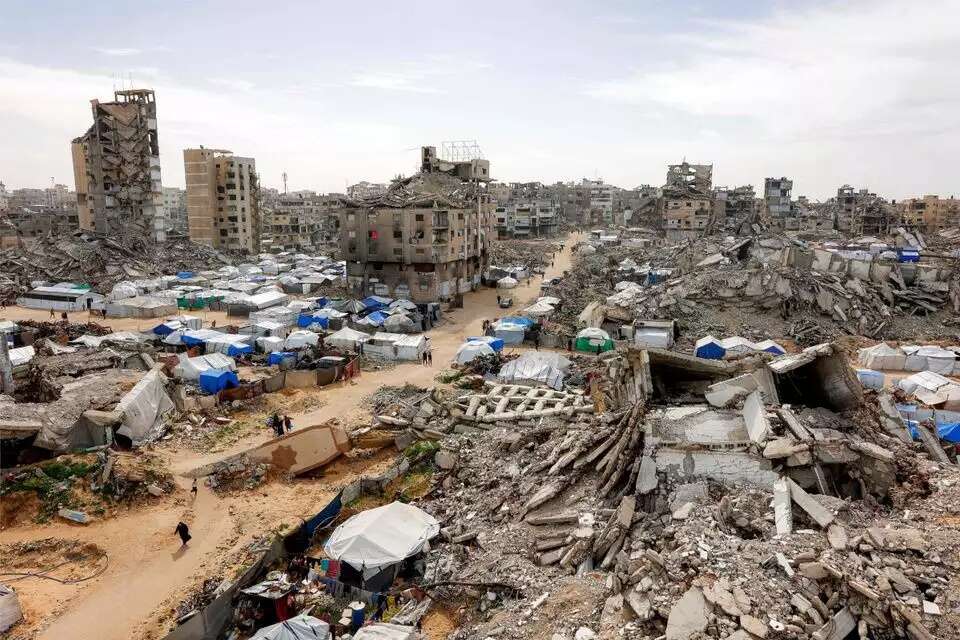
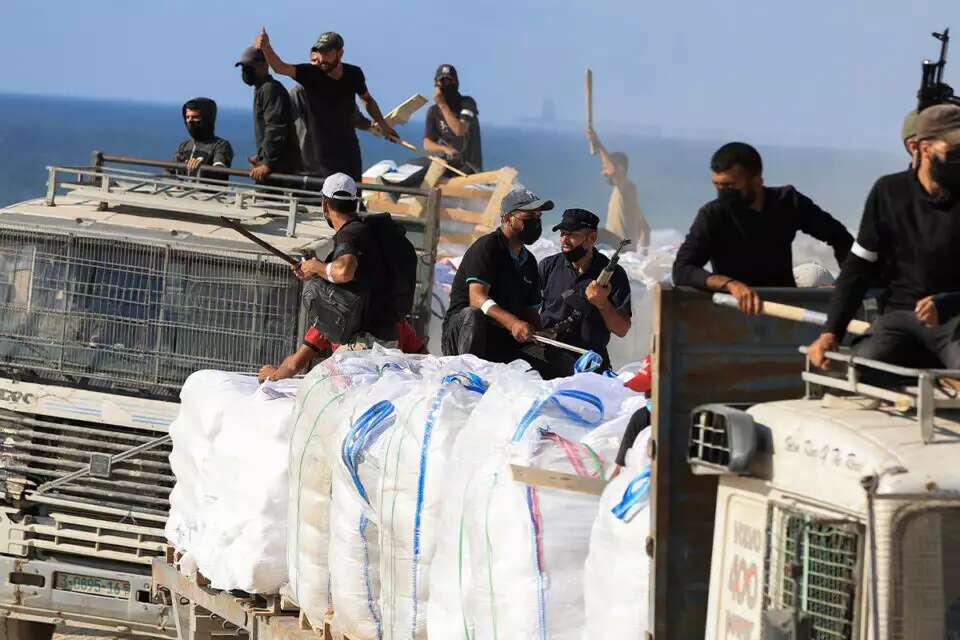
Security officials who spoke with us said Hamas is continuing to grow stronger and rebuild itself for a confrontation with Israel, both through money reaching it from outside the Gaza Strip and thanks to the "humanitarian" aid that continues to enter Gaza unchecked, about 600 trucks a day, while the real need is only about 200, or at most 250, trucks a day.
Israel Hayom can now report that Hamas directly taxes the incoming trucks, inspecting and registering them in order to collect a tax of between 15% and 30% from merchants.
Hamas also controls the markets, forcing merchants to sell their goods to traders operating under its auspices at a "supervised" price, so it can collect tax on the price gaps and take a cut of the profits for the organization. Hamas also manages to smuggle banned products into the Gaza Strip, such as cigarettes and tobacco, which are sold at high prices and taxed at a higher rate.
In addition, the terrorist organization exploits essential systems for the sake of its military buildup. For example, there is evidence that Hamas sells electricity produced by hospital generators, using fuel that enters the Gaza Strip for humanitarian needs, to residents living near the hospitals.
The terrorist organization does not stop there, also collecting fees from merchants. In other words, it imposes additional taxes and fees on local merchants by charging rent for operating markets, renewing business licenses, operating stalls and the like. In addition to direct tax collection from the private sector, Hamas uses overseas financial mechanisms to operate an offset system in which money enters the Gaza Strip in the form of goods. This enables the terrorist organization to efficiently fund its military arrays.
Growing militarily and ready for combat with Israel
"One cannot deny that Hamas is growing stronger," sources in the defense establishment said. "The money Hamas receives from outside the Gaza Strip, along with the strengthening it achieves through the aid entering the Strip, enables it to rehabilitate military infrastructure, recruit new and young operatives who cannot find other work in Gaza, and the money Hamas offers is their solution."
According to the sources, Hamas is engaged in military buildup and preparing for combat with Israel. "We cannot repeat the statements we made before Oct. 7, according to which Hamas was deterred and would not attack. We cannot once again ignore what the other side is doing," the sources added. At the same time, they noted that in the near term it is doubtful Hamas will be able to carry out again what it did on Oct. 7, though the possibility that the organization will try to act against IDF soldiers or positions along the yellow line has not been ruled out.
According to the sources, Hamas is also closely watching the fact that the Americans are tying Israel's hands in Lebanon and Iran, and is aware that the Americans want to advance their 20-point plan at almost any cost. Even when it is clear to everyone that Hamas has no intention of disarming, and that there is no body that will disarm it, this does not stop the Americans from advancing the remaining clauses of their plan, which include, among other things, rehabilitating the Gaza Strip in areas without Hamas.

Israel's leadership is also speaking in several voices regarding the Gaza Strip and has not laid out a clear policy. For example, while IDF Southern Command, headed by Maj. Gen. Yaniv Asor, is talking about the need to return to fighting so as not to allow Hamas to restore its strength, the top echelon of the General Staff does not support such a move, and even says explicitly that the worst possible outcome would be military rule in Gaza.
Prime Minister Benjamin Netanyahu, for his part, declares on the one hand that there will be no reconstruction in the Gaza Strip without its demilitarization. On the other hand, discussions are being held in Israel about reconstructing Rafah in areas without Hamas. One way or another, there is no doubt that Israel's attention is now focused on Iran and the north, and Hamas is exploiting this to prepare for the next campaign, which, for lack of any alternative, will come sooner or later.