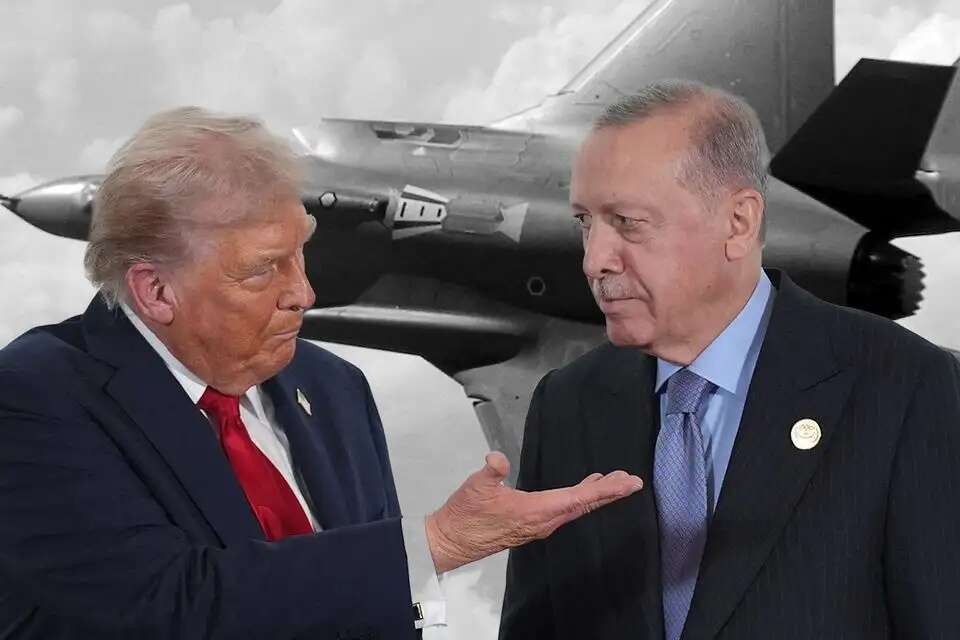
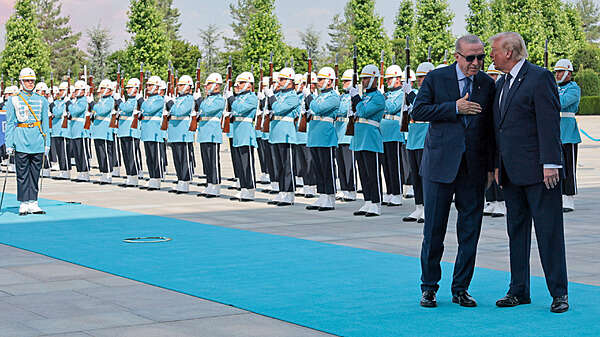
US President Donald Trump's visit to the NATO summit in Turkey offered a glimpse into the changes taking place in the US and their impact on the Middle East and the wider region.
During a joint press conference with Trump, Turkish President Recep Tayyip Erdogan stressed that the US president had promised to sell Turkey five F-35 fighter jets and that he had no doubt Trump would keep his word.
It was a brief statement that was translated for Trump, who neither denied nor corrected it. He has done so several times in the past when a leader standing beside him at a press conference departed from previous understandings or promises, or presented an inaccurate version of events.
The sale of F-35 fighter jets to Turkey therefore appears to be a done deal, even though US law requires such an agreement to receive congressional approval.
Even after that approval is granted, the line of countries and air forces waiting for the aircraft, including Israel, is so long that it will take years, at least five, before Turkey receives its first jets. That is unless Trump decides to give preferential treatment to friends. His affection for Erdogan is plain for all to see.
From Bush to Trump
The significance of an advanced and powerful air force is clear to every Israeli. The events of recent years and the rounds of fighting against Iran demonstrate it better than any explanation could. The defense procurement deals approved by Israel in recent months ensure that the Israeli Air Force will remain a long-range, powerful and lethal arm capable of handling any mission or challenge.
The emerging sale of F-35 fighter jets to Turkey is about far more than the transfer of an advanced combat aircraft. It reflects three developments that extend well beyond the jets themselves:
Losing Israel's privileged position: Since Trump entered the White House, Israel has been undergoing a steady decline in its status as the leading US partner and the only regional ally with Washington's ear. Following Israel's failed operation in Qatar, Doha received a US defense commitment and protective umbrella that effectively serve as an insurance policy against similar Israeli actions in the future.
Turkey has also been drawing closer to the US, beginning with the central role it played in the agreement to end the war in Gaza. The status Trump granted Erdogan, including Erdogan's signature on Trump's 20-point plan, and now the sale of advanced fighter jets place Turkey in a similar position.
Erosion of Israel's qualitative military edge: The protection and preservation of Israel's qualitative military edge, known as QME, has been enshrined in US law since October 2008, during the administration of President George W. Bush.
The law requires the US administration to provide Congress with an explanation and assessment showing that a proposed arms sale will not harm Israel's qualitative military edge, or alternatively to offer measures that will ensure it is maintained. In this case, US officials could point to Israel's planned future aircraft purchases as evidence that its advantage is ostensibly being preserved.
Turkey's ambitions: Under Erdogan, Turkey has consistently adopted a more extreme position toward Israel since the May 2010 Mavi Marmara incident. Turkey is a NATO member with a large, modern military and regional imperial ambitions. It makes no secret of its territorial aspirations in the region. Its growing relationship with Syria's new president, Ahmed al-Sharaa, is part of this vision, as is its involvement in Gaza and elsewhere.
Turkey's efforts to move closer to Israel's borders, including through Syria and Gaza, should be a cause for concern. In the long term, they carry the potential to develop into a direct threat to Israel. The struggle over maritime routes to and from Israel must also be taken into account. Recent events have demonstrated the importance of keeping shipping lanes open and the effect disruptions can have on the economy.
Appropriate compensation
Israeli officials would be wise to act as though the decision has already been made. Instead of wasting valuable time, they should use it to improve Israel's position and work on a compensation package that will protect and preserve the country's qualitative and military advantage.

The list of capabilities and measures Israel should demand is extensive:
Israel should seek to shorten delivery times for the weapons systems it decided to purchase over the past year, including F-35 and F-15 fighter jets, attack helicopters and aerial refueling aircraft. Reducing a wait of at least five years to a much shorter period could be highly significant.
Israel should also demand access to advanced artificial intelligence capabilities, including computers, software and related technologies.
Intelligence cooperation should be expanded, with Israel receiving greater access to advanced detection and tracking systems, including satellite systems, particularly for monitoring Iran.
Israel's air and missile defense systems should also be strengthened. The most recent military campaigns have demonstrated their importance.
The Israeli Air Force should receive advanced munitions, particularly weapons designed to strike underground infrastructure, which is becoming deeper, more complex and more significant in every current and future theater of war. Here too, recent fighting has exposed both the existing gap and the US advantage.
A strong Israel is first and foremost an Israeli national necessity, but it is also a US interest. Israel's power, as demonstrated in the war against Iran, has not gone unnoticed by any US decision-maker, regardless of who occupies the White House in two or eight years. Israel's responsibility is to do everything possible to preserve its status and capabilities for the years ahead.