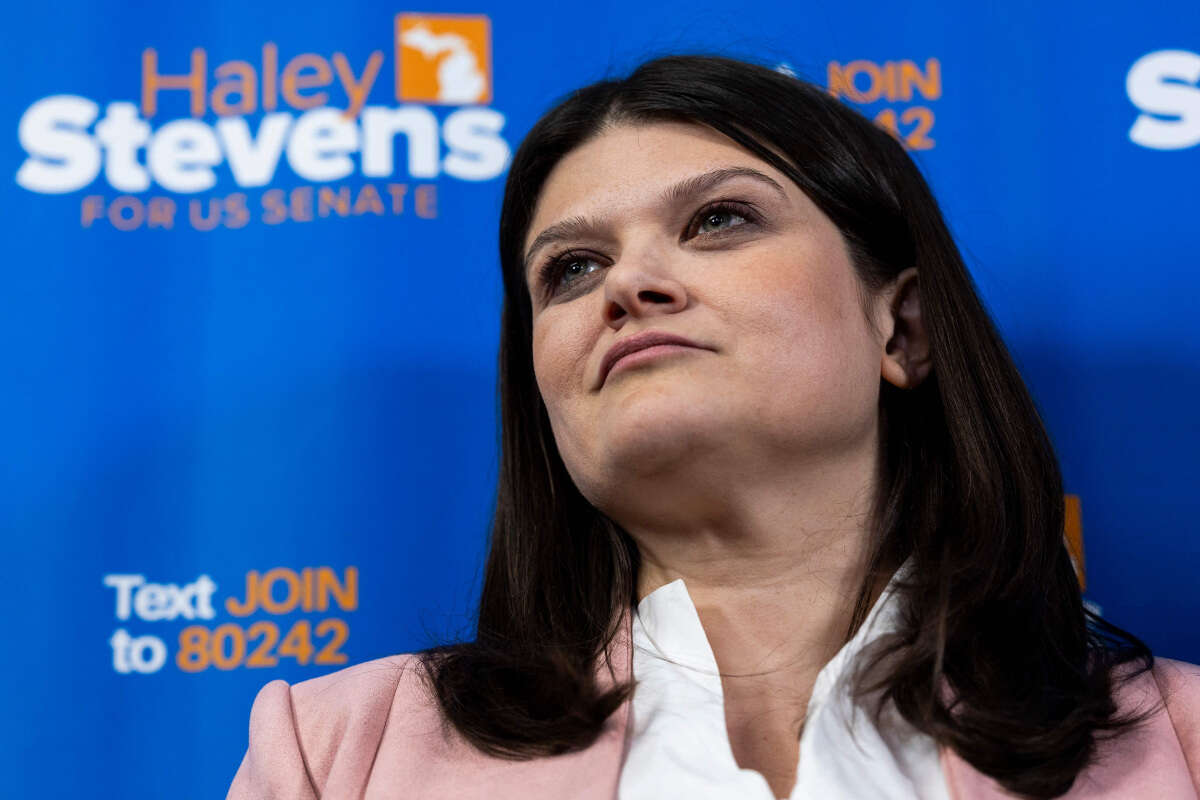
A few weeks ago, Congresswoman Haley Stevens, who represents Michigan's 11th Congressional District, was fighting for her political future against Abdul El-Sayed. Today, she is visiting Israel on a short, private trip, and I got to sit across from her at a café in Jerusalem.
Stevens is a four-term congresswoman from Michigan who first came to Washington after flipping a Republican-held suburban Detroit district in 2018. Before Congress, she served as chief of staff to President Barack Obama's Auto Rescue Task Force, working on the effort credited with saving General Motors, Chrysler, and hundreds of thousands of Michigan jobs. She built the kind of résumé Democrats once pointed to as a model for winning competitive America: pragmatic, pro-labor, focused on manufacturing and willing to appeal beyond the party's ideological base.
But earlier this month, Stevens lost the Democratic nomination for US Senate by roughly one percentage point, or approximately 8,000 votes, to Abdul El-Sayed, a progressive candidate backed by Bernie Sanders and Alexandria Ocasio-Cortez. El-Sayed ran on Medicare for All, abolishing ICE and ending military assistance to Israel. He has called Israel's war in Gaza a genocide, called for an end to US military aid to Israel and said he "struggles" to understand why Israel should exist as a Jewish state. El-Sayed also campaigned alongside Hasan Piker, the far-left streamer whose rhetoric about Israel and American Jews has repeatedly trafficked in antisemitism. El-Sayed's victory is widely viewed as one of the progressive movement's most significant breakthroughs of the 2026 election cycle.
Stevens, meanwhile, calls herself something that is becoming increasingly uncomfortable to say in certain corners of her own party: a Democratic Zionist.
I asked her point blank whether support for Israel has become an electoral liability inside the Democratic Party. "It is certainly something that people have begun to run away from," she told me. "I have had three elections where being pro-Israel was a point of objection of those who were running against me, and two out of the three elections I won."
And now, just weeks after losing one of the most consequential Democratic primaries in the country, she is here in Israel, and she does not feel defeated. "I still very much have a political future," she said, referencing a recent interview in which she made clear that she wants to stay in the Democratic Party and fight for the Democratic Party.
We also discussed the Democrats who voted on an amendment proposed by Republican Representative Thomas Massie that sought to cut $3.3 billion in foreign military funding to Israel. A total of 103 Democrats voted in favor, while only 98 opposed it. It was a seismic shift from just two years earlier, when only 37 Democrats voted to block aid to Israel in a similar vote.
Stevens addressed that vote and explained, "I did have a colleague who publicly spoke and said that even though he wanted to support continuing the US-Israel relationship, he voted the other way because of the breakdowns in civil societies and communities." Stevens was referring to her Democratic colleague, Representative Adam Smith of Washington State. Smith faced severe domestic political pressure, including progressive primary challenges, targeted harassment, and threats within his home state due to his stance. "He just didn't want the violence being brought down on him," Stevens explained.
Hearing her say this is deeply concerning because it implies that an elected representative who supports the US-Israel relationship can be pressured to vote against it because of the intimidation and hostility surrounding the issue. Regardless of where one stands on the merits of the foreign policy itself, that is a disturbing precedent to set.
Stevens' visit included meeting Israelis directly affected by the October 7 massacre, including a visit to the site of the Nova music festival massacre. There is something remarkable about her decision to come here now. At a moment when maintaining a relationship with the Jewish state is becoming an increasingly complicated political calculation for Democrats back home, Stevens came to Israel anyway.
Despite acknowledging the growing hostility toward Israel within her party, Stevens does not believe it cost her the election. She described the primary as "ferocious," noting that the presence of a third candidate also affected the outcome.
I then asked her a question that has become increasingly difficult for American Jews who have traditionally voted Democratic but now describe themselves as politically homeless: Is it still worth fighting for their place in the Democratic Party? "Truthfully, I have long said, even before October 7, that the Democratic Party adopting anti-Israel and anti-Zionist positions would be a red line for me and push me out," Stevens told me. "I see the anti-Zionism hate movement as a real threat."
Across the Democratic Party, a battle is taking place over what kind of party will emerge from this political moment. Moderate and establishment Democrats are increasingly facing insurgent challengers who do not simply disagree with the party's traditional approach to Israel, policing, immigration or American foreign policy, but often present that entire political tradition as something that must be dismantled.
The big question today is whether there is still room in the Democratic Party for someone like Haley Stevens: a moderate Democrat who believes in the future of the US-Israel relationship and who can sit in a café in Jerusalem and say, without apology, that supporting Israel and being a Democrat are not mutually exclusive.
Sitting across from her, I was reminded that as long as people like Stevens are willing to fight for those values within the Democratic Party, perhaps all hope is not lost.