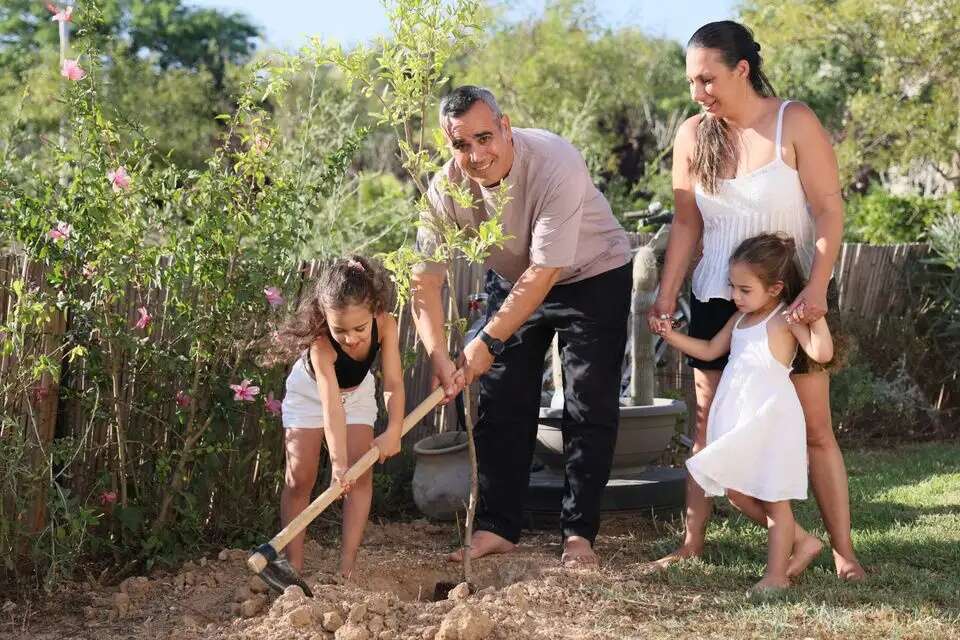
In the yard of their prefabricated home, Omri and Lishay Miran planted a pomegranate tree, perhaps the most fitting symbol of their new year: an attempt to grow new life in a new place. They now live in Carmit, a community in southern Israel, but "Nahal Oz will always be home," Omri says.
That sentence perhaps captures the tension in which they, and many other families of captivity survivors, have lived over the past year: trying to put down roots in one place without giving up the place from which they were uprooted. Raising two daughters in a new reality without erasing the old one, and relearning how to be a couple and a family after two years in which they lived in two completely different worlds.
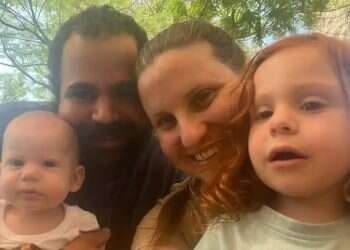
Another sentence also seems to encapsulate that journey. It was spoken at the hospital, shortly after Omri returned from captivity. Alma was 6 months old when her father was abducted and 2½ when he came back. When he stood before her, she said: "Daddy, you came out of the picture."
"What is our place in the world?"
"There's a psychologist, there's physiotherapy. That's all well and good, but those are tools. They aren't the rehabilitation itself," Omri explains. "I'm going through quite a few processes along the way. For the past 10 months, I've been undergoing rehabilitation at Rabbi Elimelech Firer's Ezra LeMarpeh rehabilitation center in Sderot. Rehabilitation is what each of us does with ourselves, what we do with each other and as a family, trying to understand what our place in the world is now and where we fit into it."
For him, coming home and coming back to life are two different things. "I think both of us, each on our own level, were in a state of, 'I'm alive, but I'm not really living.'"
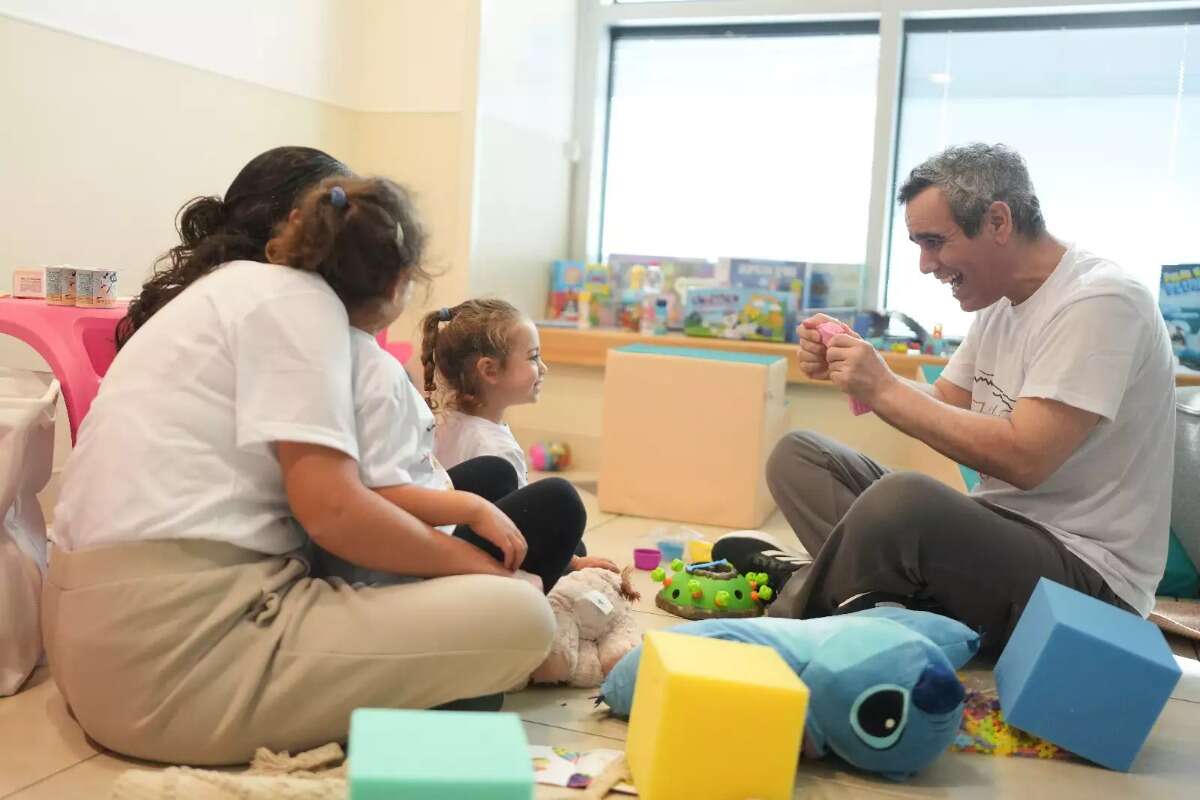
Before he was abducted on Oct. 7, 2023, and held for 738 days, Omri was a very involved father. He worked on the kibbutz and spent time with Roni. They cooked together, went on outings, rode bicycles and headed out into the fields. When he returned, he discovered that his daughters had continued growing up. "You get there, and it's completely natural, but your daughter isn't at all sure this is real. She isn't sure about you. You can't even get close to her," he says.
It took months to rebuild the bond and the sense of security. "There's guilt too, of course," he says. Alongside that guilt, he adds, came the realization that there was no shortcut. "This is the situation, and we'll work to improve it, but that's exactly what rehabilitation is. At first, you still can't be the father you want to be. And then you realize something about yourself too: Wait, I don't have that strength yet either."
An old-new relationship
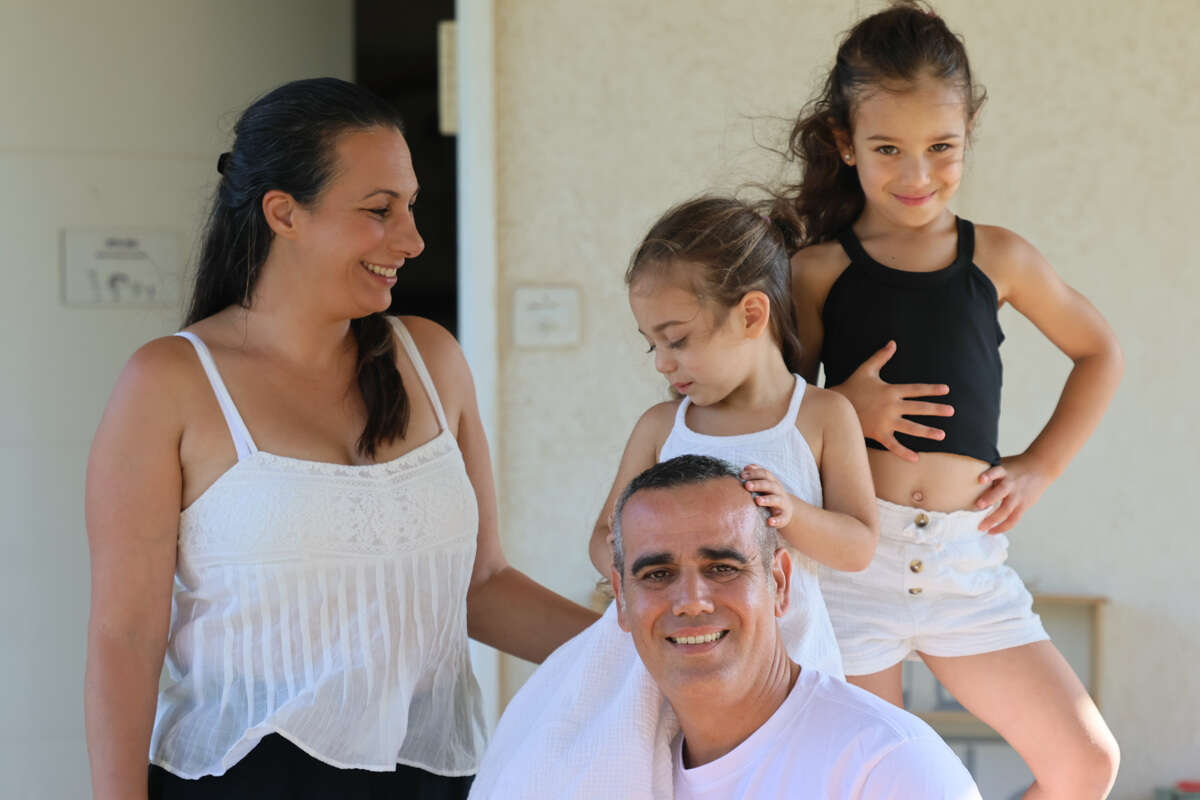
Their marriage, too, had to find its place again. Omri and Lishay have been together for about six years, two of which they spent apart. Asked what he has rediscovered since coming home, Omri talks instead about what never disappeared. "Our relationship is still fairly new. We've only been together for six years in all, but it's there, and that hasn't changed."
During the two years Omri was held captive, Lishay had one goal. She raised their daughters, traveled across Israel and around the world, gave interviews, met decision-makers and fought to bring him home. It was only after he returned, once the goal that had sustained her for two years had been achieved, that her own reckoning began.
"I think it's only in the last six months that I've even begun dealing with it," she says. "Understanding what it means to be held hostage, to see your daughter in someone else's hands with a gun pointed at her head."
On the first night after Omri returned, they barely slept. "We talked almost all night," Lishay says.
She told him what had happened in Israel, and he told her what had happened there, in Gaza. In the evenings that followed, they would sit together and try to connect the two realities. He would describe something that happened in captivity, and she would try to remember what had been happening in Israel at the same time.
Eventually, they understood that there was no way to make up for everything they had missed. "For two years, we lived in separate realities that never intersected, and we didn't know when they would intersect again," Lishay says. "People ask us, 'Have you caught up on everything yet?' But you can't really make up for two years."
"Bad people will come"
At first, the girls also tried to tell their father everything they had been through: where they had lived, what they had done and what had happened. But at a certain point, Lishay says, they too had to understand that their entire lives could not revolve around the two missing years. "We need to live in the present," she says.
Roni, 6, remembers Oct. 7 clearly. Omri recounts that during one conversation about Nahal Oz, when she realized that other people might move into the family's home as renters, her reaction was immediate. "But it's dangerous. Bad people will come and take them."
"With things like that, taking her back there isn't simple, and it isn't right," Omri says. And yet, they still do not feel at home where they are now. "I hope we can find a place again that feels like home the way Nahal Oz did," Lishay says.
She describes a complicated feeling: On the one hand, the desire to say that they will not be defeated, that they love the place and will return to it. On the other, things that were once simply part of everyday life in the Gaza border communities no longer seem like something they can simply agree to live with again.
Nearly a year after Omri's return, dealing with the state over the most basic matters continues to weigh heavily on their lives. "There's a very serious crisis of trust here," Omri explains. "All these battles we have to fight now don't actually contribute to our rehabilitation."
He says issues that should already have been resolved continue to turn into struggles. "There are things they should have decided on and implemented, and instead they don't do them and put obstacles in our way."
Lishay speaks about official recognition for people harmed by abduction, the rights of captivity survivors, long-term solutions for those unable to return to their homes, and the need to investigate the failures that led to Oct. 7.
"On the road to repair and change"
With the Israeli elections approaching, she makes no secret of her desire for change, although she does not believe a change of government alone will fix everything. "As far as I'm concerned, there has to be change here," she says. "Am I saying I'm pinning all my hopes on it and that some wonderful new world will suddenly appear? No. But we will be paving a road toward repair and change."
Politics has recently entered the family as well. Dani Miran, Omri's father, who for two years was one of the prominent voices in the campaign to bring his son home, decided to enter politics through the Pensioners Party. Omri says his father received other offers as well, but that his focus is on social issues.
Lishay draws a distinction between the state as a system and the people themselves. Speaking about reservists who are called up for repeated rounds of duty, she says: "I have nothing to say except thank you."
Their decision to begin speaking publicly also grew out of this past year. Omri has already begun appearing before audiences, including soldiers. He talks about Oct. 7 and his captivity, but focuses primarily on the mental struggle. "How do you live minute by minute, day by day," he says, "and what do you do to protect your mind and preserve it as much as possible?"
For him, telling the story is a mission. "We're here for a limited time, and we have to pass on our story. This truth must not be forgotten."
His joint event with Lishay will be different. She does not even like calling it a lecture. "It's a conversation," she says, about life before, life during the two years they spent apart and life afterward.
For Lishay, the decision is also an attempt to reclaim ownership of their story. Throughout Omri's captivity, she was careful to say that she did not know what he was thinking or feeling, or what he was going through. Now he is here. "I started feeling that other people were telling our story," she says.
He wants to return to treating patients
At the same time, Omri is beginning to reconnect with the life he had before Oct. 7. He wants to return to the world of shiatsu, where he worked as a therapist, although he does not yet feel ready to resume full treatment sessions. So he is starting with workshops. "Just to have some kind of contact with it," he says. "Some kind of adjustment, some kind of next step."
And "next step" may be the most fitting phrase for this year. Not a complete return, not the end of rehabilitation and not an attempt to erase what happened. Just another step.
When Omri was abducted, Lishay says, she made herself two promises: that he would hear the word "Daddy" again, and that her daughters would live in a better world. She has already seen the first promise fulfilled.
In their reunion, in Omri's gradual return to the world of therapy, in a marriage being rebuilt and in two girls learning that their father is no longer just a picture, they are now trying to work toward fulfilling the second. Or, as Omri puts it: "Now I'm living."