Wednesday Oct 28, 2026
NEWSLETTER
www.israelhayom.com
  • Home
  • News
    • Israel
    • Israel at War
    • Middle East
    • United States
  • Opinions
  • Jewish World
    • Archaeology
    • Antisemitism
  • Lifestyle
    • Food
    • Travel
    • Fashion
    • Culture
  • Magazine
    • Feature
    • Analysis
    • Explainer
  • In Memoriam
www.israelhayom.com
Home Analysis

Netanyahu wins first place, but his road to a government narrows to one path

Likud leads the exit polls with about 27 seats, yet the right-wing and Haredi bloc falls far short of a majority. A coalition now depends on Eisenkot, Bennett, Lapid and Liberman.

by  Bini Ashkenazi
Published on  10-28-2026 06:00
Last modified: 10-28-2026 10:06
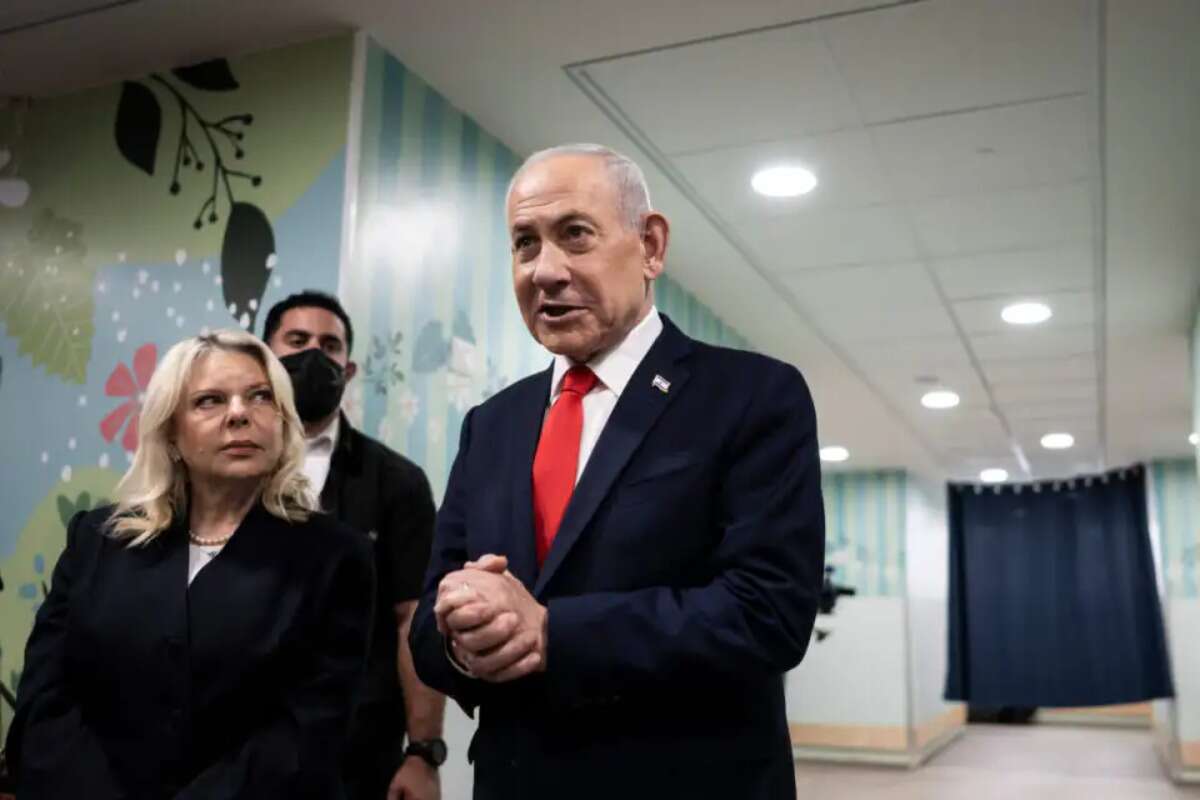
Netanyahu wins first place, but his road to a government narrows to one pathAP

Netanyahu has one realistic option left to remain prime minister | Photo: AP

Share on FacebookShare on Twitter

Prime Minister Benjamin Netanyahu entered this election campaign with one clear mission: to keep Likud as Israel's largest party. He has accomplished that mission. According to the updated exit polls on Channel 11, Channel 12 and Channel 13, Likud stands at about 27 seats, with a clear gap over Gadi Eisenkot's Yashar! party, which sits in second place.

But in the Israeli system, first place guarantees nothing. The right-wing and Haredi bloc, which won 64 seats in the previous election, stalled this time at only 51-52, according to the same exit polls. In every exit poll except the one on Channel 14, the bloc is far from the 61 seats required to form a government. In Likud, some still pin hopes on the final results and on the double-envelope ballots, but even in the optimistic scenario, the gap looks too large to close.

Video: Bini Ashkenazi reports from Likud headquarters // Bini Ashkenazi

Two trends shaped the picture. Voter turnout jumped to nearly 78%, the highest since 1999. The Arab parties, according to the exit polls, recorded a historic high of 17-19 seats. The result is a Knesset in which neither bloc reaches a majority on its own. Eisenkot's change bloc is also stuck far from 61 without the Arab parties.

The implication is simple, even if hard to swallow in Likud. If the results settle around the exit polls, Netanyahu has one realistic option left to remain prime minister – a national unity government with Eisenkot, Naftali Bennett, Yair Lapid and Avigdor Liberman. On paper, such a combination reaches a majority of close to 70 seats. In practice, it will exact a price from Netanyahu, and the only question is how high.

Here, too, lies the source of Netanyahu's power in the negotiations that will open. Facing Eisenkot, Bennett and Lapid are two uncomfortable alternatives, a government that leans on the Arab parties, or another round of elections. Netanyahu, as chairman of the largest party, will be able to present himself as the one offering the only path to a stable Zionist government, provided he is willing to pay.

The first concession is also the easiest of all, and it is Itamar Ben-Gvir. It is hard to imagine Eisenkot, Bennett, Lapid and Liberman sitting around the government table alongside the chairman of Otzma Yehudit. Netanyahu, who has already seen Ben-Gvir quit the government and rejoin it in the outgoing term, can live with this parting in peace. By cold calculation, Ben-Gvir is a partner Netanyahu can afford to sacrifice.

The second concession is far more complicated, and it involves the Haredim. Shas and United Torah Judaism are Netanyahu's longtime allies, and "the bloc" as a whole was built around them for more than a decade. But Eisenkot made clear in his first response to the results that he would work to form a "Zionist draft government," and the draft is exactly the issue on which the Haredi parties cannot compromise. Here Netanyahu will face the hardest decision on the road to the next government: whether to part ways with the partners who kept him in power, or to gamble that his new partners will blink first and agree to a formula that allows the Haredim to stay.

The confusion produced by the result is also plainly evident at the Likud headquarters at Binyanei HaUma (Jerusalem's convention center). An election night in which Likud finishes in first place was supposed to be a night of celebration, but Likud loyalists did not turn out in droves. The mood there reflected the contradiction in the result, a victory in the race for first place, alongside the understanding that it may not be enough. Even Likud's first response, from Foreign Minister Gideon Sa'ar, who declared, "The celebrations on the left are premature," sounded more like defensiveness than a declaration of victory.
Tags: 10/28Benjamin NetanyahuGadi EisenkotIsraelIsraeli elections

Related Posts

Behind the Yellow Line, Hamas is already preparing for the next phase

Behind the Yellow Line, Hamas is already preparing for the next phase

by Shachar Kleiman

Three years after the October 7 attack, Hamas is fighting to survive the war to face the day after. As...

Aryeh Amidror, the man who failed to sound the alarm

Aryeh Amidror, the man who failed to sound the alarm

by Itay Ilnai

When the Nukhba terrorists' SIM cards came online in the middle of the night, he was unfazed. When NCO V....

Not by air or sea: The new way Israel could take on the Houthis

Not by air or sea: The new way Israel could take on the Houthis

by Dr. Yossi Mansharof and Noa Lazimi

The terrorist organization's growing strength and the weakening regional response demand new ways of confronting the threat from Yemen. Alongside...

Menu

Analysis 

Archaeology

Blogpost

Business & Finance

Culture

Exclusive

Explainer

Environment


Features

Health

In Brief

Jewish World

Judea and Samaria

Lifestyle

Cyber & Internet

Sports


Diplomacy 

Iran & The Gulf

Gaza Strip

Politics

Shopping

Terms of use

Privacy Policy

Submissions

Contact Us

About Us

The first issue of Israel Hayom appeared on July 30, 2007. Israel Hayom was founded on the belief that the Israeli public deserves better, more balanced and more accurate journalism. Journalism that speaks, not shouts. Journalism of a different kind. And free of charge.

All rights reserved to Israel Hayom

Hosted by sPD.co.il

  • Home
  • News
    • Israel at War
    • Israel
    • United States
    • Middle East
    • Sports
  • Opinions
  • Jewish World
    • Archaeology
    • Antisemitism
  • Lifestyle
    • Food
    • Travel
    • Fashion
    • Culture
  • Magazine
    • Feature
    • Analysis
    • Explainer
    • Environment & Wildlife
    • Health & Wellness
  • In Memoriam
  • Subscribe to Newsletter
  • Submit your opinion
  • Terms and conditions

All rights reserved to Israel Hayom

Hosted by sPD.co.il

Newsletter

[contact-form-7 id=”508379″ html_id=”isrh_form_Newsletter_en” title=”newsletter_subscribe”]

  • Home
  • News
    • Israel at War
    • Israel
    • United States
    • Middle East
    • Sports
  • Opinions
  • Jewish World
    • Archaeology
    • Antisemitism
  • Lifestyle
    • Food
    • Travel
    • Fashion
    • Culture
  • Magazine
    • Feature
    • Analysis
    • Explainer
    • Environment & Wildlife
    • Health & Wellness
  • In Memoriam
  • Subscribe to Newsletter
  • Submit your opinion
  • Terms and conditions

All rights reserved to Israel Hayom

Hosted by sPD.co.il